Primary & Middle School Physics · Grades 1–9
59Colors and Spectra of Light
Where do colors live? In the apple, says common sense — the red is right there on the peel. Yet carry the apple into a gymnasium lit deep blue, and the “red” apple turns black as coal. Colors, it turns out, are a three-way conversation between light, object and eye — and it opens with the strangest fact in optics: white light is not white.
59.1 White light unpacked
Proposition 59.1 (White light is a mixture)
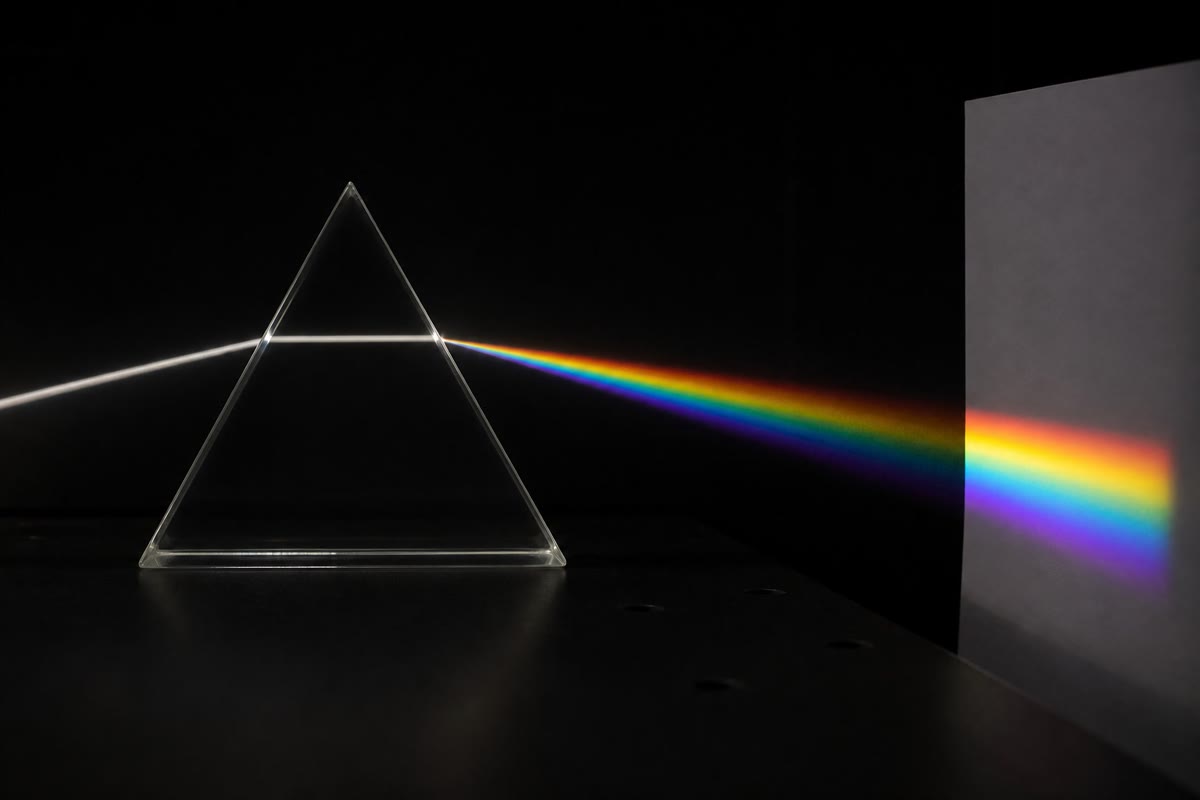
Ordinary “white” light — sunlight, lamplight — is a blend of all the colors at once. Sent through a glass prism, the blend unpacks: each color bends by a slightly different amount crossing the glass, so the colors fan apart into a continuous band from red (bent least) to violet (bent most). The band is called a spectrum, and the unpacking, dispersion.
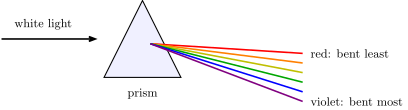
Example 59.2 (Spectra without a laboratory)
Nature and the junk drawer are full of prisms. The rainbow: every raindrop is a tiny prism-and-mirror, and the sky-wide arc is sunlight dispersed by millions of drops — always in the half of the sky opposite the Sun, which is why rainbow hunters stand with the Sun at their backs. The garden hose’s fine mist conjures one to order. A CD’s grooved face throws little spectra across the ceiling; the beveled edge of a mirror stripes the wall on sunny afternoons. White light betrays its mixture everywhere it meets fine structure or slanted glass.
Example 59.3 (Packing the mixture back up)
The unpacking runs in reverse. Paint a disc in rainbow sectors and spin it fast: the eye, too slow to follow, receives all the colors practically at once from each spot — and reads the blend: a pale, washed white-gray. The great physicist who first unpacked sunlight with a prism spun exactly such a disc to argue the packing-up — and his boldest stroke was a second prism, catching the spectrum and folding it back into a single white beam: mixture proven both ways.
59.2 Why the apple is red
Proposition 59.4 (The color of an object)
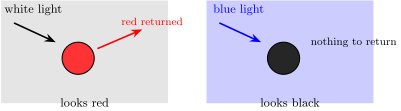
An opaque object’s color is made by subtraction. Receiving light, the object absorbs part of the blend and diffuses the rest — and the diffused remainder is what reaches your eye and names the color. A red apple absorbs nearly all of white light’s colors and returns chiefly the red. A white page returns nearly everything; a black coat returns nearly nothing — absorbing the lot (and warming accordingly, as dark cars in summer testify). The color is not in the peel: it is the peel’s answer to the light it was offered.
Example 59.5 (The gymnasium test)
Now the blue-lit gymnasium. The red apple’s peel does what it always does: absorbs everything but red, and stands ready to return red — but the blue floodlight contains no red to return. Nothing diffused, nothing received: the apple shows black. The white page under the same light returns what it is given: it looks blue. Rule of the theater: an object can only return colors the light brought — change the light, and you change every costume in the hall.
Method 59.6 (Predicting a color under any light)
- list what the light brings (white: everything; a colored lamp: chiefly its own color);
- list what the object returns in white light — its daylight color names it;
- intersect the lists: the object diffuses what appears on both;
- empty intersection: the object shows black.
A blue cap under red light: returns blue only, offered red only — intersection empty: black cap. Under white light: the full offer meets the blue answer — blue cap.
59.3 Building colors from light
Example 59.7 (Three lamps make them all)
Mixing lights adds. Overlap three floodlights — red, green, blue: red and green together make yellow; green and blue, a turquoise cyan; blue and red, magenta; all three, white. From just three well-chosen primaries, light-mixing builds virtually every color the eye can name — which is why three is the magic number of every glowing screen.
Example 59.8 (The screen in your pocket)
Examine a white area of a phone or television screen through a strong magnifier: no white anywhere — only minute red, green and blue strips, all ablaze. Every color the screen ever shows is these three lamps in dosed proportions; every “white” is the trio at full song, blended by your eye’s distance. The paint box works the other way — pigments absorb, and mixing them subtracts light rather than adding it — which is why mixing every paint gives murky darkness while mixing every light gives white; the painter’s full story belongs to art class and to chemistry.
Remark 59.9 (The sunset, paid in full)
Last year’s sunset promise falls due. Air diffuses sunlight — but not impartially: the blue end of the blend is scattered far more readily than the red. Look away from the Sun by day and you see the stolen share, forwarded from the whole sky: blue. At sunset, the direct beam’s grazing road through the air is longest, the theft of blue nearly complete — and the survivor that reaches your eye is the red-orange remainder, with pink clouds catching the late scatterings. Blue sky and red sunset are one theft, seen from the two sides of the ledger.
59.4 Exercises
Exercise 59.1 ★
What is a spectrum, and what is dispersion? Which color bends least in the prism, and which most?
Solution
Solution of Exercise 59.1.
The continuous band of colors hiding in white light, unpacked; dispersion is the unpacking — each color bent its own amount. Red bends least, violet most.
Exercise 59.2 ★
Why must a rainbow hunter stand with the Sun at their back? What plays the prism?
Solution
Solution of Exercise 59.2.
The rainbow forms in the half of the sky opposite the Sun — sunlight enters the raindrops from behind the hunter. Every raindrop plays the prism (with a mirror-bounce inside).
Exercise 59.3 ★
Give the two demonstrations that white light is a mixture — one unpacking, one packing back up.
Exercise 59.4 ★
In subtraction-language: why is grass green? Why is the white page white and the blackboard black?
Solution
Solution of Exercise 59.4.
Grass absorbs most of the blend and returns chiefly green. The page returns nearly everything — white; the blackboard returns nearly nothing, absorbing the lot — black.
Exercise 59.5 ★
Predict with the method: a yellow scarf under white light; under blue light.
Exercise 59.6 ★
Why does the red apple turn black in the blue gymnasium — yet the white handkerchief beside it turn blue?
Solution
Solution of Exercise 59.6.
The apple can return only red, and the blue flood brings none: black. The handkerchief returns whatever arrives — offered blue, it returns blue: a blue handkerchief.
Exercise 59.7 ★
Name the three primaries of light-mixing and the results of each pairwise overlap — and of all three together.
Solution
Solution of Exercise 59.7.
Red, green, blue. Red green: yellow. Green blue: cyan. Blue red: magenta. All three: white.
Exercise 59.8 ★
What does the magnifier reveal in a screen’s “white”? Where does the blending happen?
Solution
Solution of Exercise 59.8.
Only minute red, green and blue strips, all lit — no white anywhere. The blending happens in your eye, too far away to separate the strips.
Exercise 59.9 ★★
Why does mixing all the lights give white while mixing all the paints gives murky darkness? One sentence per direction of the ledger.
Exercise 59.10 ★★
Complete the sunset ledger: what the air steals preferentially, who receives the stolen goods and as what, and what survives the longest grazing road — and why the eclipsed Moon of last year glows with exactly that survivor.
Solution
Solution of Exercise 59.10.
The air steals blue preferentially; the whole sky receives the stolen blue and forwards it downward as daytime’s blue dome; the red-orange remainder survives the grazing sunset road. The eclipsed Moon is lit only by light that has grazed the Earth’s rim — sunset-filtered all around the planet — so it glows with the same red survivor.
Exercise 59.11 ★★
A shop’s changing room is lit with warm reddish lamps “flattering to skin tones”. A customer buys a jacket that looked deep warm brown — and finds it dull green in daylight. Reconstruct the deception with the prediction method.
Solution
Solution of Exercise 59.11.
The warm reddish lamps offered little green; the jacket’s true answer — mostly green with some red making a dull blend — could only show its red-friendly part, which read as warm brown. Daylight’s full offer let the green answer speak: deception by a stingy light, convicted by the intersection rule.
Exercise 59.12 ★★★
Stage-craft: a designer needs a banner with bright, readable lettering on a black ground under white houselights — but the whole banner must vanish, uniformly black, letters and ground alike, under the finale’s deep red wash. Choose the letter color and the ground color (from: white, red, green, blue, black), justify each choice with the subtraction rules, and explain why white lettering — the tempting choice — would betray the finale.
Solution
Solution of Exercise 59.12.
Letters blue, ground black. Under white houselights the blue letters return their blue while the black ground returns nothing: bright blue lettering on black — readable. Under the deep red wash, the blue letters are offered nothing they can return and the black ground returns nothing as always: uniform black, banner vanished. White lettering would betray the finale: the universal returner answers even a red wash with bright red letters, legible against the black ground.
59.5 Problem: The Theater of Light
Problem 59.1
Weekend problem — dress rehearsal under colored floods; costumes, filters and one sabotaged scene; the lighting designer’s exam
Dress rehearsal: three floodlights (red, green, blue) with dimmers, a rack of costumes, and a script with tricks in it. You hold the lighting plot.
Part I — Warm-up drills.
- All three floods at full: what light bathes the stage, and why?
- Red and green at full, blue dark: name the stage’s light.
- Under that red-green mix, predict the look of: a white shirt; a blue sash; a yellow gown.
- The white cyclorama backdrop under blue alone — and the reason a backdrop is always white cloth.
Part II — Costume clinic.
- The villain’s coat must look black in scene one (red wash) yet richly green in scene two (white light). What daylight color of coat serves, and why?
- The ghost’s robe must stay white-looking in every lighting. What color robe, and what will it actually show under each single flood?
- An actor’s red scarf must “bleed away” — indistinguishable from the black curtain — at one moment. Which floods may be lit for the trick, and why does it fail the instant the red flood joins them?
- The programme’s gold lettering looked splendid at noon but muddy under the blue-heavy evening preset. Explain, treating gold as a warm yellow.
Part III — The sabotage. Opening scene: the set’s rainbow arch (painted stripes: red, orange, yellow, green, blue, violet) under full white light.
- A prankster swaps the white preset for pure red. Stripe by stripe, what does the audience now see?
- The director, improvising, calls for red and blue floods together. Which stripes revive, and what does the magenta-ish wash do to the green stripe?
- The stage manager asks why the arch cannot simply be “lit back to normal” with a very bright single green flood. Answer with the only light that shows all six stripes.
- Write the designer’s exam answer: the two laws of the theater of light — one about what lights do when mixed, one about what objects do with what they are given — each in one sentence.
Solution
Solution of Problem 59.1.
1. White — the three primaries at full strength add to the complete blend. 2. Yellow. 3. White shirt: returns the offer — yellow. Blue sash: offered no blue — black. Yellow gown: yellow’s answer matches the yellow offer — brilliant yellow. 4. Blue backdrop. White cloth returns whatever the designer sends: one backdrop, every color on demand — the parallel of the white screen at the cinema. 5. A green coat: under the red wash its green answer meets no green — black villain; under white light the full offer lets the green speak — rich green. 6. A white robe — the universal returner: red under the red flood, green under green, blue under blue, white under all three; always the brightest thing on stage, always “white-looking” relative to the scene. 7. Any lighting without red: the blue flood, the green flood, or both together — offered no red, the scarf returns nothing and melts into the black curtain. The instant the red flood joins, the offer contains exactly what the scarf answers: it blazes red, and the trick dies. 8. Gold-as-warm-yellow answers red and green generously, blue barely. The blue-heavy preset offered little it could return: muddy, dim lettering. Noon’s full blend let the yellow blaze. 9. Red stripe: brilliant red. Orange and yellow: dimmed reddish versions of themselves (their answers include some red). Green: black. Blue and violet: black (violet barely ember-dark). The arch collapses to a red-and-black ruin. 10. Red and blue stripes revive; violet glows faintly (it answers blue and some red); orange and yellow show only their weak red shares; the green stripe stays black — magenta light contains no green. 11. Only white light — the full blend — shows all six stripes: each stripe returns its own color, and only an offer containing all six can be answered by all six. A green flood, however bright, lights one stripe and murders five. 12. For example: “Mixed lights add: red, green and blue build every color and, together, white. And every object subtracts: it returns only its own share of what the light brought — offer it nothing it can return, and it dresses in black.”