Primary & Middle School Physics · Grades 1–9
9Ice, Water, Steam
The same water that clinks in your glass as an ice cube pours as a drink and rises from the soup pot as a white plume. One single stuff, three states. Last year we watched warmth melt an ice cube; this year we meet all three states of matter that water can take.
9.1 Water’s three states
Example 9.1 (Where each state lives)
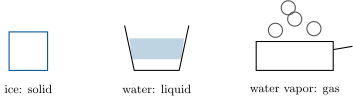
Water can be in three states of matter. Solid: ice — ice cubes, icicles under the roof, frost on the grass, snow. A solid is hard and keeps its shape. Liquid: the water that pours — rain, rivers, the sea, your glass. A liquid flows and takes the shape of its cup. Gas: water vapor, water flying invisibly in the air. Solid, liquid, gas — but always the same stuff underneath.
Remark 9.2 (Water vapor is invisible)
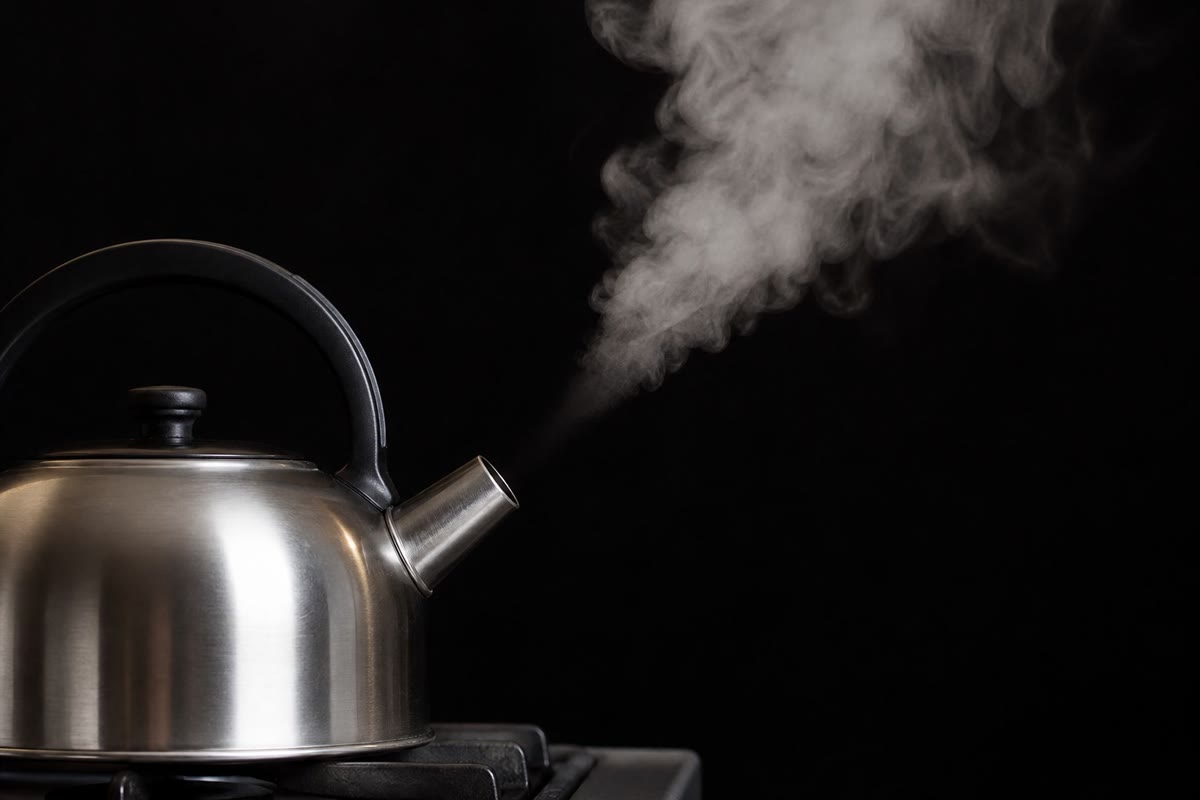
The white plume you see over the pot is made of tiny floating water droplets — little drops of liquid. The true gas — water vapor mixed into the air — cannot be seen at all! Look closely at the pot’s spout: just above it there is a short clear gap before the white plume begins. In that gap the water is a gas, invisible; a little higher it gathers into the droplets you can see. Invisible water vapor is hiding in the air of every room, and we will catch it red-handed before the chapter ends.
9.2 Changing state
Definition 9.3 (Melting and freezing)
When warmth turns solid ice into liquid water, the ice melts. When strong cold turns liquid water solid, the water freezes. Melting and freezing are opposite doors between the same two states: warmth pushes one way, cold pushes the other.
Definition 9.4 (Evaporating and condensing)
When warmth makes liquid water fly off into the air as a gas, the water evaporates — the puddle shrinks, the laundry dries. When water vapor touches something cold and turns back into liquid droplets, it condenses — mist on the cold window, fog on the bathroom mirror. Again two opposite doors: warmth sends water into the gas state, cold calls it back to the liquid.

Example 9.5 (Try it: catch the invisible water)
Take a can or a glass straight from the refrigerator, dry its outside carefully with a towel, and set it on the table. Wait while you count to . The outside turns misty, then wet — drops appear from nowhere! They are not leaking through the glass: the invisible water vapor in the room’s air touched the cold wall and condensed. You just caught the invisible gas.
Example 9.6 (Breath clouds)
Your breath always carries invisible water vapor. On a warm day it stays invisible. On a freezing morning, the cold outdoor air condenses it at once into a little cloud in front of your mouth — and the same happens on a cold window when you breathe on it to draw with your finger.
Remark 9.7 (Steam and stoves: careful)
The water vapor above a boiling pot is burning hot — hotter than the water itself feels. Never put your hand into the plume, and lift lids away from you, with an adult nearby. Changes of state are for watching, not for touching, whenever a stove is involved.
9.3 The same water, round and round
Example 9.8 (The shrinking puddle)
After the rain, a puddle shines on the playground. By afternoon it has shrunk; by tomorrow it is gone. Nobody drank it and it did not leak through the tarmac: the Sun’s warmth made it evaporate, drop by drop, into the air. Draw a chalk line around a puddle in the morning and check after lunch: the water has retreated inside your line.
Example 9.9 (From the sea to the rain)
What evaporates must condense somewhere. Water flies up from seas and puddles, invisible; high in the sky, where the air is cold, it condenses into the droplets that make clouds; the droplets gather, grow heavy, and fall — rain! The rain fills the puddles and the seas, and the round trip starts again. The water in your glass has made this journey more times than anyone can count.
9.4 Exercises
Exercise 9.1 ★
Which state of matter is each of these — solid, liquid, or gas: an icicle; the sea; the invisible water just above the soup pot’s spout; frost on the grass; rain?
Solution
Solution of Exercise 9.1.
Icicle: solid. The sea: liquid. The invisible water above the spout: gas (water vapor). Frost: solid. Rain: liquid.
Exercise 9.2 ★
Name the change of state: a snowman shrinking in the sun; a puddle disappearing; mist appearing on the bathroom mirror; a pond turning hard in winter.
Solution
Solution of Exercise 9.2.
The snowman melts; the puddle evaporates; the mirror mist condenses; the pond freezes.
Exercise 9.3 ★
In the change-of-state picture, which way does warmth always push: toward the solid or toward the gas? And cold?
Solution
Solution of Exercise 9.3.
Warmth pushes toward the gas (solid to liquid to gas); cold pushes back toward the solid (gas to liquid to solid).
Exercise 9.4 ★
The drops on the cold can of Example 9.5 — did they leak out through the glass? Where did they come from?
Solution
Solution of Exercise 9.4.
No — glass does not leak. The invisible water vapor in the room’s air condensed on the cold outside wall of the can, turning into visible drops.
Exercise 9.5 ★
Why can you see your breath on a freezing morning but not on a warm day? Use the words of Definition 9.4.
Solution
Solution of Exercise 9.5.
Breath always carries invisible water vapor. Freezing air condenses it at once into tiny droplets — a visible cloud. Warm air lets it stay evaporated, so there is nothing to see.
Exercise 9.6 ★
Wet laundry dries faster in the sun than in the shade. Which change of state is at work, and what does the Sun add to speed it up?
Solution
Solution of Exercise 9.6.
Evaporation. The Sun adds warmth, and warmth is what sends water into the air as a gas faster.
Exercise 9.7 ★
Why is the plume above a boiling pot dangerous, and what is the safe rule from Remark 9.7?
Solution
Solution of Exercise 9.7.
The plume is burning hot — hotter than bath-hot water. The rule: never put a hand in the plume, lift lids away from you, and only with an adult nearby.
Exercise 9.8 ★
Tell the round trip of a raindrop: start at the sea, end back in the sea, and use the words evaporate and condense on the way.
Solution
Solution of Exercise 9.8.
The Sun warms the sea and some water evaporates, flying up invisibly. High up, in the cold, it condenses into cloud droplets. The droplets grow heavy and fall as rain, which runs back into the sea — ready to go around again.
Exercise 9.9 ★★
On the pot’s spout there is a clear gap, and only above it does the white plume begin. What is in the clear gap? What does this show about water in its gas state?
Solution
Solution of Exercise 9.9.
The clear gap holds water in its gas state — water vapor, invisible. Only a little higher, cooling air condenses it into the white droplets of the plume. So the real “steam” cannot be seen; the white we call steam is already tiny drops of liquid water.
Exercise 9.10 ★★
Nino leaves a glass of water on the windowsill for a week; the level sinks day after day, though nobody drinks it. His cat is accused. Defend the cat: explain what really happened, and invent a way to show the water leaves into the air, not into the cat.
Solution
Solution of Exercise 9.10.
The water evaporated into the air of the room, a little every day. To clear the cat: cover an identical glass with a plate or plastic film and leave both side by side. After a week the covered glass is still full while the open one has sunk — the water escapes into the air, and no cat can drink through a lid.