Primary & Middle School Physics · Grades 1–9
21Melting and Boiling: Changes of State
You have known for years that warmth melts ice and boils water. But now you own a thermometer — and the thermometer has something astonishing to report from inside the melting ice bucket: while the ice melts, the temperature refuses to move. Let us watch the old changes of state with new eyes.
21.1 The proper names
Water’s changes of state now get their grown-up names, good for every stuff, not just water. From solid to liquid: melting. From liquid back to solid: freezing (also called solidifying). From liquid to gas: boiling when it happens fast with big bubbles, evaporation when it happens quietly from the surface. From gas back to liquid: condensation. Every stuff in the world — water, chocolate, iron, gold — can play this game, each at its own temperatures.
Definition 21.1 (Melting point)
The melting point of a stuff is the temperature at which it melts — and also the temperature at which the liquid freezes back. For water it is . Each stuff has its own: chocolate melts near (mouth temperature — no accident, ask any chocolate maker), candle wax near , iron only at .
Definition 21.2 (Boiling point)
The boiling point of a stuff is the temperature at which it boils. For water it is . Each stuff again has its own — which is why a careful cook can boil water away while the oil in the same pan stays quietly liquid.
Example 21.3 (Reading the world with two numbers)
Why is a chocolate bar solid on the shelf () but liquid in your pocket on a summer hike ()? Because its melting point, near , sits between the two. A stuff is solid below its melting point, liquid above it — up until its boiling point, where it leaves as gas. Two numbers tell the whole story of any stuff at any temperature.
21.2 The stubborn thermometer
Method 21.4 (Watching ice melt properly)
- Fill a bowl with crushed ice or snow and plant the thermometer in it; wait and read: ;
- bring the bowl into the warm kitchen and read the thermometer every few minutes while the ice melts;
- keep reading until long after the last sliver of ice has gone.
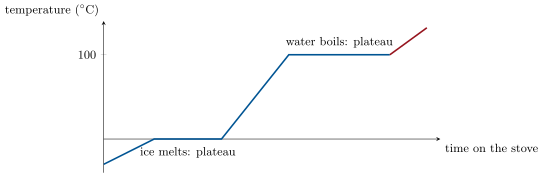
The report: all through the melting — water and ice together in the bowl — the thermometer stands stubbornly at . Only when the last piece of ice has melted does the temperature begin to climb.
Proposition 21.5 (The plateau law)
While a stuff is changing state — melting or boiling — its temperature stands still at the milestone, however hard the stove works. All the incoming warmth is spent on the change of state itself, none on climbing. Solid and liquid live together at the melting point; liquid and gas at the boiling point.
Example 21.6 (The plateau in the kitchen)
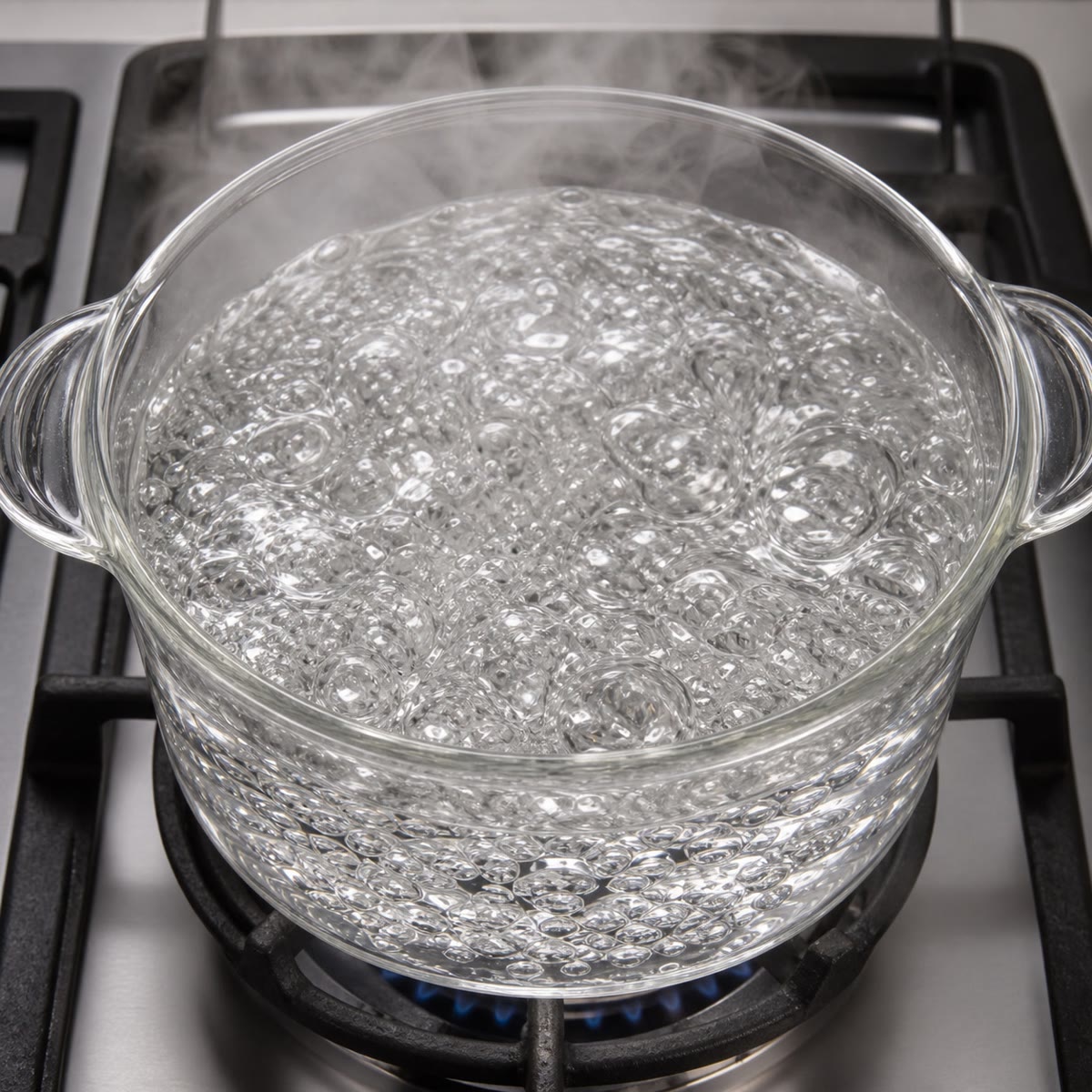
This is why gently boiling and furiously boiling water cook pasta equally fast: both pots stand at exactly — the furious one only wastes its extra warmth making steam faster. And it is why a drink with ice cubes stays at down to the last sliver: the melting ice pins the temperature to the milestone.
Remark 21.7 (A number the eye cannot see)
Without a thermometer, nobody would guess the plateau: the pot looks busier and busier, the ice bucket looks calmer and calmer, and the temperature in both stands rock still. It is one more victory of measuring over seeming — and one of the first great surprises that instruments ever handed to science.
21.3 Each stuff keeps its milestones
Proposition 21.8 (Milestones are identity marks)
The melting point and boiling point of a pure stuff never change: water melts at today, tomorrow, in a palace or a tent. The milestones are part of the stuff’s identity — so well kept that a scientist can recognize an unknown stuff by measuring where it melts and boils.
Example 21.9 (The candle and the foundry)
A candle by the fireplace slumps and drips: wax passes its melting point near . In a foundry, workers pour glowing-orange liquid iron like soup — their furnace passed . Same game, wildly different milestones: what the fireplace does to wax, only a furnace can do to iron. And gold melts at : goldsmiths have known that number, in their hands if not in degrees, for thousands of years.

21.4 Exercises
Exercise 21.1 ★
Give the proper name: solid to liquid; liquid to solid; liquid to gas with big bubbles; gas to liquid on a cold window.
Solution
Solution of Exercise 21.1.
Melting; freezing (solidifying); boiling; condensation.
Exercise 21.2 ★
What are water’s two milestones, with their temperatures? And chocolate’s melting point, roughly?
Solution
Solution of Exercise 21.2.
Melting point , boiling point . Chocolate melts near — mouth temperature.
Exercise 21.3 ★
A bowl holds ice and water together, well stirred. What does the thermometer read? What will it read five minutes later, if some ice still remains?
Solution
Solution of Exercise 21.3.
— and still five minutes later: while ice and water live together, the temperature is pinned to the melting point.
Exercise 21.4 ★
State the plateau law. Where does the stove’s warmth go while the water boils, since the temperature no longer climbs?
Solution
Solution of Exercise 21.4.
While a stuff melts or boils, its temperature stands still at the milestone. The warmth is all spent on the change of state itself — turning liquid into steam — not on climbing.
Exercise 21.5 ★
Wax melts near . Is a candle solid or liquid: in a living room? next to a flame that warms it to ? in a summer attic?
Exercise 21.6 ★
Pasta cooks in gently boiling water. Papa turns the flame to maximum and the pot boils furiously. Is the water now hotter? What does the extra warmth produce instead?
Solution
Solution of Exercise 21.6.
No hotter: both pots stand at , the boiling plateau. The extra warmth only makes steam faster — wasted flame, same pasta.
Exercise 21.7 ★
On the plateau graph of the chapter, how can you spot the two changes of state without reading a single word?
Solution
Solution of Exercise 21.7.
By the two flat stretches — the plateaus. Wherever the curve runs level while the stove keeps heating, a change of state is under way.
Exercise 21.8 ★
Iron melts at and gold at . A furnace runs at : which of the two metals pours like soup in it, and which stays solid? By how many degrees does the furnace miss the other one?
Solution
Solution of Exercise 21.8.
Gold () pours; iron () stays solid. The furnace misses iron’s milestone by degrees.
Exercise 21.9 ★
Why does a drink with ice cubes stay just as cold down to the last sliver of ice — and only then start warming up?
Solution
Solution of Exercise 21.9.
Melting ice pins the drink to : all incoming warmth is spent melting ice, none on warming the drink. Only when the last sliver is gone can the temperature start to climb.
Exercise 21.10 ★★
A scientist receives an unknown white solid. She finds it melts at exactly and its liquid boils at exactly . What is her best guess about the stuff — and which law lets milestones serve as identity cards?
Solution
Solution of Exercise 21.10.
Her best guess: the stuff is ice — frozen water. The law that milestones are identity marks: a pure stuff’s melting and boiling points never change, so matching water’s two numbers exactly is as good as a signature.
Exercise 21.11 ★★
Mountain climbers report that high on great peaks, water boils while only just too hot to touch — and their tea never brews properly. What everyday certainty about boiling water breaks down up there? (The reason hides in the air itself, and a later chapter on air pressure will catch it.)
Solution
Solution of Exercise 21.11.
The certainty that water always boils at . High on a peak it boils well below that — hot but not — so the “boiling” water is too cool to brew tea properly. The culprit is the thinner air pressing less on the water, as the air-pressure chapter will show.