Primary & Middle School Physics · Grades 1–9
57Current and Voltage Laws in Circuits
Two meters, two quantities — and now, at last, the constitution. Every circuit you will ever build, from a torch to a city grid, obeys four short laws: two about the current’s bookkeeping, two about the voltage’s. Armed with them and a little algebra, you can compute readings you have not yet measured — and catch any measurement that lies.
57.1 The current laws
Proposition 57.1 (Current law for a series loop)
Along a single loop, the intensity is the same everywhere:
One road, one march — last chapter’s tollbooths, now a law of the constitution.
Proposition 57.2 (The junction law)
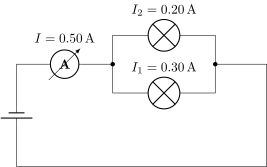
At any junction, the intensities flowing in together equal the intensities flowing out together: for a main road splitting into two branches,
Charge is neither created, destroyed nor stored at a fork: whatever arrives, leaves. (True for any number of branches — sum the arrivals, sum the departures, and the books balance.)
57.2 The voltage laws
Proposition 57.3 (Voltage law for a series loop)
Around a series loop, the battery’s voltage is shared among the devices, and the shares add up exactly:
The waterfall image keeps the books: the battery lifts the march through its full height, and the devices spend that height between them, drop by drop — with good wires spending none.
Proposition 57.4 (Voltage law for parallel branches)
Devices in parallel all span the same two junctions — so one voltage serves them all:
Each branch enjoys the full push between the junctions — which is why parallel lamps shine at full nominal brightness, and why your house’s every socket offers the same .
Example 57.5 (Why unequal shares?)
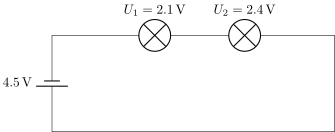
Two different lamps in series carry the same current (law one) yet split the voltage unequally — against . The bigger share goes to the lamp that opposes the march more: the harder worker takes the larger drop. What exactly “opposes more” means, and how to measure it, is the next chapter’s whole subject — the laws of this chapter are its stage.
57.3 Computing before measuring
Method 57.6 (Solving a circuit with the four laws)
Given a circuit with some readings known:
- draw the diagram and mark every known and ;
- write the applicable laws as equations — junction sums for currents, loop sums for voltages, sameness for series and parallel ;
- solve for the unknowns (your algebra course’s equations, earning their keep);
- sanity-check: no lamp receiving more than the battery offers, no branch current exceeding the main road’s.
Example 57.7 (Worked: the mixed circuit)
A battery feeds lamp A in series with a parallel pair (B and C). Measured: , , . Compute the rest. Junction law: . Series current law: lamp A carries the full . Loop voltage law: the pair receives ; parallel voltage law: . Every meter reading in the circuit, now known — four laws, one line of algebra each.
Example 57.8 (The laws as lie detectors)
A lab report claims: battery ; two series lamps at and . The loop law adds the shares: spent from a purse — impossible; someone misread a dial. Another report: junction in , branches out and — the fork “creates” : rejected. Before the laws, wrong readings looked as good as right ones; now the constitution audits every page.
Remark 57.9 (Batteries under the same laws)
The nose-to-tail rule is the series voltage law wearing its oldest clothes: batteries in series add their voltages ( — the flat battery’s secret), and one reversed cell subtracts, its push spent fighting the others. The laws govern givers and spenders alike; only the sign of their contribution differs.
57.4 Exercises
Exercise 57.1 ★
State the four laws — two for current, two for voltage — each in one line.
Solution
Solution of Exercise 57.1.
Series current law: one loop, one intensity everywhere. Junction law: currents in equal currents out. Series voltage law: the battery’s voltage equals the sum of the devices’ shares around the loop. Parallel voltage law: branches spanning the same junctions share one and the same voltage.
Exercise 57.2 ★
A junction receives and sends down one branch. The other branch carries?
Solution
Solution of Exercise 57.2.
.
Exercise 57.3 ★
A battery feeds three series lamps; two of them take and . The third’s share?
Solution
Solution of Exercise 57.3.
.
Exercise 57.4 ★
Two lamps in parallel across a battery: each lamp’s voltage? What everyday fact about house sockets is the same law?
Solution
Solution of Exercise 57.4.
each — the parallel voltage law. The same law puts the identical on every socket of the house’s parallel wiring.
Exercise 57.5 ★
In the worked mixed circuit, which single further measurement would have been redundant, and why? (Pick any, justify by a law.)
Exercise 57.6 ★
Two different series lamps carry the same current but split the voltage against . Which lamp opposes the march more? What chapter-to-come measures that opposition?
Exercise 57.7 ★
Audit: battery ; series lamps measured , , . Do the books balance within a meter’s honesty?
Solution
Solution of Exercise 57.7.
against a purse: half a volt astray — beyond honest meter scatter for such readings; one dial was misread (or a share went unmeasured).
Exercise 57.8 ★
Audit: main road ; three branches , , . Verdict?
Solution
Solution of Exercise 57.8.
leaving against arriving: the fork “creates” — convicted by the junction law.
Exercise 57.9 ★★
A battery, lamp D in series with a switch — then, in parallel with lamp D, a voltmeter shows across the open switch and across D. Show both readings obey the loop voltage law.
Exercise 57.10 ★★
Three identical cells nose-to-tail light a lamp; a fourth, reversed, joins the queue. Total voltage before and after, by the series law with signs? What does the lamp do?
Solution
Solution of Exercise 57.10.
Before: . After: — the reversed cell subtracts. The lamp dims from its glow to a one.
Exercise 57.11 ★★
A two-branch circuit: branch one carries lamps E and F in series; branch two carries lamp G alone. Battery ; . Compute and , citing a law for each step.
Exercise 57.12 ★★★
The complete audit: a battery; lamp P in series with a junction; branches Q and R rejoin and return. Measured: , , . Compute every remaining current and voltage in the circuit (, , ), stating the law behind each line — then invent one extra “measurement” a careless student might report that your finished solution would instantly convict.
57.5 Problem: The Sealed Mystery Boxes
Problem 57.1
Weekend problem — the electronics club’s sealed-box challenge; four laws against four mysteries; the grand audit
The club seals simple circuits into boxes, leaving only meter sockets. Teams must deduce the insides — constitution in hand. The bench battery is throughout.
Part I — Box A: two terminals, two lamps. The label admits: two identical lamps and nothing else, either in series or in parallel.
- Wired to the battery, box A draws ; a single such lamp alone on is known to draw about . Series or parallel? Argue with a current law.
- Predict what the box would draw in the other arrangement.
- What voltage does each inner lamp receive in the actual arrangement, by which voltage law?
- In which arrangement would the hidden lamps shine at full nominal brightness — and why do they visibly not, through the box’s peephole?
Part II — Box B: the three-lamp puzzle. Box B admits: one lamp (X) in series with a parallel pair (Y, Z — not necessarily identical).
- The team measures and, at Y’s own test socket, . Find and , citing laws.
- A voltmeter across X: . Find the parallel pair’s voltage — and each of , .
- Y and Z carry different currents at the same voltage. What does this reveal about the two lamps, in the language of Example 57.5?
- The team unscrews Y through a hatch. Predict the new direction of change (rise, fall, or hold), reasoning from roads and their opposition.
Part III — Box C: the cheat.
- Box C’s builder reports: “battery ; two series lamps inside at and ; junction inside receiving and sending plus .” Convict the report twice, one law per conviction.
- One of the two reported voltage readings is later found honest. If it is the , what must its partner truly be?
- The builder confesses the junction numbers were “rounded generously”. If the two branch readings and are honest, what must the main road truly carry?
- Why do the four laws make sealed-box cheating a losing game? One sentence.
Part IV — The constitution.
- Write the club’s charter: the four laws in four lines, each with the everyday image that carries it (roads, tollbooths, waterfalls, forks).
Solution
Solution of Problem 57.1.
1. Series. In series the two lamps oppose the march one after the other: the loop’s current falls well below a single lamp’s — the measured fits. (Parallel would add two full branches.) 2. Parallel: two branches of about each — roughly from the battery. 3. The series voltage law splits the between two identical lamps: about each. 4. Parallel — each lamp would span the full . Through the peephole the series pair glows dim: each is underfed at half its usual push. 5. (junction law); — X sits on the undivided road (series current law). 6. (loop law); (parallel law). 7. Same push, different marches: the lamps oppose the current unequally — Z, carrying less at the same voltage, is the stronger opposer (the harder road). 8. Fall: losing Y’s branch removes a road; the remaining Z-road opposes more than the pair did together, so the battery drives less total current. 9. Conviction one, loop law: spent from a purse. Conviction two, junction law: in , out . 10. . 11. . 12. Because the four laws over-determine every honest circuit: each reading must agree with the others’ sums, so one invented number must lie to at least one law — and is convicted by arithmetic alone. 13. For example: “One road, one march — the series current law. At every fork the marches balance, in equals out — the junction law. Around any loop, the battery’s waterfall is spent to the last drop by the workers — the series voltage law. And branches hanging between the same two junctions drink from the same height — the parallel voltage law.”