Primary & Middle School Physics · Grades 1–9
30Series and Parallel Circuits
When one bulb died, the whole party string went dark — the curse of the single loop. Yet when a bulb burns out in your kitchen, the rest of the house shines on. Somebody wired your house a cleverer way. Today we learn it: the way of the branches.
30.1 Two ways to wire
You know the first way: in series, all players threaded on one loop, beads on one necklace. Here is the second.
Definition 30.1 (In parallel)
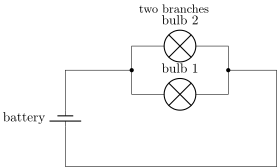
Players are in parallel when the circuit splits into separate branches — one player per branch — that fork apart and rejoin. The points where roads fork or rejoin are called junctions. Each branch is a complete road from one battery terminal to the other.
Method 30.2 (Building it)
With one battery, two bulbs and wires:
- wire the first bulb to the battery, alone, as a plain loop — branch one;
- now wire the second bulb directly across the first: one wire from each side of bulb 1 to the matching side of bulb 2 — branch two;
- trace each branch with your finger: from , every road should pass exactly one bulb before reaching .
Both bulbs light — and both shine as brightly as a single bulb would alone.
30.2 The rules of the branches
Proposition 30.3 (Rules of the parallel circuit)
With each player on its own branch:
- independence: a gap in one branch stops only that branch — unscrew one bulb, and the other burns on;
- full brightness: each bulb shines as if it were alone — no sharing of the battery’s push between branches;
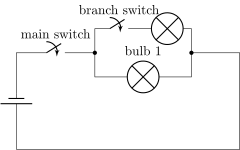
- command posts: a switch inside a branch commands only that branch; a switch on the common road, before the fork, commands everyone. (The price: the battery feeds every branch at once, and so it drains faster.)
Example 30.4 (The unscrewing test, replayed)
Do to the parallel pair exactly what once killed the series pair: unscrew bulb 2. Bulb 1 does not even flicker — its own branch, its own complete road, is untouched. Screw it back, unscrew bulb 1 instead: bulb 2 burns calmly on. The curse of the single loop is lifted: in parallel, every player minds its own branch.
Example 30.5 (Your house is a parallel circuit)
Every lamp, socket and appliance in your home rides its own branch of one great parallel circuit. That is why the kitchen bulb can burn out while the living room reads on undisturbed; why each room’s switch commands only its own light; and why one main switch — in the fuse box by the meter — can cut the whole house at once for repairs. Modern party lights joined the club: their bulbs are wired so one dead bulb no longer darkens the string.
Remark 30.6 (Series and parallel, side by side)
One gap: series — all dark; parallel — one branch dark. More bulbs: series — all dimmer; parallel — all at full brightness, but the battery drains faster. One switch for everything: series — anywhere; parallel — only before the fork. Neither way is “better”: the flashlight is happily series (one bulb, one switch), the house is necessarily parallel. An electrician’s first question about any circuit is simply: where does the road fork?
30.3 Reading circuits
Method 30.7 (Following the roads)
To predict any bulb’s fate in a circuit drawing:
- put your finger on the battery’s and walk every possible road to , listing the players each road passes;
- a bulb lights if at least one unbroken road passes through it;
- players sharing every road are in series with each other; players on different forks are in parallel.
Walk the roads before you predict — guessing from the drawing’s shape alone is how circuits fool people.
30.4 Exercises
Exercise 30.1 ★
What is a branch? A junction? In a parallel circuit with two bulbs, how many branches carry a bulb?
Solution
Solution of Exercise 30.1.
A branch is one of the separate roads the circuit forks into; a junction is a point where roads fork or rejoin. Two bulbs in parallel ride two bulb-carrying branches.
Exercise 30.2 ★
State the three rules of the parallel circuit.
Exercise 30.3 ★
Two bulbs in parallel: bulb 1 is unscrewed. What does bulb 2 do? And in the series pair — what did it do there, and why the difference?
Exercise 30.4 ★
Two identical bulbs: pair A is in series, pair B in parallel, same batteries. Which pair shines brighter per bulb? Which drains its battery faster?
Exercise 30.5 ★
In the figure with the two switches, what does each bulb do when: both switches closed? main open? main closed, branch switch open?
Exercise 30.6 ★
Why is a house wired in parallel and not in series? Give two everyday comforts that depend on it.
Solution
Solution of Exercise 30.6.
In series, one dead bulb (or one switched-off lamp!) would darken the whole house, and everything would dim as more lights joined. Comforts from parallel wiring: each room’s switch rules only its room; a burnt-out kitchen bulb leaves the rest of the house lit; every lamp burns at full brightness.
Exercise 30.7 ★
Where in a house circuit does a switch command everything at once? What is that switch’s everyday name and use?
Solution
Solution of Exercise 30.7.
Before the fork — on the common road where the current enters the home: the main switch in the fuse box. It cuts the whole house at once, used for repairs and emergencies.
Exercise 30.8 ★
A bedside lamp and its wall socket: are they in series or in parallel with the ceiling light? How do you know from daily life?
Solution
Solution of Exercise 30.8.
In parallel: switching the ceiling light off does not kill the bedside lamp, and unplugging the lamp does not darken the ceiling — each rides its own branch.
Exercise 30.9 ★★
Draw (with symbols) a circuit for a hallway: one battery, one bulb, and this comfort — the bulb must go on and off from a switch at either end of the hallway… Try honestly; if your designs stubbornly fail, explain what is hard. (True two-way switching needs a cleverer switch than ours — the attempt teaches more than the answer.)
Solution
Solution of Exercise 30.9.
With our plain switches the designs keep failing: a switch in series with the bulb can be opened from one end only; two plain switches in series demand both closed (either end can turn the light off but not always on); two in parallel demand both open for darkness. The hallway comfort needs a switch that chooses between two roads instead of just breaking one — the two-way switch, which real hallways use in matched pairs.
Exercise 30.10 ★★
A string of modern party lights keeps shining when one bulb dies — but the box warns: “Do not run the string with more than three bulbs removed.” Using the rules of the branches, explain both the comfort and, harder, a sensible reason for the warning. (Think of what each remaining branch receives from the battery, and of the battery’s own effort.)
Solution
Solution of Exercise 30.10.
The comfort: the bulbs ride parallel branches, so a dead bulb darkens only itself. The warning: every missing bulb removes a branch, and the battery (or the string’s little power supply) pushes its full effort through the branches that remain — with too many gone, the survivors each receive more than they were built for, burn hotter, and fail young.
Exercise 30.11 ★★
In the two-switch figure, an electrician wants to add one more bulb that lights only when the branch switch is closed, and is dark otherwise — even with the main switch closed. Onto which stretch of road must the new bulb be wired, and is it then in series or in parallel with bulb 2?