Primary & Middle School Physics · Grades 1–9
20Measuring Mass
At the market: “A kilogram of apples, please!” The seller pours apples into the pan until the scale is satisfied. What exactly did the customer order — and how does the scale know when to stop? With levers and balance scales in our toolbox, we are ready to measure a new thing: mass.
20.1 Mass: how much stuff
Definition 20.1 (Mass)
The mass of a thing tells how much stuff it is made of. The more stuff, the greater the mass — and the harder the Earth pulls it down, which is why things with more mass feel heavier in your hand and press their pan of a balance scale down.
Example 20.2 (Big is not heavy)
A pillow fills your whole arms, yet you carry it easily. A stone smaller than your fist strains your wrist. The pillow is big but holds little stuff — mostly feathers and air; the stone is small but packed with stuff. Mass is about how much stuff, not about how much room it takes. (These two ideas, and the tricky dance between them, meet again in the floating-and-sinking story one day.)
Definition 20.3 (Gram and kilogram)
Mass is measured in grams (written ) and kilograms (written ):
A paperclip has a mass of about ; an apple about ; a carton of milk about ; you, a few tens of kilograms. Like the metre, these units are the same for everyone on Earth.
20.2 Weighing with a balance scale
Method 20.4 (Weighing with blocks)
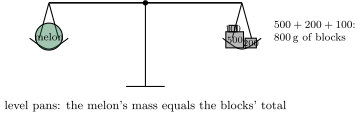
To measure a melon’s mass with a balance scale and a box of marked metal blocks (, , , , …):
- check the empty scale hangs level;
- put the melon in one pan;
- add blocks to the other pan, biggest useful ones first, until the pans hang level;
- add up the blocks: their total is the melon’s mass.
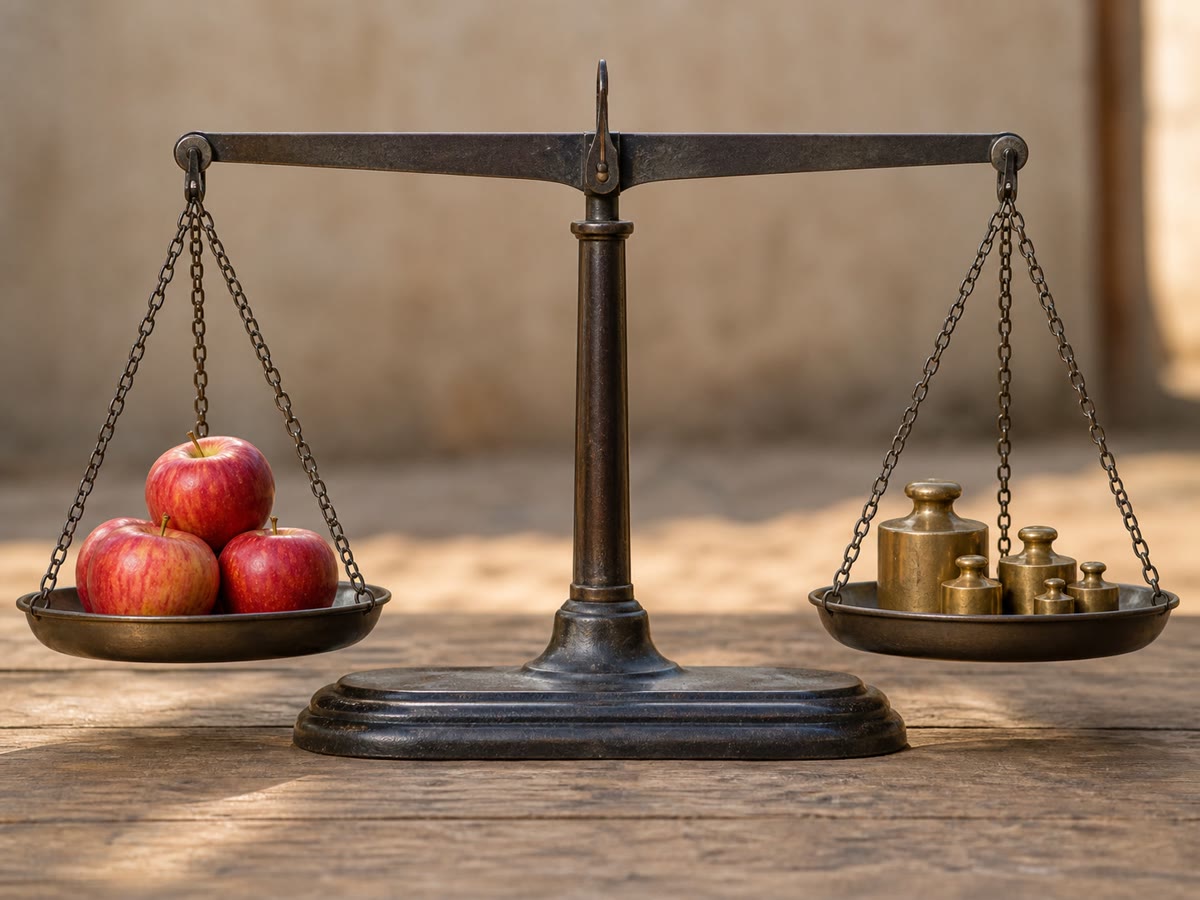
If the pans level with a , a and a block, the melon’s mass is .
Example 20.5 (Other scales)
The kitchen scale and the bathroom scale have no second pan: you put the load on, and a needle turns (or a number lights up) to show the mass directly. Inside, a squeezed spring does the comparing for you. Handy and fast — but the old two-pan balance hides no machinery at all: just the lever rule you already understand.
Example 20.6 (Reading the market)
“A kilogram of apples” means: apples until the scale balances a block — about or apples. Flour comes in bags, chocolate bars are often , a letter needs about of paper, and the postman’s rule “under , one stamp” is a mass rule.
20.3 Mass follows the stuff
Proposition 20.7 (Same stuff, same mass)
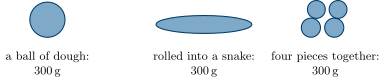
Changing a thing’s shape does not change its mass. Roll a ball of dough into a snake, flatten it into a pancake, or cut it in four and weigh all the pieces together: the scale reports the same mass every time. Mass counts the stuff — and squashing, rolling and cutting neither add stuff nor take any away.
Remark 20.8 (The scale ignores appearances)
This is the quiet power of measuring: eyes judge a flattened pancake “bigger” than the ball it came from, and a fluffed pillow “heavier” than a stone — but the balance scale, like the thermometer and the ruler before it, reports the stuff and nothing else. One by one, our instruments are replacing “it seems” with “it is”.
20.4 Exercises
Exercise 20.1 ★
What does the mass of a thing tell? Which two units measure it, and how many grams make one kilogram?
Exercise 20.2 ★
Choose the likelier mass: a paperclip — or ? An apple — or ? A carton of milk — or ? A cat — or ?
Solution
Solution of Exercise 20.2.
Paperclip: . Apple: . Milk carton: . Cat: .
Exercise 20.3 ★
The pans level when a pumpkin faces a block and two blocks. What is the pumpkin’s mass?
Exercise 20.4 ★
Why must the empty scale hang level before any weighing? (Remember the cheating merchant.)
Solution
Solution of Exercise 20.4.
If the empty scale already tips, every weighing lies in favor of one side — like the cheating merchant’s long arm. Level when empty is the proof of a fair start.
Exercise 20.5 ★
A beach ball is much bigger than a can of soup, yet the can presses its pan down. Explain with Example 20.2.
Exercise 20.6 ★
How many grams are in ? In half a kilogram? Which is more: or ?
Exercise 20.7 ★
A chocolate bar of is broken into all its little squares, and every square goes on the scale together. What mass does the scale show, and which law says so?
Solution
Solution of Exercise 20.7.
Still : breaking changes the shape, not the stuff — the law “same stuff, same mass”, with all the pieces on the pan together.
Exercise 20.8 ★
The kitchen scale and the two-pan balance both weigh a bag of flour. What does each use to do the comparing — and which one works by a rule you learned three chapters ago?
Exercise 20.9 ★
The baker needs of flour and has blocks of , , , and . Find two different ways to weigh out exactly — knowing that blocks are allowed to sit in either pan.
Solution
Solution of Exercise 20.9.
First way: of blocks opposite the flour. Second way: put the block with the flour and opposite; level pans then mean flour equals , so the flour is .
Exercise 20.10 ★★
Nina weighs a whole orange: . She peels it and weighs the peeled orange alone: . Has Proposition 20.7 failed? Where are the missing grams, and how could Nina prove it with one more weighing?
Solution
Solution of Exercise 20.10.
The law has not failed: no stuff vanished — it was only separated. The missing are the peel. One more weighing proves it: the peel alone should read , and .
Exercise 20.11 ★★
A riddle, at last easy for you: which has more mass, a kilogram of feathers or a kilogram of iron? And which takes more room? Explain why so many people answer the first question wrongly.