Primary & Middle School Physics · Grades 1–9
10Air Around Us
Wave your hand fast in front of your face: something soft brushes your cheek. You cannot see it, grab it, or put it in a drawer — yet it fills every room, every bottle, every playground on Earth. This chapter is about air: the invisible stuff we live at the bottom of.
10.1 Is air really something?
Definition 10.1 (Air)
Air is the invisible stuff all around us. It has no color, no smell of its own, and light passes straight through it — which is why we forget it is there. But it is real stuff, as the experiments of this chapter will prove, and it is precious: every breath you take is a gulp of it.
Example 10.2 (Try it: catch some air)
Open a plastic bag wide, sweep it through the room, and twist it shut. The bag stands puffed up like a cushion — squeeze it: it pushes back! Something is clearly trapped inside. Open a corner and squeeze again: you feel the invisible prisoner stream out over your fingers. An “empty” bag full of nothing could not push back.
Example 10.3 (Where air shows itself)
Air is invisible, but its tricks are not: it wobbles as shimmering above a hot road, it lifts kites, it rustles the leaves, and it makes bubbles wherever it escapes underwater. Blow through a straw into your glass: every silver bubble is a little parcel of air on its way up.
10.2 Air takes up room
Method 10.4 (The dry-towel dive)
A magic trick that is pure physics — do it over a basin.
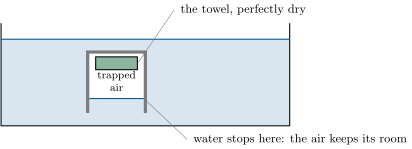
- Stuff a dry paper towel snugly into the bottom of a glass so it cannot fall out;
- turn the glass exactly upside down;
- push it straight down into a basin of water, deeper than the whole glass, without tilting;
- pull it straight back out and touch the towel.
The towel is perfectly dry! The glass was never empty: it was full of air, and the trapped air kept its room, so the water could not come in.
Example 10.5 (The glugging bottle)
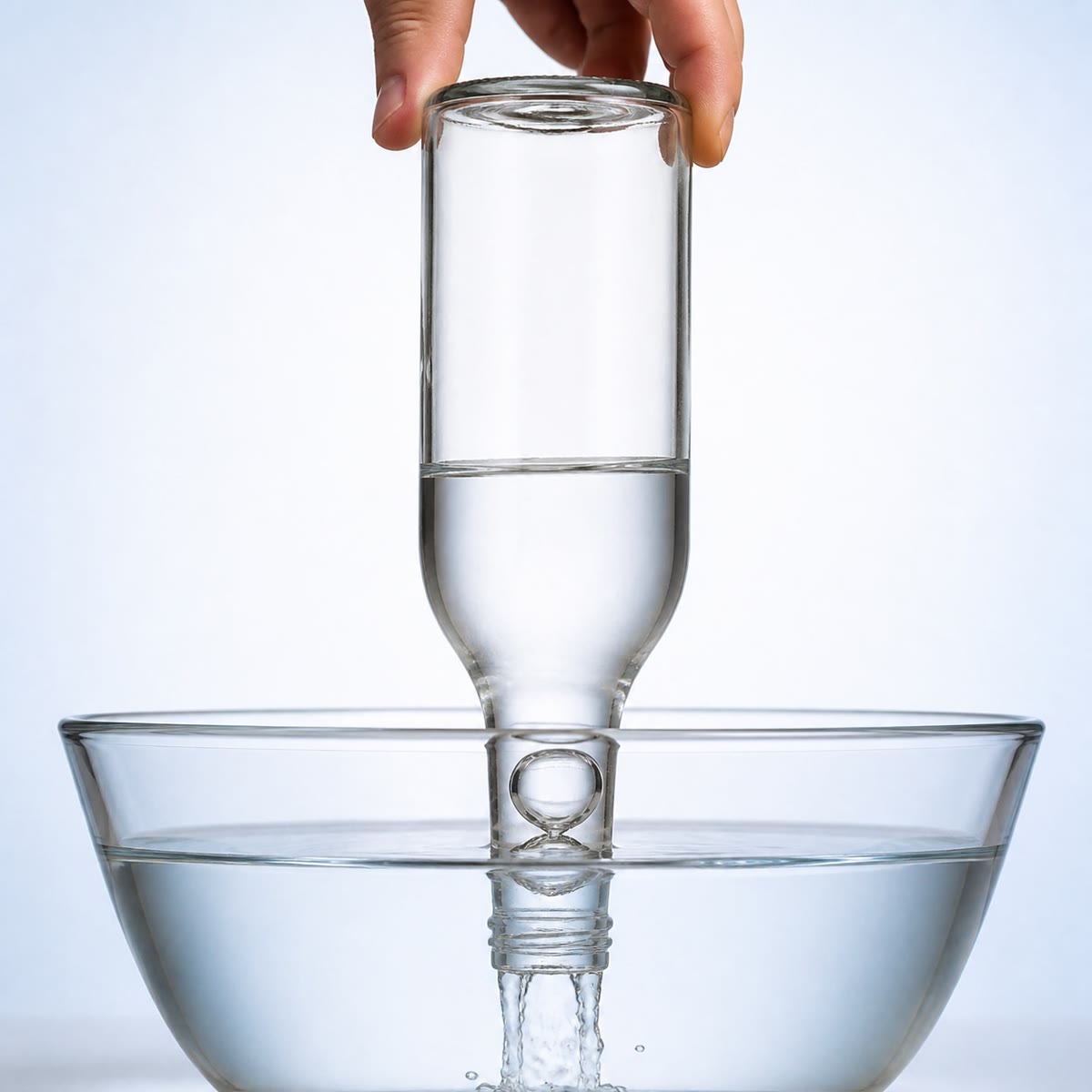
Push an “empty” bottle mouth-down into the basin and tip it slightly: glug, glug, glug — big silver bubbles race to the surface, and water takes their place inside. The bottle was full of air; the water can only move in as fast as the air moves out. That glug at the kitchen sink is the sound of air and water swapping rooms.
Remark 10.6 (No such thing as an empty bottle)
From now on, be suspicious of the word “empty”. The empty bottle, the empty glass, the empty box: all full of air, right up to the brim. Truly empty — with nothing at all inside, not even air — is very hard to arrange, and one day you will meet the strange name scientists give it.
10.3 Air pushes
Definition 10.7 (Wind)
Wind is air on the move. Still air brushes nobody; moving air pushes whatever stands in its way — gently on a breezy day, hard enough in a storm to bend trees.
Example 10.8 (Air at work)
Moving air does real jobs: it fills the sails of boats, spins wind toys, dries the laundry, and carries kites. You make wind yourself every time you blow out a birthday candle — your breath is a small private gust, strong enough to push the flame right off its wick.
Example 10.9 (Try it: the balloon jet)
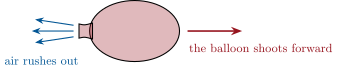
Blow up a balloon and hold its neck shut. Inside, squeezed air is waiting. Let go: the air rushes out backward, and the balloon shoots forward across the room, wobbling wildly. The escaping air pushes the balloon — a tiny cousin of the way squeezed-out gas pushes real rockets.
Remark 10.10 (Air is precious)
The most important push of all happens quietly in your chest: with every breath, air flows in, your body keeps a little of what it needs, and the rest flows out. People, cats, birds, even fish (who sip the air hidden in water) all need their share. Invisible does not mean unimportant — with air it means the opposite.
10.4 Exercises
Exercise 10.1 ★
Name three clues, seen this week, that air is real — without using any experiment from a book.
Solution
Solution of Exercise 10.1.
For example: the wind bending trees or rustling leaves; a kite or flag flying; breath-clouds on a cold morning; bubbles when blowing through a straw; a door slamming in a draught.
Exercise 10.2 ★
Why does the twisted-shut bag of Example 10.2 push back when you squeeze it? What is inside?
Exercise 10.3 ★
In the dry-towel dive, why does the water not reach the towel? Say it with the chapter’s words: what keeps its room?
Exercise 10.4 ★
What must you not do with the glass during the dry-towel dive, and what would happen to the towel if you did?
Solution
Solution of Exercise 10.4.
Do not tilt it. Tilted, the trapped air escapes upward as big bubbles, water takes its room — and the towel gets soaked.
Exercise 10.5 ★
What is the glug-glug of a bottle filling underwater? What goes out, what comes in, and why must they take turns?
Exercise 10.6 ★
“Pass me the empty bottle.” What is really inside an empty bottle? (See Remark 10.6.)
Solution
Solution of Exercise 10.6.
Air — right up to the brim. “Empty” only means “no drink left”; the bottle is full of invisible stuff.
Exercise 10.7 ★
What is wind, in the words of Definition 10.7? Give two jobs that moving air does.
Exercise 10.8 ★
When the balloon jet flies, which way does the air rush out, and which way does the balloon go?
Solution
Solution of Exercise 10.8.
The air rushes out backward through the neck, and the balloon shoots forward, the opposite way.
Exercise 10.9 ★★
A funnel sits snugly in the neck of a bottle, sealed tight all around with sticky putty. Ana pours water into the funnel — and after a small gulp, the water just sits in the funnel, refusing to go down into the bottle. Explain what blocks it, and propose the one-second fix.
Exercise 10.10 ★★
Underwater in the bath, tip a glass full of air so its mouth faces a glass full of water, also underwater. Can you pour the air upward from one glass into the other? Describe what you would see, and why the bubbles go up while poured water goes down.
Solution
Solution of Exercise 10.10.
Yes! Tip the air-filled glass so its mouth is under the other glass’s mouth: the air leaves as big silver bubbles that rise up into the water-filled glass and gather at its top, pushing the water out downward. Air climbs and water falls because air always floats up through water — pouring, upside down.