Primary & Middle School Physics · Grades 1–9
54Electric Current and Its Effects
The current has marched namelessly useful through five years of circuits: lighting threads, spinning motors, sounding buzzers. This year electricity turns quantitative — meters, units and laws — and we open by taking inventory: what, exactly, can a current do? Three effects, it turns out, and the whole electrical world is built from them.
54.1 The three effects
Proposition 54.1 (The effects of the electric current)
A current flowing through matter shows itself by three effects:
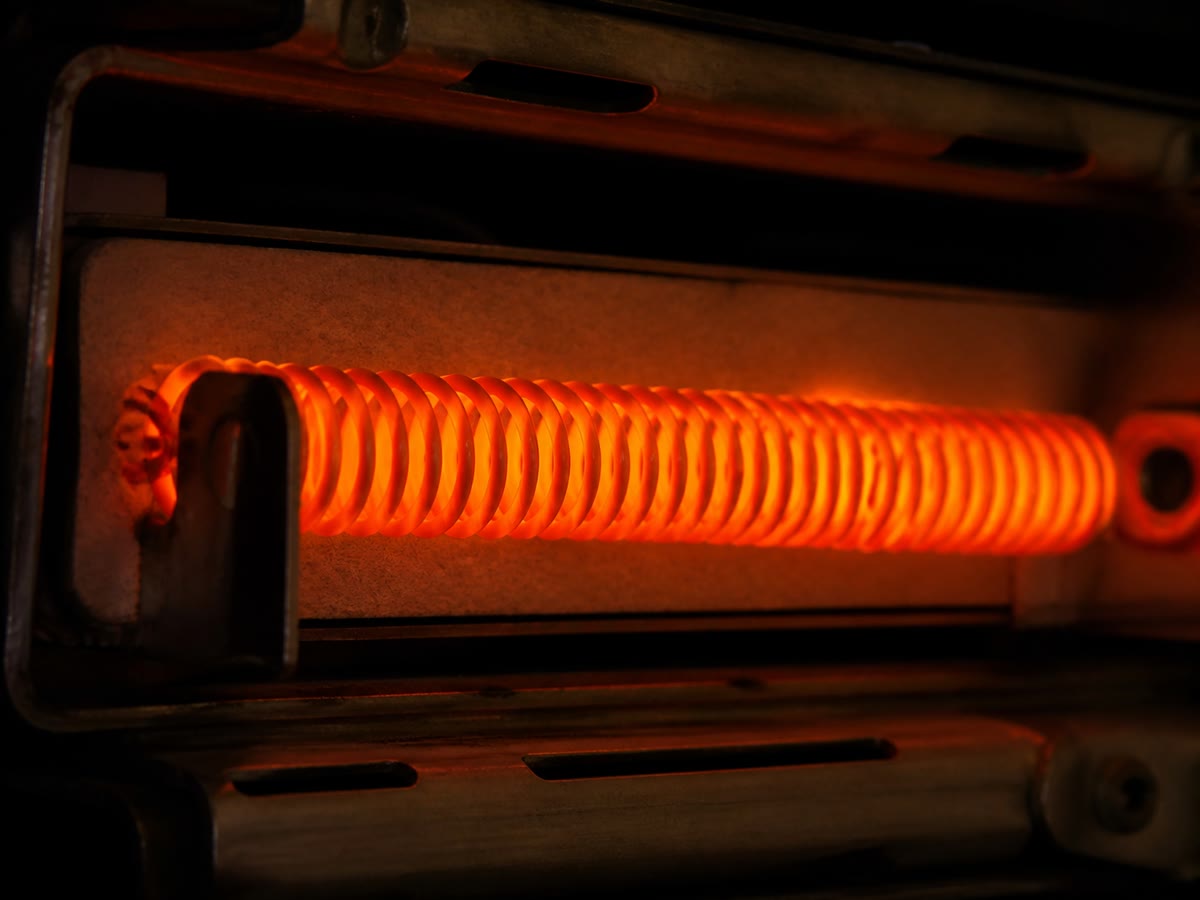
- the heating effect: every current warms the conductor it crosses — gently in good wires, fiercely in thin or overloaded ones, white-hot on purpose in filaments and toasters;
- the magnetic effect: a current turns its surroundings magnetic — a wire deflects a nearby compass needle, and a coiled wire becomes a true magnet with poles, switchable at will;
- the chemical effect: crossing certain liquids, a current drives chemical change — splitting water into two gases, plating spoons with silver, charging and discharging every battery.
Example 54.2 (The heating effect at work)
Deliberate: the toaster’s glowing bars, the kettle’s hidden coil, the old lamp’s white-hot filament, the fuse built to melt first. Unwanted: warm phone chargers, hot laptop undersides — and the short circuit’s menace, which you studied as the villain’s signature. One effect, servant and danger, dosed by how hard the current runs — a dose we learn to measure in the next chapter.
54.2 The current makes magnets
Example 54.3 (The compass betrays the wire)
Two centuries ago, during a lecture, a physicist noticed a compass needle twitch each time he closed a circuit on the bench beside it. That twitch — barely a trembling of a needle — was the first bridge ever seen between electricity and magnetism, two sciences until then as separate as weather and music. Lay a compass beside a wire and switch on: the needle swings aside; reverse the current, and it swings the other way. The current creates magnetism around itself, with a direction.
Definition 54.4 (Electromagnet)
An electromagnet is a coil of insulated wire — often wound on an iron core — that becomes a magnet while current flows through it: north pole, south pole, iron-grabbing power and all. Unlike any stone magnet, it obeys a switch: current on, magnet on; current off, magnet gone; current reversed, poles exchanged.

Example 54.5 (Switchable magnetism runs the world)
The scrapyard crane grips a car with an electromagnet and drops it by opening a switch — try that with a stone magnet. Electric door-locks, the clack of a relay, the doorbell’s hammer (an electromagnet snatching it against the bell, cutting its own current, springing back: rattle made law), the reading head of old telephones, and — supremely — every electric motor: current-made magnetism pushing against magnets, thousands of times a second. The magnetic effect is the muscle of the electrical age.
Method 54.6 (Winding an electromagnet)
- wind a metre or two of thin insulated wire in tight, tidy turns around a large iron nail or bolt, leaving two free ends;
- connect the ends to a battery through a switch (never directly for long — the coil is nearly a short circuit and warms: the heating effect chaperones the experiment);
- close the switch briefly: the nail-head grabs paperclips; open it: they drop;
- test with a compass: the coil’s two ends behave as N and S poles — and swap when you reverse the battery.
More turns, stronger grip: dose the magnetism by winding.
54.3 The chemical effect
Example 54.7 (Current through water)
Dip two pencil-lead electrodes wired to a battery into water made slightly conducting (a spoon of washing soda helps), and watch: tiny bubbles stream from both leads — two different gases, born of the water itself, twice the volume at one lead as at the other. The current is dismantling water into its two invisible components. This door between electricity and chemistry — electrolysis — plates cheap spoons with silver, wins aluminium from ore, and belongs mostly to your chemistry course; physics salutes it and moves on.
Example 54.8 (Every battery is the effect run backward)
Inside every battery, chemistry pushes the current: stored chemical energy drives the march, spending itself as it serves — the emptying you have known since the flashlight dimmed. Rechargeable cells close the circle: the charger forces current through backward, and the chemical effect rebuilds the store. Chemical to electrical, electrical to chemical: one effect, both directions, the whole battery industry.
Remark 54.9 (Effects as detectors)
The three effects answer a question that stumped you as the tester’s apprentice: how do you see a current — an invisible march in an opaque wire? By its deeds. A warming wire, a twitching compass, a streaming bubble: each betrays the march. Every current-measuring instrument ever built reads one of the three effects — and the one waiting in the next chapter reads the magnetic twitch, refined into a numbered dial.
54.4 Exercises
Exercise 54.1 ★
Name the three effects of the electric current, each with one servant use.
Solution
Solution of Exercise 54.1.
Heating (the toaster, the kettle, the filament); magnetic (the electromagnet, the motor, the doorbell); chemical (electroplating, splitting water, charging batteries).
Exercise 54.2 ★
Which effect, in each scene: a fuse melting; a doorbell hammering; bubbles at the pencil leads; a toaster’s glow; a scrapyard crane’s grip?
Solution
Solution of Exercise 54.2.
Heating; magnetic; chemical; heating; magnetic.
Exercise 54.3 ★
What did the twitching compass beside the lecture bench reveal? What happens to the twitch when the current reverses?
Solution
Solution of Exercise 54.3.
That a current creates magnetism around its wire — the first bridge between electricity and magnetism. Reversing the current reverses the twitch.
Exercise 54.4 ★
Give three powers an electromagnet has that no stone magnet can match.
Solution
Solution of Exercise 54.4.
It can be switched off, switched on, and have its poles flipped at will — and its strength can be dosed (more turns, more current). A stone magnet can do none of these.
Exercise 54.5 ★
In the winding method, why must the wire be insulated? And why must the coil not stay connected long without a working load?
Solution
Solution of Exercise 54.5.
Bare turns touching would let the current shortcut across the windings instead of touring the coil — insulation forces the long magnetizing path. And the coil alone opposes the march very little: left connected it is nearly a short circuit, warming coil and battery — the heating effect chaperones.
Exercise 54.6 ★
How does the crane operator release the car? Contrast with what a stone magnet of equal strength would demand.
Exercise 54.7 ★
What energy conversion happens inside a battery in use? And inside a rechargeable battery on its charger?
Exercise 54.8 ★
Why are the three effects precious as detectors? Which effect will the next chapter’s instrument refine into a number?
Solution
Solution of Exercise 54.8.
Because the march itself is invisible: only its deeds betray it. Warming, twitching, bubbling are the current’s only signatures — and next chapter’s instrument refines the magnetic twitch into a numbered reading.
Exercise 54.9 ★★
The doorbell: an electromagnet snatches the hammer toward the bell, but the moving hammer breaks its own circuit; a spring returns it, remaking the contact — and so on. Walk through one full cycle and explain why the design must rattle rather than hold.
Solution
Solution of Exercise 54.9.
Button pressed: current flows, the electromagnet snatches the hammer, ding — but the hammer’s swing opens a contact in its own supply; magnetism dies, the spring returns the hammer, remaking the contact; current returns, snatch again — and so on, many times a second. Holding is impossible by design: the snatch always cuts its own cause — and the rattle is the ring.
Exercise 54.10 ★★
A relay is a switch closed by an electromagnet: a small current in the coil closes contacts that carry a big current in another circuit. Explain why this lets a delicate thermostat safely command a hungry electric heater — and which two circuits never touch.
Solution
Solution of Exercise 54.10.
The thermostat’s frail contacts carry only the coil’s small current; the coil’s magnetism closes stout contacts that carry the heater’s hungry current in a separate loop. Small commands large, and the two circuits never touch — the delicate hand pulls a lever, not the load.
Exercise 54.11 ★★
Your compass needle twitches whenever a hidden wire in the wall carries current. Design a wall-wire finder from this fact: protocol, what a strong twitch means, and one honest limit of the instrument (think of what else moves compass needles).
Solution
Solution of Exercise 54.11.
Protocol: hold the compass flat against the wall, far from iron furniture; sweep slowly; where the needle twitches as the suspect appliance is switched on and off, a current-carrying wire runs. A strong twitch means a close or strong current. Honest limit: needles also answer iron pipes, magnets and the Earth itself — so only a twitch that follows the switch on–off proves a current.
Exercise 54.12 ★★★
An electric motor, in outline: a coil on an axle sits between the poles of a magnet; current makes the coil a magnet; the push-and-pull of poles turns the axle — and just as the coil would settle aligned, the current through it is reversed, so it must chase alignment forever. Explain, pole by pole, why the reversal is indispensable — what would the motor do without it? (You have just explained why motors contain a reversing contact — and half of how the electrical age turns its wheels.)
Solution
Solution of Exercise 54.12.
Current makes the coil a magnet; unlike poles of coil and frame attract, like poles repel, and the coil turns toward alignment. Without reversal it would reach alignment and stop — one half-turn, then a shudder into rest: a door-closer, not a motor. Reversing the current at the aligned moment swaps the coil’s poles: yesterday’s attraction is now repulsion, alignment becomes the worst place to be, and the coil must keep chasing a goal that flips away each half-turn — perpetual pursuit, which is to say: rotation.
54.5 Problem: The Inventor’s Workshop
Problem 54.1
Weekend problem — one battery, three effects, five inventions; an evening in the inventor’s workshop
The workshop bench holds batteries, wire, iron nails, a compass, two pencil leads, a jar of soda water — and a notebook of half-built inventions to assess.
Part I — Taking inventory.
- Sketch the workshop’s three-effect test bench: for one battery and a switch, describe a setup that shows all three effects at once (a thin wire to warm, a compass beside a lead, the jar in the loop). In what arrangement must the three demonstrations sit — series or parallel — for one switch to run them all?
- The thin demonstration wire grows warm but the thick supply wires stay cool, in the same loop. Which chapter-one fact about the series loop makes this more interesting than it looks — what is equal in both wires, and what differs?
- The compass twitches east when the switch closes. What two changes, made together, would leave the twitch exactly as it was?
- Bubbles stream twice as fast from one pencil lead as the other. What does this hint about water’s two components? (Chemistry will confirm the ratio.)
Part II — Assessing the inventions.
- Invention: “the silent doorbell” — an electromagnet that pulls a soft felt hammer once and holds it until the button is released. Which piece of the classic doorbell’s mechanism must the inventor remove, and what will the visitor hear?
- Invention: “the magnetic sorter” — scrap on a conveyor passes under an electromagnet that lifts out iron and steel. What happens at the drop bin, and why does the sorter leave aluminium cans on the belt (two magnet facts from earlier years answer)?
- Invention: “the pole-flipper” — a compass mounted over a coil, flipping each time a hidden switch reverses the battery. Which property of current-made magnetism is being exploited?
- Invention: “the eternal electroplater” — silver plating powered by a battery that “recharges itself from the plating”. Veto it, citing the chapter’s two battery directions and an older law about energy.
Part III — The night’s masterpiece. The inventor closes with a crane game for the fair: a joystick, a small electromagnet on strings, a bin of iron trinkets.
- Script the winning move in effect-language: what happens at “grab”, during the swing, and at “release”?
- Fairgoers complain the crane drops prizes mid-swing whenever the old battery sags. Which property of the electromagnet — virtue and weakness in one — is on display?
- The inventor doubles the coil’s turns to help. Predict the effect on grip, and name the other dose (from the battery side) that next chapter will let us number.
- Notebook’s last page: write the workshop’s summary — one sentence per effect, each naming its finest servant invention of the evening.
Solution
Solution of Problem 54.1.
1. All three demonstrations in series on one loop with the switch: one march then serves warm wire, compass wire and jar in turn — one switch, three effects. 2. The series law: the same current crosses thick and thin wire alike. What differs is only the road — the thin wire suffers the march more and warms: same dose, different patient. 3. Reverse the battery and pass the wire on the compass’s other side (or flip the compass): two reversals cancel, and the twitch stays east. 4. That water’s two components are present in a two-to-one proportion — twice the gas from one lead as the other. 5. Remove the self-interrupting contact (the piece the hammer’s swing opens): the electromagnet then holds the felt hammer against the bell in silence — the visitor hears one soft “dum” and nothing more. 6. At the bin the operator opens the coil’s switch: magnetism vanishes, iron drops. Aluminium rides on because magnets — stone or current-made — grip only iron’s family, and aluminium never answered them. 7. That the poles of a current-made magnet follow the current’s direction: reverse one, reverse the other. 8. A battery drives plating by spending its chemical store; rebuilding a store requires energy forced in from outside. A battery that refills itself from the very work it pays for is the forever-machine again — the energy bill cannot pay itself. 9. Grab: switch closes, coil magnetizes, trinket held. Swing: current maintained, grip maintained — the magnetic effect on duty. Release: switch opens over the chute, magnetism dies, prize falls. 10. That the electromagnet lives by its current: sagging battery, weaker march, weaker grip — switchability’s price is dependence. (The stone magnet never sags — and never lets go.) 11. More turns, stronger magnet at the same current: firmer grip. The other dose is the current’s own strength — the intensity, measured in the next chapter. 12. For example: “Heating: the fuse, dying first and faithfully. Magnetic: the crane game, gripping and releasing on command. Chemical: the plating jar, silvering spoons with a battery’s patience.”