Primary & Middle School Physics · Grades 1–9
5Floating and Sinking
Drop a pebble in a puddle: it disappears to the bottom. Drop a leaf: it rides on top like a little boat. Bath time, puddles and ponds all ask the same question — what floats, what sinks, and can we guess before we drop it in?
5.1 Float or sink?
Definition 5.1 (Floating and sinking)
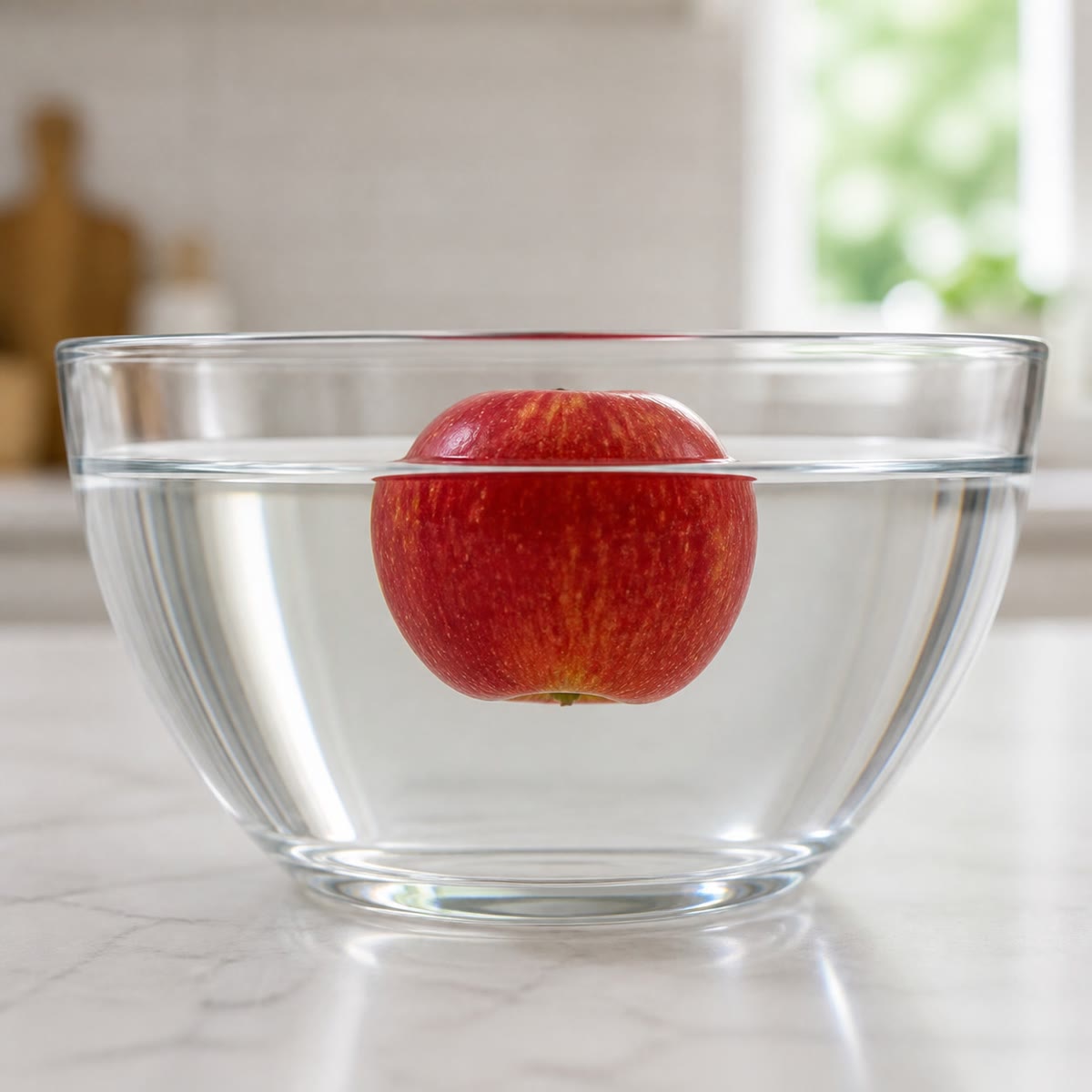
A thing floats when the water holds it up at the top; it sinks when it goes down to the bottom. A cork floats; a pebble sinks.
Method 5.2 (A fair float test)
- Fill a big bowl (or the sink) with water;
- put the object on the water gently — no throwing: a splash can push even a floater under for a moment;
- let go completely, and wait while you count to ;
- look: on top is a floater, at the bottom is a sinker.
Test each object the same way, so the comparison is fair.
Example 5.3 (Try it: the sorting game)
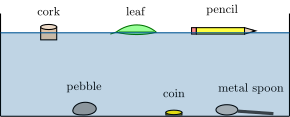
Gather a cork, a coin, a plastic spoon, a metal spoon, a pebble, a pencil and a dry leaf, and test them one by one with Method 5.2. Floaters: the cork, the plastic spoon, the pencil, the leaf. Sinkers: the coin, the metal spoon, the pebble. Before each drop, say your guess out loud — that is what scientists call a prediction, and being wrong is half the fun.
5.2 Heavy is not the whole story
Many people guess “heavy things sink, light things float”. The water has a surprise for them.
Example 5.4 (The log and the coin)
A fallen tree trunk is far too heavy for you to lift — yet it floats down the river. A little coin weighs less than a cookie — yet it sinks straight away. So heavy-or-light cannot be the whole rule: the huge log floats while the tiny coin drowns.
Example 5.5 (It is the stuff that counts)
Look back at the sorting game: the plastic spoon floated and the metal spoon sank, though they have the same shape and the same job. What made the difference is the stuff they are made of — wood and cork and most plastics are floating stuffs; metal, stone and glass are sinking stuffs. A thing usually behaves like its stuff: wood floats whether it is a twig or a whole trunk.
Remark 5.6 (A pinch of mystery)
Why does wood float and metal sink? That is a real question, and its full answer is one of the treasures of this course — it needs ideas that arrive in later years. For now we collect good observations; the “why” will find us ready.
5.3 The water pushes back
Example 5.7 (Try it: push the ball under)
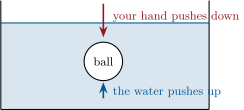
Take a floating ball in the bath and push it slowly underwater with your palm. Feel that? The water pushes it back up, harder the deeper you push — and if your hand slips, the ball leaps out of the water. The water is not just letting floaters sit on top: it is actively holding them up, like your hands holding a baby.
Example 5.8 (The plasticine boat)
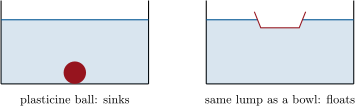
Roll a lump of plasticine into a ball and drop it in the water: it sinks — plasticine is a sinking stuff. Now take the same lump and shape it into a little bowl with high sides, and set it gently on the water: it floats! Same stuff, same lump — only the shape changed. A wide, hollow shape gives the water more to push up on. That is the secret of the great ships: metal is a sinking stuff, but a metal hull is shaped like a huge hollow bowl.
5.4 Exercises
Exercise 5.1 ★
Sort into floaters and sinkers: a cork; a key; a dry twig; a marble; a plastic duck; a stone.
Solution
Solution of Exercise 5.1.
Floaters: the cork, the dry twig, the plastic duck. Sinkers: the key, the marble, the stone.
Exercise 5.2 ★
In Method 5.2, why must you put the object on the water gently instead of throwing it in?
Solution
Solution of Exercise 5.2.
A splash can push even a floater underwater for a moment, so a thrown object might fool you. Putting it down gently and waiting makes the test fair.
Exercise 5.3 ★
Before testing, Nora guesses: “The metal spoon will float because spoons float.” What happened in the sorting game? What should Nora look at instead of the shape’s job: the stuff or the name?
Solution
Solution of Exercise 5.3.
The metal spoon sank while the plastic spoon floated. Nora should look at the stuff a thing is made of, not its name or its job.
Exercise 5.4 ★
Give one thing that is heavy and floats, and one thing that is light and sinks. What does this show about the guess “heavy things sink”?
Exercise 5.5 ★
A twig floats. Will a whole tree trunk float too? Which example of the chapter helps you answer?
Solution
Solution of Exercise 5.5.
Yes — wood is a floating stuff, and a thing usually behaves like its stuff, twig or trunk. The log of Example 5.4 floats down the river.
Exercise 5.6 ★
Push a floating ball underwater in the bath and let go. What do you feel while pushing, and what does the ball do when you let go?
Solution
Solution of Exercise 5.6.
While pushing, you feel the water pushing the ball back up, harder the deeper it goes. When you let go, the ball pops back up to the top — the water’s push wins.
Exercise 5.7 ★
Ships are made of metal, and metal is a sinking stuff. What shape saves the ship? Which experiment of the chapter shows it?
Solution
Solution of Exercise 5.7.
The hollow-bowl shape: a wide hull with high sides gives the water more to push up on. The plasticine boat of Example 5.8 shows it — same stuff, but the bowl shape floats.
Exercise 5.8 ★
Test at bath time: does a full, closed bottle of water float or sink? And the same bottle empty, with its cap on? Say your guesses first, then try.
Exercise 5.9 ★★
Leo’s plasticine boat floats nicely — until he squashes it back into a ball, and it sinks. “The water got tired of holding it,” says Leo. Give a better explanation, using Example 5.8.
Solution
Solution of Exercise 5.9.
The water never gets tired. Squashed into a ball, the plasticine gives the water only a small round bottom to push on; shaped as a hollow boat, the same lump spreads wide and the water’s push on all that bottom is enough to hold it up. It is the shape that changed, not the water.