Primary & Middle School Physics · Grades 1–9
43The Sun–Earth–Moon System
Three worlds run our sky: the Sun that gives the day, the Earth that carries us, the Moon that keeps us company. You know each one; now we chart the system — who circles whom, how fast, how far — and pay an old debt: the promised secret of the seasons is in this chapter.
43.1 Three motions, three clocks
Definition 43.1 (Axis and orbit)
The Earth’s axis is the imaginary line through its poles around which it spins, like a top’s spindle. An orbit is the closed path one heavenly body travels around another — very nearly a circle for the Earth around the Sun, and for the Moon around the Earth.
Proposition 43.2 (The three motions)
The whole calendar hangs on three steady motions:
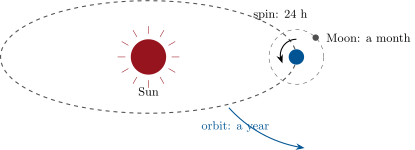
- the Earth spins on its axis: one turn in hours — the day, parading Sun and stars across our sky;
- the Earth orbits the Sun: one lap in about days and a quarter — the year, sliding the Sun’s arc up and down through the seasons;
- the Moon orbits the Earth: one lap in about a month — and, as its sunlit half faces us by turns, parading its phases through your old Moon diary.
Three motions, three clocks: day, month, year — humankind’s oldest timekeepers, all still running.
Example 43.3 (The quarter day and the leap year)
The Earth’s lap takes days and about a quarter — nature owes no loyalty to round numbers. Calendars pay the debt by saving the quarters: four years of quarter-days make one whole day, added to the calendar every fourth year — the -day leap year, with its extra day at February’s end. Miss this bookkeeping for a century and the calendar drifts weeks away from the seasons — as older calendars, painfully, discovered.
Example 43.4 (The system, to scale)
Numbers for the notebook: the Earth is about across; the Moon, about a quarter of that, orbits about away — thirty Earths laid side by side. The Sun is about Earths across and sits million kilometres away. Shrink the Earth to a centimetre marble and the model says: Moon, a peppercorn centimetres away; Sun, a ball over a metre wide, standing more than a hundred metres down the street. Our whole neighborhood is mostly emptiness — as the park scale model of the Solar System already whispered.
43.2 The debt repaid: why seasons
Proposition 43.5 (The tilt makes the seasons)
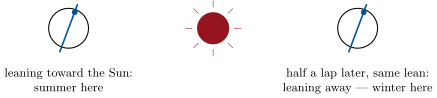
The Earth’s axis is not upright on its orbit: it leans, by about a quarter of a right angle — and it keeps leaning the same way all around the year’s lap, like a faithful compass of the stars. So for half the lap, our half of the world leans toward the Sun: the Sun rides high, days run long — summer. Half a lap later, the same unchanged lean points us away: low Sun, short days — winter. The seasons are not the Sun changing, nor the distance: they are a tilted planet carrying its unchanged lean around its star.
Method 43.6 (The globe and the lamp)
See the whole machine on a table:
- set a lamp mid-table as the Sun, and carry a tilted globe (or a ball on a slanted skewer) slowly around it, keeping the skewer pointing at the same corner of the room the whole way;
- at each quarter of the lap, stop and look at your home’s latitude: watch how much of its daily spin-circle lies in the light;
- on one side of the lamp, your hemisphere basks tilted-in — long lit arcs, high lamp: summer; opposite, tilted-out — short arcs, low lamp: winter;
- at the two stations between, neither pole leans in: day and night share equally — spring and autumn.
The one discipline that makes it work: never let the skewer swing — the axis’ faithfulness is the seasons.
Example 43.7 (The old clues, accounted for)
Every observation of your sundial years now reports to the tilt. Summer’s high arc: our hemisphere leans in, so the Sun stands taller at noon. Winter’s stubby arc and long shadows: leaning out, the Sun skims low. Opposite seasons across the equator — December beach holidays in the south while the north shovels snow: when one hemisphere leans in, the other must lean out. Even the equal days of spring and autumn fall out of the lamp-and-globe walk. One quarter-of-a-right-angle lean runs the whole show.
Remark 43.8 (Not distance — and the proof)
The Earth’s orbit is so nearly circular that sunward distance changes little — and, delightfully, we ride slightly closer to the Sun in the northern winter. The seasons care about the slant of the light, not the length of the trip: leaning in, sunlight strikes steep and concentrated; leaning out, the same light spreads thin across the ground. A torch held straight-on versus slanted against a wall shows the difference in one second — steep light bites, grazing light barely warms.
43.3 Exercises
Exercise 43.1 ★
Name the three motions of the system and the clock each one winds.
Exercise 43.2 ★
What is the Earth’s axis? What quarter-of-a-right-angle fact about it, plus what faithfulness, makes the seasons?
Exercise 43.3 ★
Why does the calendar add a day every fourth year? What would slip if it never did?
Solution
Solution of Exercise 43.3.
The Earth’s lap takes days and a quarter; four saved quarters make the leap year’s extra day. Without it the calendar would drift through the seasons — about a day every four years, weeks in a century.
Exercise 43.4 ★
About how many Earths, laid side by side, reach the Moon? How many Earths span the Sun’s face?
Exercise 43.5 ★
In the globe-and-lamp walk, why must the skewer keep pointing at the same corner of the room? What breaks if it swings?
Exercise 43.6 ★
When it is summer here, what season is it for the hemisphere across the equator, and why must it be so?
Solution
Solution of Exercise 43.6.
The opposite one: when our hemisphere leans toward the Sun, the other must lean away — one tilt cannot favor both ends at once.
Exercise 43.7 ★
Use the torch-against-the-wall picture of Remark 43.8 to explain why leaning toward the Sun warms us more.
Exercise 43.8 ★
An old friend returns: why does the Moon show phases through the month? Which of the three motions runs that show?
Exercise 43.9 ★★
A stubborn uncle insists: “Winter is when the Earth is farthest from the Sun.” Marshal two facts from this chapter that together defeat him.
Solution
Solution of Exercise 43.9.
First: the northern winter happens while the Earth rides slightly closer to the Sun — distance points the wrong way. Second: the two hemispheres have opposite seasons at the same moment and the same distance — no shared distance could do that; only the tilt, favoring one end and disfavoring the other, can.
Exercise 43.10 ★★
Suppose the Earth’s axis stood perfectly upright on its orbit — no lean at all. Describe a year: what happens to seasons, to the Sun’s noon height, to the length of days? (Walk the upright globe around the lamp in your head.)
Exercise 43.11 ★★
The Moon’s lap takes about days, yet full moon to full moon takes about . Propose the resolution — what else moved while the Moon lapped? (Sketch the Earth advancing along its orbit during one Moon-lap.)
Solution
Solution of Exercise 43.11.
While the Moon lapped its days, the Earth advanced along its own orbit — so the Sun’s direction shifted, and the Moon needs about two and a half extra days of travel to catch up to the same lineup with the Sun that makes a full moon. Lap and lineup are different finishing posts.
Exercise 43.12 ★★★
In midsummer, regions near the North Pole keep the Sun above the horizon at midnight — the famous “midnight sun” — and in midwinter they wait weeks for a sunrise. Explain both marvels with the tilted spin-circles of Method 43.6: what does the lean do to a polar town’s daily circle in June, and in December?
Solution
Solution of Exercise 43.12.
A polar town’s daily circle is small and, thanks to the June lean, can lie entirely in the lit half: the town spins around without ever leaving daylight — midnight sun. In December the same lean tips its little circle entirely into the dark half: whole spins without a sunrise. The tilt does gently to every latitude what it does absolutely at the poles.
43.4 Problem: The Sports-Field Model
Problem 43.1
Weekend problem — the class builds the Sun–Earth–Moon system on the sports field; marbles, peppercorns and a very long walk; the tilt joins the model
The class builds the system to scale: the Earth is a marble across. Handy true numbers: Earth across; Moon across, orbiting away; Sun Earths across, million kilometres away.
Part I — Casting the parts.
- In the model, stands for how many kilometres?
- The Moon is about a quarter of the Earth’s width. How wide is the model Moon — and what kitchen item plays it well?
- The true Moon distance is Earth-widths. Where does the model Moon stand from the marble?
- The model Sun is marbles across. How wide is that, in centimetres — and what playground object is about that size?
Part II — The long walk.
- The Sun’s distance is million km. In the model — divide by the answer to question 1 — how many centimetres is that, and how many metres?
- Will the model fit on a sports field? Where must the Sun-ball stand?
- A pupil walks the Earth–Sun stretch at metre per second. About how many minutes does the walk take?
- Standing at the marble and looking back at the metre-wide Sun-ball metres away, the class is surprised: it looks about the same size as the quarter-centimetre Moon-grain centimetres from the marble. Check the two ratios — and connect this coincidence to something that happens, rarely and gloriously, in the real sky.
Part III — Making it run.
- To animate the model honestly, how long should the marble take to circle the Sun-ball, and the pea to circle the marble, if one real day is played by one second? (Count roughly: a year as days, a Moon-lap as days.)
- The marble must also spin. At one real day per second, how fast is that in the model — and why will nobody see it on a marble?
- A skewer through the marble plays the axis. At what slant, and pointing how, must the skewer be carried around the whole lap?
- Write the model’s honest disclaimer: name one thing the sports-field model shows truly, and one thing no field-sized model can show at once (sizes and distances together? motions? light?). Justify with your numbers.
Solution
Solution of Problem 43.1.
1. per centimetre. 2. About — a peppercorn (or a grain). 3. from the marble. 4. cm — about a metre: a hula hoop or a large beach ball. 5. — about . 6. Barely not: the Sun-ball must stand some beyond the far goal line of a field. 7. About seconds — roughly two minutes. 8. Sun: ; Moon-grain: — nearly equal: the two look the same size from the marble. So too in our sky — and when the Moon passes exactly before the Sun, it covers it almost exactly: a total solar eclipse, nature exploiting the coincidence. 9. The marble’s lap: about seconds — six minutes of walking; the grain’s lap around the marble: about seconds. 10. One full spin per second — and on a smooth centimetre marble with no markings, a spin leaves nothing for the eye to catch: painting a dot on it is the honest fix. 11. Slanted by about a quarter of a right angle from upright — and carried around the whole lap pointing always at the same distant corner of the field, never turning to face the Sun-ball. 12. For example: the model shows distances and sizes together, truly — the great emptiness is its triumph. What it cannot show at once is the motions at true pace (a six-minute “year” is already a wild speed-up; the real marble would creep) — nor, of course, the light and warmth: no metre-wide ball lights a sports field the way the Sun lights a planet.