Primary & Middle School Physics · Grades 1–9
52Motion Graphs and Average Speed
Two years ago, speed meant “kilometres covered in one hour,” counted on your fingers. Now, armed with letters and graphs, the idea grows teeth: a formula that computes in three directions, a picture that shows a whole journey at a glance — and a famous trap about averages that catches adults daily.
52.1 The formula
Definition 52.1 (Speed, by formula)
For a journey (or stretch of one) covered at a steady pace, the speed is the distance divided by the travel time :
With in kilometres and in hours, speaks kilometres per hour (); with metres and seconds, metres per second () — the scientist’s favorite. Like density’s, this formula computes in all three directions: , , .
Example 52.2 (The recipes at work)
A train covers in hours: . How far at that pace in hours? . How long for ? hours — two hours and thirty minutes (mind the rebel: hours is minutes, never “”).
Example 52.3 (Two units, one speed)
A sprinter runs in : . How fast is that in road units? In one hour — seconds — the sprinter would cover : so . The general exchange rate: each is worth — because an hour holds seconds and a kilometre only metres. Sound’s , in road units: over .
52.2 The journey as a picture
Proposition 52.4 (The graph laws)
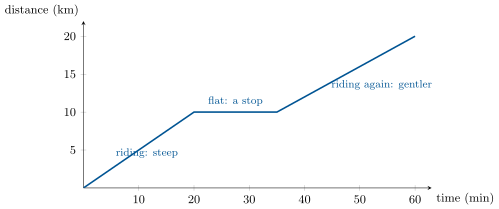
Plot distance covered against time, and motion writes its autobiography:
- uniform motion draws a straight line — equal distances in equal times, step after step;
- the steeper the line, the faster the motion: steepness is speed made visible;
- a flat stretch is a stop: time passes, distance stands.
Bends tell of change: curving upward, speeding up; flattening, slowing down.
Method 52.5 (Reading a distance–time graph)
- check the axes and their units first — minutes or hours, metres or kilometres;
- split the line at its bends into stretches; label each: straight-and-steep, straight-and-gentle, flat;
- for any straight stretch, read off its rise and its run — distance gained, time taken — and divide: the stretch’s speed;
- for the whole story, read total distance at the final time — and remember the flat stretches are part of the total time.
Example 52.6 (The courier, decoded)
Apply the method to the figure. First stretch: in minutes — a third of an hour — so . Second: flat from minute to — a delivery stop. Third: in minutes, a shade under . Total: in one hour — which hands us the chapter’s next idea on a plate.
52.3 Average speed — and its famous trap
Definition 52.7 (Average speed)
The average speed of a whole journey is the total distance divided by the total time — stops included:
It is the one steady pace that would have covered the same road in the same overall time — the courier’s in one hour: average , though the wheels never once turned at that speed.
Proposition 52.8 (The trap)
The average speed of a journey is not, in general, the midpoint of its speeds. Slow stretches eat more time than fast ones, so they weigh more heavily in the average. Only the full recipe — total distance over total time — is trustworthy; averaging the speed numbers themselves is the most seductive wrong move in the chapter.
Example 52.9 (The trap, sprung)
A cyclist rides out at , and the same home at . “Average: ”? Check honestly. Out: hours. Home: hours. Whole journey: in hours — . The slow half claimed three hours of the five, and dragged the average below the midpoint. The faster you go on one half, the less time that half even exists.
Remark 52.10 (What the speedometer knows)
Average speed describes a whole journey; the speedometer needle answers a different question — how fast right now. On the graph, “right now” lives in the line’s steepness at a single point — easy to see on a straight stretch, subtle where the line curves. Making “steepness at a point” precise is one of mathematics’ greatest inventions, and it waits for you at the end of high school. Until then: straight stretches get numbers, curves get stories.
52.4 Exercises
Exercise 52.1 ★
Write the speed formula and its two everyday units. Which recipe finds a distance? A time?
Exercise 52.2 ★
A ferry covers in hours; a hare runs in . Compute both speeds, each in its natural unit.
Solution
Solution of Exercise 52.2.
Ferry: . Hare: .
Exercise 52.3 ★
Convert, with the exchange rate: to ; to .
Solution
Solution of Exercise 52.3.
; .
Exercise 52.4 ★
State the three graph laws. What does a bend that flattens gradually tell?
Solution
Solution of Exercise 52.4.
Straight line: uniform motion; steeper: faster; flat: stopped. A gradually flattening bend tells of slowing down.
Exercise 52.5 ★
On the courier’s graph: between which minutes is the pace gentlest (but not zero)? How can you tell without computing?
Solution
Solution of Exercise 52.5.
From minute to — the third stretch: it is the least steep of the rising stretches, read directly from its gentler slant.
Exercise 52.6 ★
A walker’s graph shows a straight line through the points ( min, ) and ( min, ). Uniform or varied? Speed in ?
Solution
Solution of Exercise 52.6.
Uniform — one straight line. It gains each half hour: .
Exercise 52.7 ★
Define average speed. A hike: in hours including a one-hour picnic. Average speed — and average speed while walking?
Solution
Solution of Exercise 52.7.
Total distance over total time, stops included. Whole hike: . Walking only: .
Exercise 52.8 ★★
Why is a slow stretch “heavier” in an average than a fast one of equal length? Answer with time, not with formulas.
Solution
Solution of Exercise 52.8.
Over equal distances, the slow stretch simply lasts longer — more of the journey’s clock is spent living at the slow pace, so the slow pace speaks with more of the journey’s voice.
Exercise 52.9 ★★
Replay the trap: out at , back at . Predicted midpoint, honest average — and which half of the journey owned most of the clock?
Exercise 52.10 ★★
Sketch (or describe precisely) the graph of this trip: uniform for half an hour; stopped for a quarter hour; uniform for a quarter hour. Then compute the trip’s average speed.
Solution
Solution of Exercise 52.10.
Graph: straight to (, ); flat to min; straight and steeper to (, ). Average: in one hour — .
Exercise 52.11 ★★
Storm-counting, upgraded: thunder arrives after the flash. With sound at , use for the storm’s distance — and check the old “divide by three for kilometres” rule against your formula.
Solution
Solution of Exercise 52.11.
— about . The old rule: kilometres — agreeing, because means very nearly a kilometre every three seconds.
Exercise 52.12 ★★★
An old chestnut, worth every minute: a driver covers the first half of the distance of a trip at and wants an overall average of . Show — with the total-distance-over-total-time recipe on a trip — that the second half would have to be covered in zero time: the wish is impossible, not merely difficult.
52.5 Problem: The Courier’s Friday
Problem 52.1
Weekend problem — one bicycle courier, one city Friday; the dispatcher’s graph, the trap in the bonus sheet
The dispatcher records courier Lena’s Friday on a distance–time graph and settles her pay from it. You audit the sheet.
Part I — The morning, from the graph. The graph shows: a straight climb from ( min, ) to ( min, ); flat until min; straight from there to ( min, ); flat until min.
- Tell the morning’s story in words: stretches, stops, and what the stops presumably were.
- Speed on the first stretch, in ?
- Speed on the second riding stretch?
- Lena’s average speed over the whole -minute morning, stops included?
Part II — The afternoon, from the formula.
- Afternoon leg one: at a steady . How long did it take, in minutes?
- Leg two: a delivery uptown, at . How many kilometres?
- Leg three: the long ride to the depot, , done in minutes. Steady-pace speed in ?
- Total afternoon: add the distances and the times (legs only, no breaks): what average speed did the wheels keep while rolling?
Part III — The bonus sheet’s trap. The bonus rule: “average speed over a full tour above earns the fast-rider bonus.”
- Lena’s full Friday: in hours (all stops included). Does she earn the bonus?
- Her colleague Max claims it: “I rode half my tour at and half at — that averages !” The dispatcher checks: both halves were . Compute Max’s true average and rule on his bonus.
- Explain to Max, in time-language, where his went wrong.
- Lena proposes a fairer bonus rule for couriers — one that does not punish delivery stops. Suggest one (the graph knows how), and say which speed it measures.
Part IV — The dispatcher’s lesson.
- Friday review: write the dispatcher’s three sentences — what a straight stretch, a flat stretch, and a steeper stretch each mean on the graph — and the one warning about averaging speeds.
Solution
Solution of Problem 52.1.
1. A brisk ride ( min), a -minute stop (delivery), a gentler ride ( min), and a second -minute stop — two runs, two calls. 2. in half an hour: . 3. in half an hour: . 4. in hours: . 5. hours: minutes. 6. minutes is a third of an hour: . 7. minutes is hours; . 8. Distances: ; times: minutes hours; rolling average: . 9. — far below : no bonus (her stops are honest work, but the rule counts them). 10. Max: fast half h; slow half h; total in h: exactly — not above : no bonus. 11. His averaged the two numbers, as if each pace owned half the clock. In truth the slow half owned of his hours — two thirds of the journey’s voice — and dragged the true average down to . 12. For example: pay the bonus on rolling average speed — total distance divided by riding time only, the flat stretches of the graph excluded. It measures the pace the wheels actually keep, rewarding fast riding rather than skipped deliveries. 13. “A straight stretch is a steady pace; a flat stretch is a stop with the clock still running; a steeper stretch is a faster pace — steepness is speed. And never average speed numbers: average the journey — total distance over total time — or the slow hours will make a fool of the sheet.”