Primary & Middle School Physics · Grades 1–9
35Speed: Distance and Time
“I’m faster!” — “No, I am!” Every playground settles this the honest way: line up, ready, set, go. But how do you compare a cyclist with a runner who raced yesterday, on another road? Speed is how physics settles races that can never be run side by side.
35.1 Two ways to win a race
Proposition 35.1 (The fair race rules)
Two honest ways to compare fast and slow:
- over the same distance, the faster one needs less time — first across the line wins the sprint;
- in the same time, the faster one covers more distance — after one minute, the faster swimmer is simply farther.
Same distance or same time: fix one, compare the other. Comparing with both different — “I ran farther!” “But you ran all afternoon!” — decides nothing.
Example 35.2 (Unfair and fair)
Lena cycled ; Marco cycled . Is Marco faster? No way to tell — perhaps he rode three times as long. But if both rode for exactly one hour, the comparison turns fair: same time, more distance, Marco is faster. That little “in one hour” is about to become our favorite phrase.
35.2 Speed: the distance in one hour
Definition 35.3 (Speed)
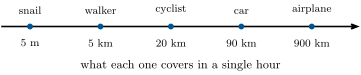
The speed of a steady traveler is the distance it covers in one fixed helping of time — usually one hour. “This car travels kilometres in each hour” names its speed; a brisk walker manages about kilometres in each hour, a racing cyclist . For crawlers we use friendlier helpings: a snail covers about metres in each hour.
Method 35.4 (Measuring your own speed)
- Measure or find a stretch of exactly (many sports tracks mark one);
- walk it at your natural pace while a friend times you — suppose it takes one minute;
- one hour holds of those minutes, so in an hour you would cover ;
- said in kilometres: your walking speed is kilometres in each hour.
Repeat at a run and compare — most children roughly double.
35.3 Predicting distances
Proposition 35.5 (Distance from speed)
A steady traveler covers its one-hour distance again in every further hour. So:
A car doing kilometres each hour covers, in hours, .
Example 35.6 (Journey sums)
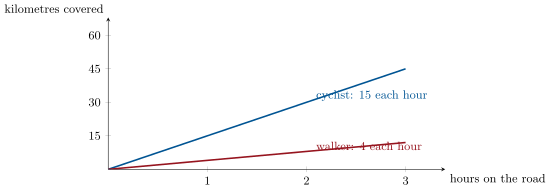
The walker at kilometres each hour, out for hours: . The cyclist at kilometres each hour, riding hours: . The airliner at kilometres each hour, flying hours: — a continent crossed between two meals.
Remark 35.7 (Steady is a simplification)
Real travelers are rarely steady: the car slows in villages, the cyclist flies downhill and toils up, you dawdle past the bakery. Our sums pretend the whole journey runs at one faithful pace — a useful pretense, good enough for planning. How to be honest about a journey of many paces — and what “average” really means — is a story for a later year, once you own the right mathematics.
Example 35.8 (Reading speeds around you)
Road signs and car dashboards speak in kilometres-per-one-hour — the round sign saying tells drivers: cover at most kilometres in each hour, a pace chosen so that a child chasing a ball can still be spared. The high-speed train’s screen may boast ; walkers’ signposts in the mountains prefer hours over kilometres — “lake: 2 h” — trusting the walker to know their own speed.
35.4 Exercises
Exercise 35.1 ★
State the two fair ways to compare fast and slow. Why does “I ran farther than you” alone prove nothing?
Solution
Solution of Exercise 35.1.
Same distance — less time wins; same time — more distance wins. “I ran farther” fixes neither: with unequal times, more distance proves nothing about being fast.
Exercise 35.2 ★
Two swimmers cross the same pool; Ana needs seconds, Bo needs . Who is faster, and by which fair-race rule?
Solution
Solution of Exercise 35.2.
Bo — same distance (one pool), less time ( seconds): rule one.
Exercise 35.3 ★
After one hour, a tractor has covered and a scooter . Who is faster, and by which rule?
Solution
Solution of Exercise 35.3.
The scooter — same time (one hour), more distance ( kilometres): rule two.
Exercise 35.4 ★
What does “this train travels kilometres in each hour” mean? How far does it get in hours? In half an hour?
Solution
Solution of Exercise 35.4.
In every hour it covers . In hours: . In half an hour: half of , so .
Exercise 35.5 ★
Rank by speed: a walker ( kilometres each hour); a pigeon ( kilometres each hour); a snail ( metres each hour); a city bus ( kilometres each hour).
Solution
Solution of Exercise 35.5.
Snail ( metres each hour), walker ( kilometres), city bus (), pigeon ( kilometres each hour).
Exercise 35.6 ★
You stroll a marked in minutes. How many metres would you cover in an hour at that pace? Say your speed in kilometres in each hour.
Solution
Solution of Exercise 35.6.
An hour holds helpings of minutes: — a speed of kilometres in each hour.
Exercise 35.7 ★
A car keeps a steady kilometres each hour for hours. How far does it travel? And a cyclist at kilometres each hour for the same hours?
Solution
Solution of Exercise 35.7.
The car: . The cyclist: .
Exercise 35.8 ★
On the journey graph of the chapter, how do you spot the faster traveler at a glance? Read from it: how far has the cyclist gone after hours?
Solution
Solution of Exercise 35.8.
The faster traveler’s line climbs more steeply. After hours the cyclist’s line stands at .
Exercise 35.9 ★★
A ferry covers kilometres in each hour. The crossing is . Using Proposition 35.5 backwards — try hours one by one — how long does the crossing take?
Exercise 35.10 ★★
Two towns are apart. Mara cycles from one at kilometres each hour; at the same moment Jon cycles from the other toward her at kilometres each hour. How many kilometres does the gap between them shrink each hour? After how many hours do they meet?
Solution
Solution of Exercise 35.10.
Each hour Mara closes and Jon : the gap shrinks by each hour. From , it reaches zero after hours — they meet, from Mara’s town.
Exercise 35.11 ★★
The old fable, with numbers: the race is long. The hare runs metres in each minute — but after one minute of running it stops for a -minute nap, then runs on. The tortoise plods metres in each minute and never stops. Where is the hare when it starts its nap? At what time does each cross the finish line? Who wins?
Solution
Solution of Exercise 35.11.
After its one running minute the hare stands at — halfway — and falls asleep. The tortoise needs minutes and finishes at time . The hare wakes at time , runs its last in one minute, and finishes at time . The tortoise wins by minutes — steady beats speedy, now with arithmetic.