Primary & Middle School Physics · Grades 1–9
24Weight and Mass
Astronauts on the Moon bounced like children on a trampoline, though they carried heavy packs. Were their packs heavy or light up there? To answer properly, we must split an everyday word in two: what a thing is made of — its mass — and how hard the Earth pulls on it — its weight. They are close cousins, but not twins.
24.1 Two ideas hiding in “heavy”
You know mass: how much stuff, in grams and kilograms, judged by the balance scale. And you know the Earth’s pull: the no-touch force that brings every dropped thing down. Weight is where the two meet.
Definition 24.1 (Weight)
The weight of a thing is the force with which the Earth pulls it downward. Weight is what your arm fights when you hold a bucket, and what stretches the spring when the bucket hangs from it. Like every force, weight has a direction: straight down, always.
Proposition 24.2 (More stuff, stronger pull)
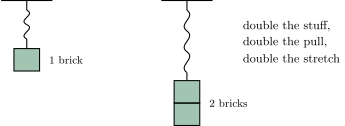
The Earth pulls harder on things that contain more stuff: at the same place, more mass always means more weight — two identical bricks weigh twice what one does. That is why the balance scale, which compares the pulls on its two pans, manages to compare masses: at one place, equal pulls mean equal stuff.
Example 24.3 (Cousins, not twins)
Mass answers: how much stuff? It is a property of the thing alone — the same in your hand, underwater, or on the Moon. Weight answers: how hard is it pulled down here? It depends on the thing and on where it is. Change nothing but the place, and the mass stays; the weight can change.
24.2 The spring scale
Definition 24.4 (Spring scale)
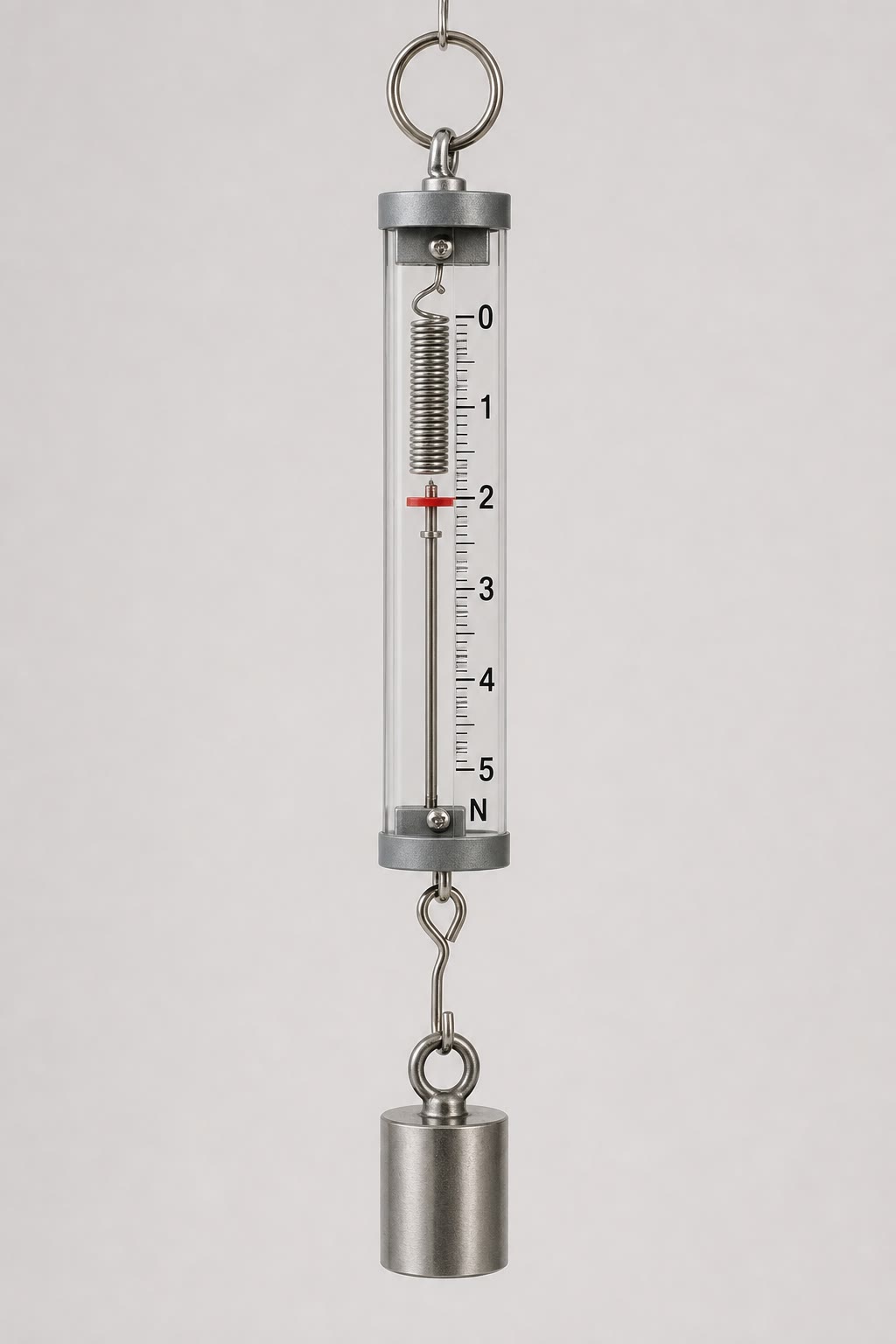
A spring scale measures weight by letting it stretch a spring: the harder the pull, the longer the stretch. A pointer beside the stretched spring shows the reading. Fishermen’s scales, luggage scales and the kitchen scale’s insides all work this way — they feel the pull, not the stuff.
Method 24.5 (A rubber-band scale)
Build a weight-feeler of your own:
- hang a rubber band from a hook, with a light paper cup taped to its bottom;
- with the cup empty, mark where the cup’s rim stands and measure nothing yet: this is the zero mark;
- load the cup — marbles, say — and measure with your ruler how far the rim sank below the zero mark;
- load marbles and measure again.
Twice the marbles, about twice the stretch: your rubber band confirms the proposition — more stuff, stronger pull.
24.3 A trip to the Moon
Example 24.6 (The Moon is a weaker puller)
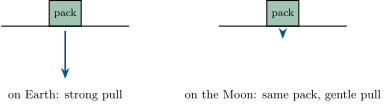
The Moon is much smaller than the Earth, and it pulls things far more weakly — about six times more weakly. An astronaut’s pack keeps every gram of its mass on the trip, but its weight up there shrinks to a sixth. That is the whole secret of the bouncing: legs trained to fight Earth-pull suddenly fight a gentle Moon-pull, and every step becomes a leap.
Example 24.7 (Two scales on the Moon)
Take both scales to the Moon and weigh the same pack. The spring scale tells the truth about the place: it reads six times less — the pull really is weaker. The balance scale notices nothing: the Moon pulls the pack and the reference blocks weakly alike, the pans still tie, and it reports the same mass as on Earth. Springs feel the place; balances compare the stuff.
Remark 24.8 (Everyday words, physics words)
In the shop, “the melon weighs one kilogram” is harmless talk — on Earth, mass and weight travel everywhere together, so nobody is confused. Physics splits the words because it plans farther than the shop: for astronauts, for falling things, and — in a later year — for measuring forces in their own proper unit, which will be named after the scientist who first wrote the law of the Earth’s pull.
24.4 Exercises
Exercise 24.1 ★
What question does mass answer? What question does weight answer? Which one is a force?
Exercise 24.2 ★
Which way does weight always pull? What instrument feels weight by stretching?
Solution
Solution of Exercise 24.2.
Straight down, always. The spring scale — weight stretches its spring, and the pointer reports the stretch.
Exercise 24.3 ★
One brick stretches the spring scale’s spring by two finger-widths. How far will two identical bricks stretch it? Which proposition says so?
Solution
Solution of Exercise 24.3.
About four finger-widths — double the stuff, double the pull, double the stretch: the proposition “more stuff, stronger pull”.
Exercise 24.4 ★
In the rubber-band scale of Method 24.5, why must you mark the empty cup’s position before loading it?
Exercise 24.5 ★
An astronaut carries a pack of of stuff to the Moon. Up there, is its mass still ? Is it as hard to hold up as on Earth?
Exercise 24.6 ★
Why could the astronauts leap so high on the Moon, in spite of their heavy packs?
Solution
Solution of Exercise 24.6.
Their legs push as hard as Earth-trained legs always do, but the Moon’s pull-back is six times weaker — so every ordinary step turns into a leap.
Exercise 24.7 ★
On the Moon, which scale changes its report — the spring scale or the balance scale? Explain what each one really compares or feels.
Solution
Solution of Exercise 24.7.
The spring scale: it feels the local pull, and reads six times less. The balance scale compares the pack’s pull with the blocks’ pull, and the Moon weakens both alike — the pans still tie at the same mass.
Exercise 24.8 ★
True or not: “A thing with no stuff at all would have no weight anywhere.” Defend your answer with Proposition 24.2.
Exercise 24.9 ★
The greengrocer’s hanging scale dips as she loads apples into its pan. Which of the two cousins is her scale feeling? Why does her trick still sell fair kilograms of apples — on Earth?
Exercise 24.10 ★★
A space agency must check that a probe’s parts have exactly the right masses — but the finished probe will work near a small far planet whose pull is feeble. An engineer worries: “Our Earth weighings will all be wrong out there!” Reassure him: which measurements travel unchanged, and which instrument made them?
Solution
Solution of Exercise 24.10.
Mass measurements travel unchanged: they describe the stuff itself, not the place. Any weighing done by comparison — the balance scale against reference blocks — reports mass and remains exactly right near the far planet. Only spring-style readings of weight will shrink out there, and those were never what the parts list recorded.
Exercise 24.11 ★★
Deep in space, far from Earth, Moon and Sun alike, an astronaut lets go of a wrench: it floats beside her hand, weightless. Has the wrench lost its mass? Give two everyday-style clues she could still notice showing the stuff is all there. (Hint: try to shake it, or to throw it.)
Solution
Solution of Exercise 24.11.
The mass is all there. Clues: shaking the wrench still takes real effort — her hand feels the stuff resisting the back-and-forth; and thrown, it flies off no faster than her muscles can manage — a hammer of stuff is still a hammer to throw. Weight is gone; stuff, never.