Primary & Middle School Physics · Grades 1–9
67Alternating Current
Every circuit you have ever built ran on a battery: current marching steadily from to , dutiful as a clock’s hand. But the sockets in your walls deliver something wilder — a current that reverses direction a hundred times each second, its voltage swinging ceaselessly between plus and minus. Meet the alternating current: the form in which virtually all the world’s electricity is born, shipped and delivered.
67.1 Two kinds of current
Definition 67.1 (Direct and alternating current)
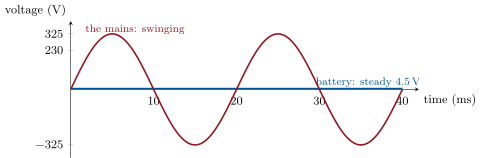
A direct current (DC) flows always in the same direction, driven by a steady voltage — the battery’s gift, constant until the store runs down. An alternating current (AC) reverses direction periodically, driven by a voltage that swings smoothly from positive to negative and back, over and over — the socket’s regime, and the alternator’s (next chapter tells whose).
Definition 67.2 (Period and frequency)
The period of an alternating voltage is the duration of one complete cycle — one full swing up, down and back, in seconds. Its frequency is the number of cycles per second, in hertz — sound’s unit, serving again — and the two are each other’s reciprocals:
Proposition 67.3 (The mains’ vital statistics)
Across most of the world the mains alternates at — fifty full cycles per second, a period of : twenty milliseconds per swing (some regions run at sixty). The current in your reading lamp’s cord reverses direction a hundred times each second — twice per cycle — and has never once marched steadily from one terminal to the other.
Example 67.4 (Frequency arithmetic)
The reciprocal pair computes both ways. A generator cycling at : — seventeen milliseconds. An oscilloscope shows a cycle lasting : . A bicycle dynamo at slow pedaling makes : period a tenth of a second — and its lamp visibly flickers, ten pulses to the second, until speed smooths them beyond the eye’s noticing.
67.2 Reading the swing
Method 67.5 (Reading an oscilloscope trace)
The oscilloscope — or any analyzer app — draws voltage against time on a squared screen; each square’s worth in volts and in milliseconds is set by two dials. To harvest a trace:
- count squares for one full cycle and multiply by the time-per-square: that is ; then ;
- count squares from the middle line to a crest and multiply by the volts-per-square: the peak voltage ;
- check the shape: mains and alternators draw the smooth, endlessly repeated wave of the figure — the sinusoid, mathematics’ name for the perfect swing.
Proposition 67.6 (Effective voltage)
What is “the” voltage of a swing that visits every value from to a hundred times a second? The honest single number is the effective voltage : the steady DC voltage that would heat a resistor equally well. For the sinusoid it sits well below the crest — is about times — and it is what every AC voltmeter is built to read. The famous “” of the socket is the effective value; the crests actually reach about , fifty times a second, each way.
Example 67.7 (Which devices care)
The heating effect works fine either way — a filament or kettle coil warms regardless of the march’s direction, which is why lamps and heaters drink AC without complaint. But electronics — phones, laptops, anything with chips — need steady DC: their charger bricks and hidden power supplies convert the socket’s swing into a battery-like constancy (feel the brick’s warmth: conversion pays its tax). And the battery world cannot charge on a swing either: charging is chemistry run backward, and chemistry insists on a consistent direction.
Remark 67.8 (Why the world chose the swing)
If batteries are so agreeably steady, why is civilization wired for AC? Two reasons, both waiting two chapters ahead: alternating current is what spinning machines naturally make — and, decisively, only AC feeds the transformer, the humble humming box that lets electricity travel a country at colossal voltage and enter your home at a tame one. The grid is alternating because the journey demands it; the next two chapters follow the current from spinning coil to kitchen wall.
Remark 67.9 (The swing and the body)
Safety’s old arithmetic gains one grim detail: the mains’ fifty swings a second lie near the rhythm that most easily disrupts the heart’s own electrical timing — alternating shocks are, ampere for ampere, more dangerous than steady ones. Every childhood rule stands, doubled: the socket’s effective — at crest — is not merely a bigger battery. It is a different, less forgiving animal.
67.3 Exercises
Exercise 67.1 ★
Distinguish DC from AC in one sentence each, with each one’s household source.
Exercise 67.2 ★
Define period and frequency and write their reciprocal relation. Compute for and for .
Solution
Solution of Exercise 67.2.
: the duration of one full cycle; : cycles per second; and . For : . For : .
Exercise 67.3 ★
How many times per second does the mains current reverse direction at ? (Careful: reversals per cycle.)
Solution
Solution of Exercise 67.3.
A hundred times: two reversals in every one of the fifty cycles.
Exercise 67.4 ★
A scope shows one cycle spanning squares at per square. Find and .
Solution
Solution of Exercise 67.4.
; .
Exercise 67.5 ★
The socket says ; the crest reaches . Name the two values and the meaning of the smaller one.
Solution
Solution of Exercise 67.5.
is the effective voltage — the steady DC value that would heat equally well, and what AC voltmeters read; is the peak, the crest the swing actually touches, each way, fifty times a second.
Exercise 67.6 ★
Why do kettles accept AC happily while phone chargers must convert it? One effect, one chemistry.
Solution
Solution of Exercise 67.6.
Heating cares nothing for direction — the coil warms on any march, so kettles drink the swing directly. Charging is chemistry run backward, and chemistry demands one consistent direction: the brick converts the swing to steadiness first.
Exercise 67.7 ★
Sketch (or describe) the two traces: a battery, and an alternating voltage of period and peak . What single instrument-drawn feature tells them apart at a glance?
Solution
Solution of Exercise 67.7.
The battery: a flat line at . The alternating supply: a smooth wave swinging between and , one cycle per . The glance-test: flat against wavy.
Exercise 67.8 ★
Give the two reasons civilization wired itself for AC, as previewed by the chapter.
Solution
Solution of Exercise 67.8.
Spinning machines make AC naturally; and only AC feeds the transformer, without which electricity could not travel the country at high voltage and enter homes at a tame one.
Exercise 67.9 ★★
A slow bicycle dynamo lights its lamp with visible flicker; pedaling harder steadies the glow. Explain both regimes with frequency — and estimate the frequency below which flicker annoys, given that cinema fools the eye at about pictures per second.
Solution
Solution of Exercise 67.9.
At low pedaling the dynamo’s few cycles per second pulse the lamp visibly — each crest a flash, each zero a dip; faster pedaling multiplies the pulses until the eye fuses them. Cinema’s pictures set the eye’s rough fusion rate: below about of light-pulses, flicker annoys; above, the glow reads steady.
Exercise 67.10 ★★
An AC voltmeter across a socket reads . A (theoretical) fearless oscilloscope across the same socket shows crests at what value — and how many crests per second, counting both signs?
Solution
Solution of Exercise 67.10.
Crests at about — and a hundred of them per second, fifty positive and fifty negative.
Exercise 67.11 ★★
A region’s grid runs at with effective . Compute its period and approximate peak voltage — and name which of your travel devices would object (consult Example 67.7; modern chargers read the fine print on their labels).
Solution
Solution of Exercise 67.11.
; peak . Heaters and lamps adjust indifferently; modern chargers read “100–240 V, 50/60 Hz” on their labels and convert happily — the objectors are old single-voltage devices, and any motorized clock that counts the grid’s cycles: it would run fast on sixty.
Exercise 67.12 ★★★
Old films of screens and fluorescent lamps sometimes show dark rolling bars — the camera’s frames catching the lamp’s brightness mid-swing. A mains lamp at brightens at every crest of either sign: how many brightness pulses per second? A camera at frames per second samples that pulsing: reason out why the beat between the two rhythms paints slow-moving bars, and why filming in a region changes the pattern.
Solution
Solution of Exercise 67.12.
Brightening at both crests gives pulses per second. A -frame camera samples every — four pulses per frame, but not aligned identically at every point of the rolling exposure: the slight mismatch between the camera’s rhythm and the lamp’s paints bands that creep across successive frames — a beat between two clocks. At ( pulses), the mismatch against frames changes, and the bars change width and speed — the pattern betrays the local grid.
67.4 Problem: The Oscilloscope Bench
Problem 67.1
Weekend problem — qualification night on the oscilloscope bench; four mystery supplies, one screen; the technician’s ledger
Four unlabeled supplies must be identified from their traces. The scope’s dials: per horizontal square, per vertical square (except where noted). You keep the ledger.
Part I — The four traces.
- Supply A: a flat line, squares above the middle. Identify its kind and voltage — and its likely household identity.
- Supply B: a smooth wave, one cycle per squares, crests squares high. Kind, period, frequency, peak voltage?
- Supply C: a flat line below the middle by squares. What is it, and what tiny error explains it?
- Supply D: a smooth wave, one cycle per squares, crests squares. Full statistics — and why D’s lamp would flicker less than B’s if both fed one.
Part II — The technician’s questions.
- An AC voltmeter across supply B reads about , though its crests hit . Reconcile the two numbers.
- Which of the four supplies could charge a phone directly, and what must stand between the others and its battery?
- The bench’s warning plate: “AC bites worse, volt for volt.” Restate the reason.
- A trainee asks why the scope draws B’s wave so smoothly rounded rather than zigzag. Name the shape and its origin (what kind of machine, next chapter, draws it naturally?).
Part III — The grid’s own trace. A safely isolated demonstrator shows the mains, at and per square.
- Predict the trace: squares per cycle, and crest height in squares.
- From the trace, recover and the effective voltage — and check both against the socket’s famous label.
- The demonstrator is switched to a battery bank of equal effective heating power. Describe the new trace in one line.
- Close the ledger with the technician’s three-line summary: what the flat line means, what the wave means, and which single number lets the two be fairly compared.
Solution
Solution of Problem 67.1.
1. DC at : the flat pocket battery. 2. AC; , ; peak . 3. DC at connected backward — the leads swapped: harmless on a scope, instructive in the ledger. 4. AC; , ; peak . Its hundred-per-second doubled pulses sit beyond the eye’s fusion rate more comfortably than B’s fifty-cycle flicker. 5. The voltmeter reports the effective value — the DC-equivalent for heating — which for a sinusoid sits at about the peak divided by : . Both numbers describe one swing. 6. Supply A alone (right way round — C after re-plugging). The AC supplies need a converter — the charger’s rectifying brick — between them and any battery. 7. The mains’ fifty swings a second lie near the heart’s own electrical rhythm and can disrupt it: ampere for ampere, the swing endangers more than the steady march. 8. The sinusoid — the perfect swing, drawn naturally by a coil turning at constant speed in a magnetic field: the alternator of the next chapter. 9. One cycle per squares (); crests squares above and below. 10. ; effective — the label, recovered from the screen. 11. A flat line at — steadiness of equal heating power. 12. For example: “A flat line is a battery’s constancy — one direction, one value. A wave is the grid’s swing — direction and value in ceaseless cycle. And the fair exchange rate between them is the effective voltage: equal heat, equal worth.”