Primary & Middle School Physics · Grades 1–9
14Solids, Liquids, Gases
A stone, a glass of milk, the air in a balloon: three kinds of stuff that behave in three utterly different ways. Last year, water showed us its three states; this year we discover that everything is in one of these three states — and each state has strict rules.
14.1 Three families of stuff
All the stuff in the world can be sorted into three families, called the three states: solid like the stone, liquid like the milk, gas like the air. Ice, water and steam were our first example: one stuff visiting all three families. Now let us learn each family’s rules.
14.2 Solids keep their shape
Definition 14.1 (Solid)
A solid is stuff that keeps its own shape. A key keeps its zigzag in your pocket, in a drawer, or underwater. You can hold a solid between two fingers, and moving it does not change what it looks like. Some solids are hard (stone), some soft (bread), some bendy (a rubber band) — but left alone, each keeps its shape.
Example 14.2 (A solid made of grains)
Sand seems to break the rule: poured from a bucket, it takes the shape of its pile, almost like a liquid. But look closely: sand is a crowd of tiny solid grains, and each grain keeps its shape perfectly. Flour, sugar and rice play the same trick — crowds of little solids that flow together while each member stays solid.
14.3 Liquids flow — but keep their amount
Definition 14.3 (Liquid)
A liquid is stuff that flows: it has no shape of its own and takes the shape of whatever container holds it. But a liquid keeps its amount: pour a full glass of milk into a bowl and it is still the same amount of milk — not a drop more or less, only a new shape.
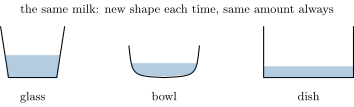
Proposition 14.4 (A resting liquid lies level)
The surface of a liquid at rest is always flat and level — parallel to the floor. Tilt the bottle: the water inside does not tilt with it; its surface stays level while the bottle leans.
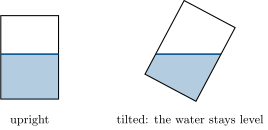
Example 14.5 (The level at work)
Builders use this law every day: their spirit level is a little window of liquid with one bubble; when the bubble sits between its marks, the shelf is as level as the liquid inside. And at breakfast, watch the juice in a tilted carton: however you tip it, the surface inside stays flat and level — until it finds the spout.
14.4 Gases fill everything
Definition 14.6 (Gas)
A gas is stuff that spreads out to fill all the room it is given. Air is a gas: put it in a bottle, it fills the bottle to every corner; open the bottle in a bigger room, and it spreads through that too. A gas has neither its own shape nor its own resting place — offer it more room, and it takes everything.
Example 14.7 (The traveling perfume)
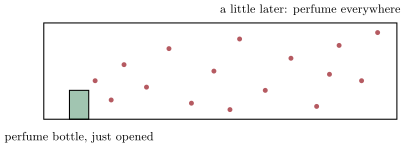
Someone opens a perfume bottle at one end of the room. A moment later, noses at the other end notice it. The perfume gas did not stay politely near its bottle: released, it spread through all the air of the room, corner to corner — exactly what the gas family always does.
Remark 14.8 (Sorting the tricky ones)
Some stuff needs a careful eye. Honey flows — slowly, but it flows, takes its container’s shape and keeps its amount: a liquid, just a lazy one. Toothpaste and ketchup flow when squeezed: thick liquids. A sponge is a solid full of air-filled holes. And smoke? Tiny solid specks riding on hot gas. When in doubt, ask the family questions: does it keep its shape? does it flow? does it fill all the room it gets?
14.5 Exercises
Exercise 14.1 ★
Sort into the three families: a coin; orange juice; the air in a tire; a wooden bead; oil; the steam-gas above the clear gap of a boiling pot.
Exercise 14.2 ★
What does a solid keep that a liquid does not? What does a liquid keep when poured from glass to bowl?
Exercise 14.3 ★
A full bottle of lemonade is poured into a wide salad bowl. Is there now more lemonade, less, or the same amount? What changed?
Solution
Solution of Exercise 14.3.
The same amount — only the shape changed, from bottle-shape to wide-bowl-shape.
Exercise 14.4 ★
Draw a fish tank half full of water: first standing flat, then tilted up on one edge. Draw the water surface in both — which way does it lie?
Solution
Solution of Exercise 14.4.
In both drawings the water surface lies flat and level, parallel to the floor — in the tilted tank the surface does not tilt with the glass; the water gathers at the low side.
Exercise 14.5 ★
How does a builder’s spirit level tell that a shelf is level? Which law of this chapter is it using?
Exercise 14.6 ★
Why does the smell of pancakes reach your bedroom upstairs? Which family is at work, and what is its rule?
Exercise 14.7 ★
Sand pours like a liquid, yet we call it solid. Explain, using Example 14.2.
Exercise 14.8 ★
Honey takes a whole minute to flow off the spoon. Solid or liquid? Ask the family questions of Remark 14.8 and answer.
Solution
Solution of Exercise 14.8.
It flows (slowly), takes its container’s shape, and keeps its amount: honey answers the questions like a liquid — a lazy one.
Exercise 14.9 ★
Which family: keeps its own shape? takes its container’s shape but keeps its amount? takes all the room it can get? Give one member of each family found in your kitchen.
Exercise 14.10 ★★
An ice cube (solid) melts into water (liquid), which the summer sun dries into invisible flying water (gas). Which family rule breaks at each step: what does the stuff stop keeping when ice melts? when water evaporates?
Solution
Solution of Exercise 14.10.
When ice melts, the stuff stops keeping its own shape (but still keeps its amount). When water evaporates, it stops keeping even its resting place: as a gas it spreads into all the room there is.
Exercise 14.11 ★★
A balloon is blown up and knotted. Mira says the air inside is “balloon-shaped, so a gas does have a shape”. Explain what is really giving the shape, and what the air would do the instant the balloon popped.