Primary & Middle School Physics · Grades 1–9
53Sound: Production and Propagation
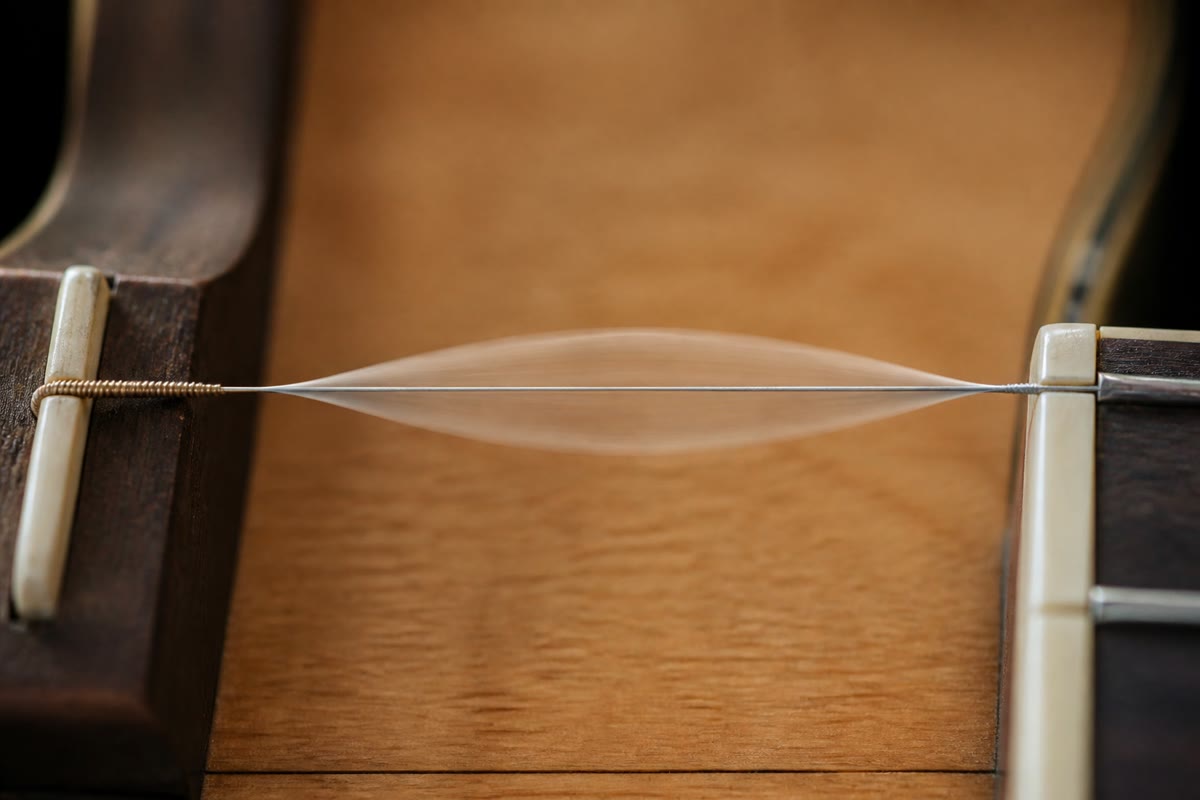
You have known since childhood that sound is born in a trembling and dies in emptiness — the rice grains danced, the bell in the jar fell silent. What you lacked was the messenger’s name. Now you own the molecular world, and sound’s whole journey — from a guitar string to your eardrum, through air, water or steel — can finally be watched from inside.
53.1 The messengers
Definition 53.1 (Medium)
A medium (plural media) is the substance a sound travels through: air, water, wood, steel — any state will serve, for all are crowds of molecules. What no sound can cross is the absence of a crowd: vacuum, the empty stage.
Proposition 53.2 (How sound travels)
A vibrating source shoves the molecules beside it; they crowd against their neighbors and rebound; the neighbors shove the next rank in turn. The shove — a traveling squeeze of the crowd — races outward from the source in every direction, molecule relaying molecule, though each molecule itself only jiggles about its place. Sound is the relay, not the runners: the message travels; the messengers stay home.
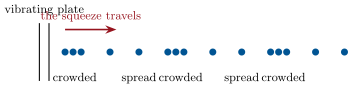
Example 53.3 (The jar, explained at last)
The famous silenced bell now confesses its mechanism. Pumping out the air removes the crowd: the bell’s trembling walls shove at nothing, no relay forms, and no message crosses the glass. The bell never stopped — it lost its messengers. And space’s great silence follows at once: between the stars there is no crowd to carry a cry.
Example 53.4 (Loud, quiet, and worn out)
A harder shove makes a stronger squeeze: louder sound. And as the relay spreads — pond-rings in three dimensions — each squeeze is shared over a vaster and vaster shell of crowd, weakening with distance: why shouts fade, and why the neighbor’s music is a murmur through two walls. Nothing of this needed new laws: crowd physics pays for everything.
53.2 Every medium has its pace
Proposition 53.5 (The speed of sound depends on the medium)
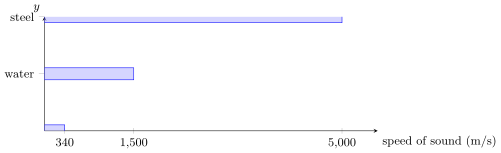
The relay’s speed is a property of the crowd:
- in air: about ;
- in water: about — four times faster;
- in steel: about — fifteen times faster than air.
The pattern: the more tightly a medium’s molecules touch, the faster they hand the shove along. Flying air molecules must first cross gaps to deliver; water’s touching crowd relays briskly; steel’s locked ranks pass the message almost hand-to-hand.
Example 53.6 (Old scenes, new numbers)
The scout’s ear on the rail: the steel relay outruns the air’s by a factor of fifteen — the rail’s warning arrives long before the rumble. Whales’ songs crossing seas: water’s swift, generous relay. And your own voice sounds strange on recordings partly because, speaking, you hear yourself through the skull’s bone-relay as well as through air — two media, two versions, and only other people ever hear the air-only one.
53.3 Sound with a stopwatch
Method 53.7 (Measuring the speed of sound)
The oldest method still works on any sports field:
- a partner stands a measured away (two field-lengths and a bit — pace it or use the field’s markings) with two pan lids;
- they clash the lids overhead: you see the strike instantly (light’s trip is as good as instant), and start the stopwatch on the flash of motion;
- stop on the arriving clang: expect very nearly ;
- compute: .
Repeat and average — reaction times scatter, as the honest measurement chapter taught. Thunder-counting is this method run backward: knowing , the silent seconds hand you the distance.
Example 53.8 (The echo, computed)
A clap toward a cliff returns in . The sound traveled to the cliff and back: , so the cliff stands at half: . The rule of every echo sum: the measured time pays for the round trip — forgetting the “and back” is the classic slip, and doubles every answer wrongly.
Example 53.9 (Sonar, in earnest)
The survey ship’s sonar clicks downward; the seabed’s echo returns in . In water, round trip: depth . Dolphins and bats run the same arithmetic by instinct; ships print it on charts. Note the discipline: the medium chooses the speed — feeding an underwater echo the air’s is the chapter’s second classic slip.
Remark 53.10 (What “fast” still is not)
Steel’s sounds heroic — until light is recalled. In the storm, the flash’s trip counts as instant while thunder jogs its kilometre in three seconds; and no medium, not steel, not diamond, brings sound within shouting distance of light’s pace. Exactly how fast light runs — and how humans finally clocked something that crosses a room in a hundred-millionth of a second — is next year’s story, with a chapter of its own.
53.4 Exercises
Exercise 53.1 ★
What is a medium? Name three, and the one “non-medium” no sound can cross.
Solution
Solution of Exercise 53.1.
The substance a sound travels through — air, water, wood, steel, any molecular crowd. The non-medium: vacuum.
Exercise 53.2 ★
In the relay picture, what travels from source to ear — and what does each individual molecule do?
Solution
Solution of Exercise 53.2.
The relay travels: a racing pattern of squeezes handed from rank to rank of the crowd. Each molecule only jiggles about its home place — the message moves, the messengers stay.
Exercise 53.3 ★
Explain the silenced bell-in-the-jar with molecules — and why films’ roaring space battles are physics fiction.
Solution
Solution of Exercise 53.3.
No crowd, no relay: the pumped-out jar leaves the bell’s trembling walls shoving at nothing, so no message forms. Space battles are silent for the same reason — explosions between the stars have no crowd to carry their roar.
Exercise 53.4 ★
Give the three speeds of the chapter’s table, and the pattern connecting a medium’s molecular arrangement to its pace.
Exercise 53.5 ★
Why does the scout’s rail-message outrun the air’s? By roughly what factor?
Solution
Solution of Exercise 53.5.
Steel’s locked ranks relay nearly hand-to-hand: about fifteen times the air’s pace, so the rail’s message arrives long before the airborne rumble.
Exercise 53.6 ★
In the field measurement, why is watching the lids’ strike as good as a starting gun at the source itself?
Exercise 53.7 ★
A clap’s echo from a warehouse wall returns in . How far is the wall? Name the slip that would answer .
Solution
Solution of Exercise 53.7.
round trip: the wall stands at . Answering forgets that the second paid for going and coming back.
Exercise 53.8 ★
A ship’s sonar echo returns in . The depth? Name the slip that would use .
Solution
Solution of Exercise 53.8.
In water: round trip — depth . The slip: borrowing the air’s for an underwater journey.
Exercise 53.9 ★★
Fireworks over the bay: you see the burst, and hear it later. How far is the shell? Why is the same computation useless for judging the distance of a jet you can hear but not see?
Solution
Solution of Exercise 53.9.
. The firework’s flash gave a true starting gun; the unseen jet offers none — no moment of emission to time from — and worse, the heard roar left the jet seconds ago: the ear points at where the jet was.
Exercise 53.10 ★★
A swimmer with one ear underwater hears the pool’s underwater speaker before a friend on the deck hears it through air — though the friend stands nearer. Reconcile with the table.
Exercise 53.11 ★★
Old railway lore: put your ear to the rail and you hear the train twice. Explain the two arrivals, and compute the gap for a train away (steel at , air at — one decimal is enough).
Exercise 53.12 ★★★
Design a measurement of the speed of sound in water for a calm lake, using a waterproof clacker, a hydrophone (an underwater microphone) away, and a recorder that also captures the clacker’s airborne clap through a normal microphone beside it. Explain how comparing the two recorded arrival times yields water’s speed — and compute the expected gap between the two arrivals.
Solution
Solution of Exercise 53.12.
One clack sends the same instant into both media; at the recorder captures the water arrival (on the hydrophone) and the air arrival (on the microphone). Expected times: water , air — a gap of about . Run backward: with and the air speed known, the measured gap gives the water arrival time (), and — water’s pace measured without ever timing the silent clack itself.
53.5 Problem: The Canyon Survey
Problem 53.1
Weekend problem — mapping the silent canyon by ear; echoes, rails and river depths; the surveyor’s toolkit
A survey team maps a remote canyon with stopwatches, one sonar unit, and the physics of this chapter. Speeds: air , water , steel .
Part I — Widths by echo.
- From the eastern rim, a clap’s echo off the western wall returns in . How wide is the canyon here?
- At a narrower point, the echo returns in . The width?
- A surveyor standing between two parallel walls claps once and hears two distinct echoes: after and after . How far is each wall, and how wide is the canyon on this line?
- Why does the biggest measurement error in Part I come from the stopwatch hand, not the formula? (Cite the wisdom of the repeated-measurement rule.)
Part II — The river below.
- The sonar unit, floated on the river, pings the bottom: echo in . The river’s depth?
- The same unit pinged sideways toward a submerged boulder returns an echo in . Distance to the boulder?
- A teammate suggests saving batteries: “shout from the boat and time the bottom echo by ear.” Two physical reasons this fails where the sonar succeeds. (Think of the border between media, and of what a shout’s air relay must do at the surface.)
- The riverbed drops sharply mid-channel: predict what the sonar’s echo time does as the boat drifts across the drop.
Part III — The old mining rail. A straight abandoned rail runs along the canyon floor to the mine gate.
- A hammer blow on the rail at the gate: compute the two arrival times at the surveyors’ end — through steel, and through air.
- The team hears rail-clang and air-boom separated by that gap. Explain how the gap alone could measure the distance to the gate if the were unknown (describe the reasoning; the computation is Part III’s gift to the keen).
- Fog fills the canyon overnight — useless for lamps and mirrors. Which of the team’s three measuring channels (air-sound, water-sound, rail-sound) does fog disturb least, and why?
- Write the surveyor’s log: three sentences — the round-trip rule, the medium-chooses-the-speed rule, and which single instrument (eye or ear) started every timing in the canyon, and why it may be trusted as “instant”.
Solution
Solution of Problem 53.1.
1. round trip: width . 2. ; half: . 3. First wall: ; second: ; the canyon spans along that line. 4. The formula is exact; the hand is not: human starting and stopping scatters by tenths of a second — tens of metres at . Hence the old rule: repeat, watch the readings huddle, report the huddle. 5. round trip: depth . 6. . 7. At the air–water border most of a shout is turned back — little enters the river, and the weak bottom echo must cross the border again to reach an ear in air: almost nothing survives. And even granting the echo, round trips of tenths of a second defeat any by-ear timing. 8. The echo time lengthens abruptly as the boat crosses the drop — deeper bottom, longer round trip: the sonar draws the cliff underwater. 9. Steel: ; air: . 10. Both relays start together, so the gap grows in proportion to the distance: each kilometre adds a fixed extra delay to the slow relay over the fast one. Measure the gap, divide by the per-kilometre difference, and the distance falls out — one hammer blow, no stopwatch at the far end needed. 11. The rail-sound: fog is a crowd of droplets that scatters light hopelessly but barely troubles a relay locked inside solid steel (air-sound too survives fog well — but the rail’s message is the cleanest and fastest of the three). 12. For example: “Every echo pays for the round trip: halve before believing. Every medium sets its own pace: choose the speed with the crowd, never by habit. And every timing in this canyon started with the eye — light’s trip counts as instant here, which is why seeing the hammer fall may serve as the starting gun.”