Primary & Middle School Physics · Grades 1–9
69From Power Plant to Home: The Alternator
A year’s worth of kilowatt-hours has flowed through your audits — but from where? Follow the cable out of the house, under the street, across the pylons, and it ends at a machine spinning in a great hall: the alternator. Its secret is the loveliest surprise in this book’s electricity: the current-makes-magnetism discovery of last year, run backward.
69.1 Induction: the effect reversed
Proposition 69.1 (Electromagnetic induction)
Move a magnet near a closed circuit — or move the circuit near the magnet — and while the motion lasts, a voltage appears and drives a current: electricity induced by changing magnetism. The rules, from the bench:
- only change induces: magnet at rest beside the coil, nothing — however strong the magnet;
- faster motion, stronger magnet, more turns of coil: bigger induced voltage;
- reverse the motion, reverse the induced current — approach and retreat drive opposite marches.
Last year a current made magnetism; this year moving magnetism makes a current. The two effects are one coin, read from its two faces — and the second face powers civilization.
Method 69.2 (Induction on the bench)
A coil of many turns, a bar magnet, a sensitive zero-centered meter:
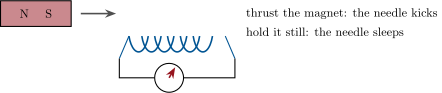
- connect the meter across the coil; hold the magnet still inside it: the needle sleeps at zero — strength alone induces nothing;
- thrust the magnet in: the needle kicks one way — and returns to zero the instant the motion stops;
- withdraw it: an equal kick, the other way;
- thrust faster: a bigger kick. Jiggle the magnet in and out rhythmically, and the needle swings left, right, left — you are hand-cranking an alternating current.
69.2 The alternator
Definition 69.3 (Alternator)
An alternator is induction made tireless: a magnet spun steadily beside a fixed coil (or a coil spun in a magnetic field). Each half-turn brings a pole toward the coil, then carries it away — change, endlessly renewed — so the induced voltage swings positive, negative, positive: alternating, by construction, tracing exactly the smooth sinusoid of the oscilloscope chapter. Spin at fifty turns a second and the output alternates at : the grid’s frequency is a rotation speed, kept in lockstep by every station on the network.
Example 69.4 (The dynamo on your wheel)
The bicycle dynamo is a pocket alternator: the wheel spins a little magnet inside a fixed coil, and the lamp lights — brighter and at higher frequency as you pedal harder, exactly as the bench rules promise (and flickering at a crawl, as the alternating chapter observed). Its price is honest too: the dynamo drags — lighting the lamp costs your legs real effort. Induction gives no energy; it converts motion into electricity, joule for joule, minus friction’s tax.
69.3 Every power plant is one machine
Proposition 69.5 (The common core)
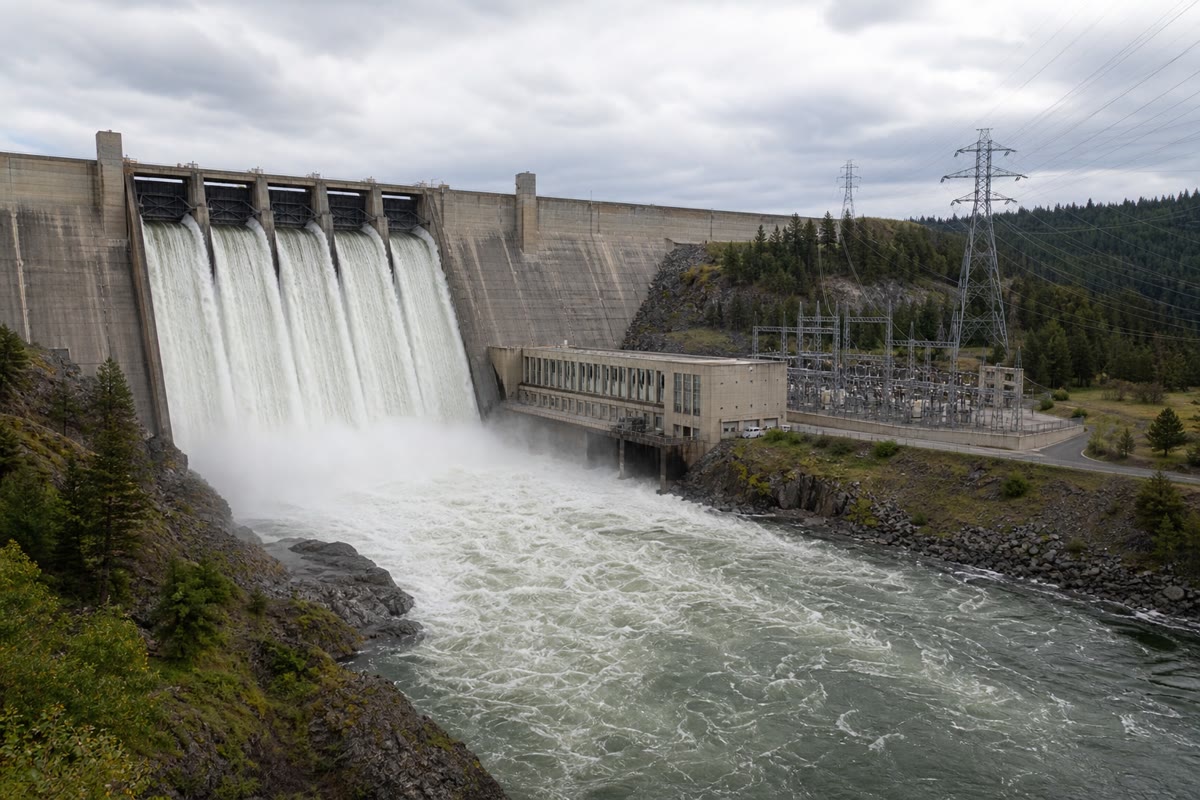
Nearly all the world’s electricity, whatever its advertisement, is made the same way: something spins a turbine — a sturdy windmill of blades — and the turbine spins an alternator. Power plants differ only in what pushes the blades:
- thermal plants boil water with burning coal or gas — steam jets drive the turbine;
- nuclear plants boil the water instead with the heat of splitting atoms — steam again;
- hydroelectric dams let a mountain lake fall through the blades — the childhood dam-chain, completed;
- wind turbines skip the middleman: the wind is the blades’ push, an alternator in every nacelle.
One exception proves the rule: solar panels make electricity with no spin at all — by a light effect belonging to the university years.

Example 69.6 (Chains, audited)
Write each plant as a childhood energy chain, now with professional vocabulary. The dam: stored height motion of falling water rotation electricity — the Sun, remember, lifted that lake by evaporation: hydro power is rain-deferred sunshine. The coal plant: chemical store heat steam’s motion rotation electricity — with warmth leaking at every arrow, as the cooling towers’ plumes confess. Wind: moving air (stirred by the Sun) straight to rotation. Sources that nature refills — water, wind, sunlight — are called renewable; the burned and split stores are spent forever on human timescales.
Remark 69.7 (Why the pylons hum at 400000 volts)
The last promise of the alternating chapter falls due. A town needs, say, a hundred million watts. By , that power can travel as an enormous current at modest voltage — or a modest current at enormous voltage. But wires heat with the current (the old heating effect), and every degree of pylon-warming is paid-for energy lost to the crows. So the grid transports at breathtaking voltages — hundreds of thousands of volts, tiny currents, minimal loss — and steps the voltage down, neighborhood by neighborhood, to the tame of your wall. The stepping machine, the transformer, is two coils and induction once more — and it works only on current that alternates: the whole grid speaks AC because the transformer does.
69.4 Exercises
Exercise 69.1 ★
State the three bench rules of induction. What does a strong magnet at rest induce?
Exercise 69.2 ★
Why does an alternator’s output alternate? Tie the sign changes to the rotation.
Solution
Solution of Exercise 69.2.
Each half-turn of the rotor brings a pole toward the coil (inducing one way), then carries it off (inducing the other): the voltage must swing sign with every half-rotation — alternation is built into the spinning.
Exercise 69.3 ★
At what rotation speed does an alternator feed a grid? What must every station on the network therefore agree on?
Solution
Solution of Exercise 69.3.
Fifty turns per second (for the simple two-pole machine). Every station must hold exactly the same rotation rhythm — the whole network spins in lockstep, sharing one frequency.
Exercise 69.4 ★
Name the two universal boxes of every power plant, and the one box that changes between coal, atom, dam and wind.
Solution
Solution of Exercise 69.4.
The turbine and the alternator. Only the pusher of the blades changes: flame’s steam, atom’s steam, falling lake, or wind.
Exercise 69.5 ★
Write the hydroelectric chain from mountain lake to your lamp — and name the celestial machine that filled the lake.
Solution
Solution of Exercise 69.5.
Lake’s stored height falling water’s motion turbine’s rotation alternator’s electricity transformer and grid lamp. The Sun filled the lake: evaporation lifted the sea, rain delivered it to the mountains.
Exercise 69.6 ★
Why does pedaling grow harder the instant the dynamo’s lamp switches on? Which principle forbids it being otherwise?
Exercise 69.7 ★
Sort into renewable and not: wind; coal; the dam’s lake; uranium; sunlight. What defines the sorting?
Exercise 69.8 ★
Why does the grid ship its power at hundreds of thousands of volts? Name the formula that offers the choice and the effect that decides it.
Solution
Solution of Exercise 69.8.
lets one power travel as high voltage with small current; the heating effect makes the wires’ loss grow with the current. Small current, cool wires, saved energy — so the grid ships high and steps down at the doorstep.
Exercise 69.9 ★★
A demonstration alternator hand-cranked slowly lights its lamp faintly with visible flicker; cranked fast, brightly and steadily. Account for both changes with the bench rules and the frequency chapter.
Exercise 69.10 ★★
A plant delivers . Compare the currents needed at and at (scientific notation). Which could real cables carry?
Solution
Solution of Exercise 69.10.
At : — four hundred thousand amperes: no cable on Earth. At : — ordinary transmission cable. The transformer’s case, closed.
Exercise 69.11 ★★
Thermal and nuclear plants are, at heart, elaborate kettles. Defend this slogan with their chains — and locate the one link where the two differ.
Exercise 69.12 ★★★
The grand tour, run backward: tonight your lamp glows at . Trace its energy upstream through every box — transformer, pylons, alternator, turbine, and one primary store of your choosing — naming the energy form at each stage and the leaks along the way. Then answer the childhood question with a year-nine sentence: where does the light in your room ultimately come from?
Solution
Solution of Exercise 69.12.
Upstream: the wall’s came through the neighborhood transformer (voltage stepped down), along pylons at hundreds of kilovolts (transport form: high-voltage AC, leaking a little warmth), from an alternator (rotation to electricity, by induction), spun by a turbine (steam or water’s motion), fed by a store — say the dam’s lifted lake, lifted by the Sun’s evaporation. So the year-nine sentence: the light in your room is sunshine — stored, fallen, spun and shipped.
69.5 Problem: Night Shift at the Station
Problem 69.1
Weekend problem — night shift at the hydroelectric station; induction, lockstep and the storm; the engineer’s log
You shadow the night engineer at the valley’s dam — lake above, town below, alternators humming between.
Part I — The machine hall.
- The engineer opens a gate: water thunders through turbine three, and its alternator’s meters wake. Write the energy chain from lake to busbar.
- Inside the alternator, what moves and what stands still — and why must something move at all?
- The grid runs at . The engineer watches a dial keeping turbine three at exactly the matching rotation. What goes wrong at the wrong speed? (What would its voltage’s frequency do?)
- A trainee asks whether a stronger magnet in the rotor would give “free” extra power. Correct the dream with the dynamo’s honest price.
Part II — The town’s demand.
- At 03:00 the town draws . At the transport line’s , what current leaves the station?
- The same power at would need what current — and what does the comparison say about the transformer’s job?
- At 07:00, kettles and heaters wake: demand doubles. What must the engineer feed the turbines more of, and what would happen to the grid’s frequency if she fed too little? (The machines slow under load, like a cyclist on a hill.)
- The station’s sister plant — a wind farm on the ridge — drops out as the wind dies. Which box of its chain failed, and which boxes stood entirely healthy?
Part III — The storm.
- Lightning severs a transport line; breakers fire. The engineer reroutes power along neighboring lines. What property of the grid — one great parallel network — makes rerouting possible?
- During the scramble, a warehouse’s lights dim brown for a minute. Interpret: what sagged, and what were the warehouse’s motors and lamps briefly underfed?
- Dawn: the log must explain to the trainees why the whole night’s electricity was, at origin, sunshine. Draft the two-line explanation (lake, evaporation, rain).
- Final line of the log, by tradition: the night’s physics in one sentence — motion, magnetism, and the town’s morning kettle in it.
Solution
Solution of Problem 69.1.
1. Lake’s height water’s rushing motion turbine’s rotation alternator’s induced alternating voltage the station’s busbar. 2. The rotor magnet spins; the coils stand fixed. Without motion, no change of magnetism through the coils — and without change, induction gives nothing at all. 3. The voltage’s frequency copies the rotation: wrong speed, wrong frequency — and a machine out of step with the grid’s fights every other alternator on the network instead of helping them. 4. A stronger rotor magnet does induce more — and the turbine immediately labors harder to keep it spinning against the stiffer magnetic drag: more electricity out demands more water through, joule for joule. The lake, not the magnet, pays. 5. . 6. — eighty-seven thousand amperes: impossible cable. The transformer’s job is exactly this exchange — voltage up, current down, power unchanged. 7. More water through the gates. Underfed, the loaded machines slow like a cyclist on a hill — and the grid’s frequency sags below fifty: the network’s clocks and machines all feel a hungry grid. 8. The first box only — the wind, the blades’ push. Turbine, alternator and transformer stood perfectly healthy, becalmed. 9. The grid is one great parallel network: many roads join every station to every town, so a severed line’s share can flow by the surviving branches — parallel independence, at national scale. 10. The rerouted, overloaded lines let the delivered voltage sag below nominal for a minute: the warehouse’s lamps dimmed and its motors turned lazily — underfed, as any device below its nominal voltage must be. 11. “Tonight’s every watt came from falling lake water; the Sun evaporated the sea and the rain carried it to our mountains. We spin sunshine here — stored in a lake, by way of the sky.” 12. For example: “Motion past magnets made every volt of the night — and at seven, ten thousand kettles asked the lake to fall a little faster.”