Primary & Middle School Physics · Grades 1–9
22Conductors and Insulators
Why are electric wires made of metal — but dressed in plastic? Why does the switch’s little bridge conduct the current, while its casing keeps your fingers safe? Last year we closed loops; this year we ask which materials electricity can travel through at all. The answer sorts every material into two kinds: conductors and insulators.
22.1 The tester
Method 22.1 (Building a tester)
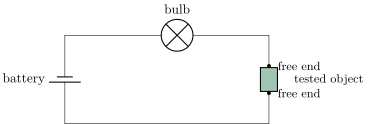
Build the loop of last year — battery, wires, bulb — but leave one deliberate gap: two free wire ends, a finger’s width apart.
- touch the two free ends together: the bulb lights — the tester works;
- bridge the gap with the object on trial, one metal end pressed firmly to each wire;
- watch the bulb: light means electricity crossed the object; darkness means it could not.
The bulb gives the answer: it lights exactly when the tested object completes the loop.
22.2 Conductors and insulators
Definition 22.2 (Conductor)
A conductor is a material that lets electricity travel through it. In the tester, a conductor bridging the gap closes the loop and lights the bulb.
Definition 22.3 (Insulator)
An insulator is a material that blocks electricity. Bridging the gap with an insulator leaves the loop as open as before: the bulb stays dark.
Example 22.4 (A morning of tests)
Results from a classroom tester: a steel paperclip — light. A coin — light. Aluminium kitchen foil — light. A key — light. A plastic ruler — dark. A wooden pencil — dark. A glass marble — dark. A rubber eraser — dark. A strip of paper — dark. The pattern jumps out: the objects that light the bulb are all made of metal.
Proposition 22.5 (Metals conduct)
All metals conduct electricity — iron, copper, aluminium, gold, every one, which is why the magnet’s fussiness about iron surprised us but the tester never will. Most other everyday solids — plastic, wood, glass, rubber, paper, wax — are insulators.
Remark 22.6 (Conductor is not magnetic)
Do not mix up the two metal talents. The magnet chooses only iron and its family; the electric current is far less picky and travels through every metal. The aluminium foil that ignored your magnet carries current beautifully — two different games, two different rules.
22.3 Conductors and insulators work together
Example 22.7 (Anatomy of a wire)
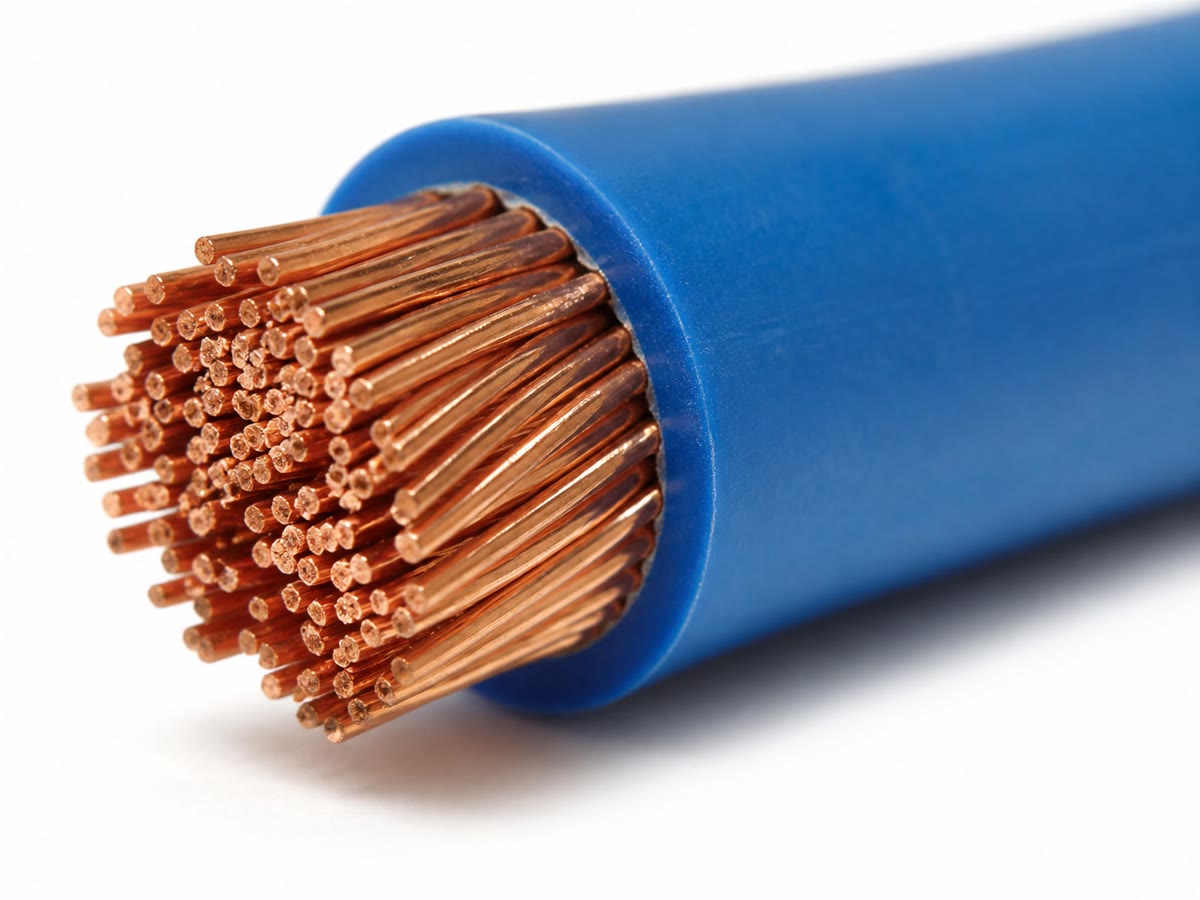
Look at the end of a lamp’s cable where it enters the plug: inside runs shiny copper — a conductor, the current’s road; around it wraps colored plastic — an insulator, the road’s fence. The copper does the work; the plastic keeps the current in and your fingers out. Every cable in your house pairs the two: a conductor inside an insulator.

Example 22.8 (Reading everyday objects)
Now many designs explain themselves. The switch: a metal bridge (it must carry current) in a plastic case (your finger must not). The electrician’s screwdriver: steel blade, thick insulating handle. The socket: metal deep inside, plastic face outside. Pylons carry bare metal cables high out of reach, hanging from long insulating discs so the current cannot leak into the tower.
Remark 22.9 (Water, people, and why rules exist)
One more conductor must be named: damp things — including damp human skin. We conduct badly, but the wall socket pushes so mightily that badly is more than enough. This is the deep reason behind the safety rules you know: never poke sockets, never touch anything electric with wet hands, keep hair dryers far from the bath. The battery tester is safe because a battery’s push is tiny; the socket forgives nothing.
22.4 Exercises
Exercise 22.1 ★
What is a conductor? An insulator? Which one lights the tester’s bulb?
Exercise 22.2 ★
Sort into conductors and insulators: a steel spoon; a cork; kitchen foil; a glass; a copper coin; a plastic brick.
Solution
Solution of Exercise 22.2.
Conductors: the steel spoon, the kitchen foil, the copper coin. Insulators: the cork, the glass, the plastic brick.
Exercise 22.3 ★
Before any trial, how do you check that the tester itself works? Why is this check important?
Exercise 22.4 ★
A trial object leaves the bulb dark. Give two possible reasons — one about the object, one about sloppy testing.
Solution
Solution of Exercise 22.4.
Either the object is an insulator — or the testing was sloppy: a wire end touching paint, varnish or dirt instead of pressing firmly on the object’s bare stuff (or a connection came loose).
Exercise 22.5 ★
Why is a lamp cable copper on the inside and plastic on the outside? What job does each material do?
Solution
Solution of Exercise 22.5.
The copper conducts: it is the current’s road to the lamp. The plastic insulates: it keeps the current in the wire and fingers safely out.
Exercise 22.6 ★
In a switch, which part is a conductor and which an insulator? Why does it need both?
Exercise 22.7 ★
Aluminium foil ignores a magnet completely. Will it light the tester’s bulb? Which rule answers, and what mix-up does Remark 22.6 warn against?
Solution
Solution of Exercise 22.7.
Yes — aluminium is a metal, and all metals conduct. The warning: magnetic and conducting are different talents; the magnet’s iron-only rule says nothing about whether it conducts.
Exercise 22.8 ★
A pencil is wood with a graphite lead. Nino’s tester stays dark across the painted wood but lights faintly tip-to-tip through the sharpened graphite. What did Nino discover about the pencil’s two materials?
Exercise 22.9 ★
Why do electricians’ screwdrivers and pliers have thick plastic handles? Which material is protecting whom?
Solution
Solution of Exercise 22.9.
The insulator is protecting the human: if the tool’s metal ever touches something electric, the thick plastic handle keeps the current from crossing into the hand.
Exercise 22.10 ★★
A necklace chain gives “light” in the tester; a wooden bead necklace gives “dark”; a necklace of metal beads knotted on a thick cotton string gives “dark” too — although every bead conducts! Explain the third result by following the current’s road bead to bead.
Solution
Solution of Exercise 22.10.
Current must travel the whole road. In the chain, metal link touches metal link: a complete metal road. In the beaded necklace, between one metal bead and the next lies a stretch of cotton knot — an insulator — so the road is broken at every bead: dark, despite all those conductors.
Exercise 22.11 ★★
Why is it far more dangerous to touch electrical things with wet hands than with dry ones? And why is the battery tester safe for your experiments while the socket never is? Use Remark 22.9.
Solution
Solution of Exercise 22.11.
Damp skin conducts much better than dry skin, so wet hands offer the current an easy road through the body. The battery tester is safe because a battery’s push is tiny; the wall socket’s push is hundreds of times mightier — through damp skin it can be deadly, which is why the rules allow battery games and forbid sockets, always.