Primary & Middle School Physics · Grades 1–9
2Hot and Cold
Soup steams, ice cream makes your teeth ache, and the car seat in summer stings your legs. Hot and cold are everywhere. In this chapter we learn to compare them, to see what warms things up — and to watch what happens to an ice cube when the warmth wins.
2.1 Warmer and colder
Definition 2.1 (Hot and cold)
Hot and cold are comparing words, like big and small. Soup is hot compared to your hand; ice is cold compared to your hand. Between the two there is a whole ladder of words: freezing, cold, cool, lukewarm, warm, hot, burning.

Example 2.2 (Ordering three drinks)
On the table: a hot chocolate, a glass of tap water, a glass of orange juice straight from the refrigerator. From coldest to hottest: the juice, then the tap water, then the hot chocolate. The tap water is cold next to the chocolate but warm next to the juice — comparing words always work in pairs.
Remark 2.3 (Touch can be fooled)
Remember the three bowls of the last chapter: the same lukewarm water felt warm to one hand and cool to the other. And touch a metal spoon and a wooden spoon that both spent the night in the same kitchen: the metal one feels colder, though nothing in the kitchen is colder than anything else. Touch is a helpful guard, but it is not a fair judge — one day soon we will need an instrument that cannot be fooled: the thermometer, which arrives in a later chapter.
Method 2.4 (Comparing hot and cold fairly)
To decide which of two bowls of water is warmer:
- use the same hand for both — two hands can disagree;
- touch one, then the other, right away — waiting lets things change;
- to be extra sure, ask a friend to try too, without telling them your answer first.
If you and your friend agree, the observation is solid.
2.2 What warms things up
Example 2.5 (Warmers)
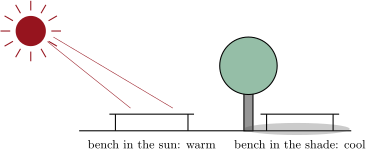
Some things warm up whatever is near them: the Sun warms the bench in the park, the flame warms the pan, the radiator warms the room, and your own body warms the blanket. Even rubbing warms: press your palms together and rub fast while you count to — feel them heat up.
Example 2.6 (Try it: sun and shade)
On a sunny day, put one hand on a wall in the sunshine and the other on the same wall in the shade. Same wall, same day — but the sunny side is clearly warmer. The Sun is the great warmer of everything outdoors; it will get a whole chapter of its own soon.
Remark 2.7 (Coats do not make heat)
A coat does not warm you the way a radiator does. Your body makes the warmth; the coat only stops that warmth from escaping, like a lid on the soup. That is why a coat lying alone on a chair stays cold inside — there is nothing in it making warmth to keep.
2.3 When warm wins: melting ice
Example 2.8 (The life of an ice cube)
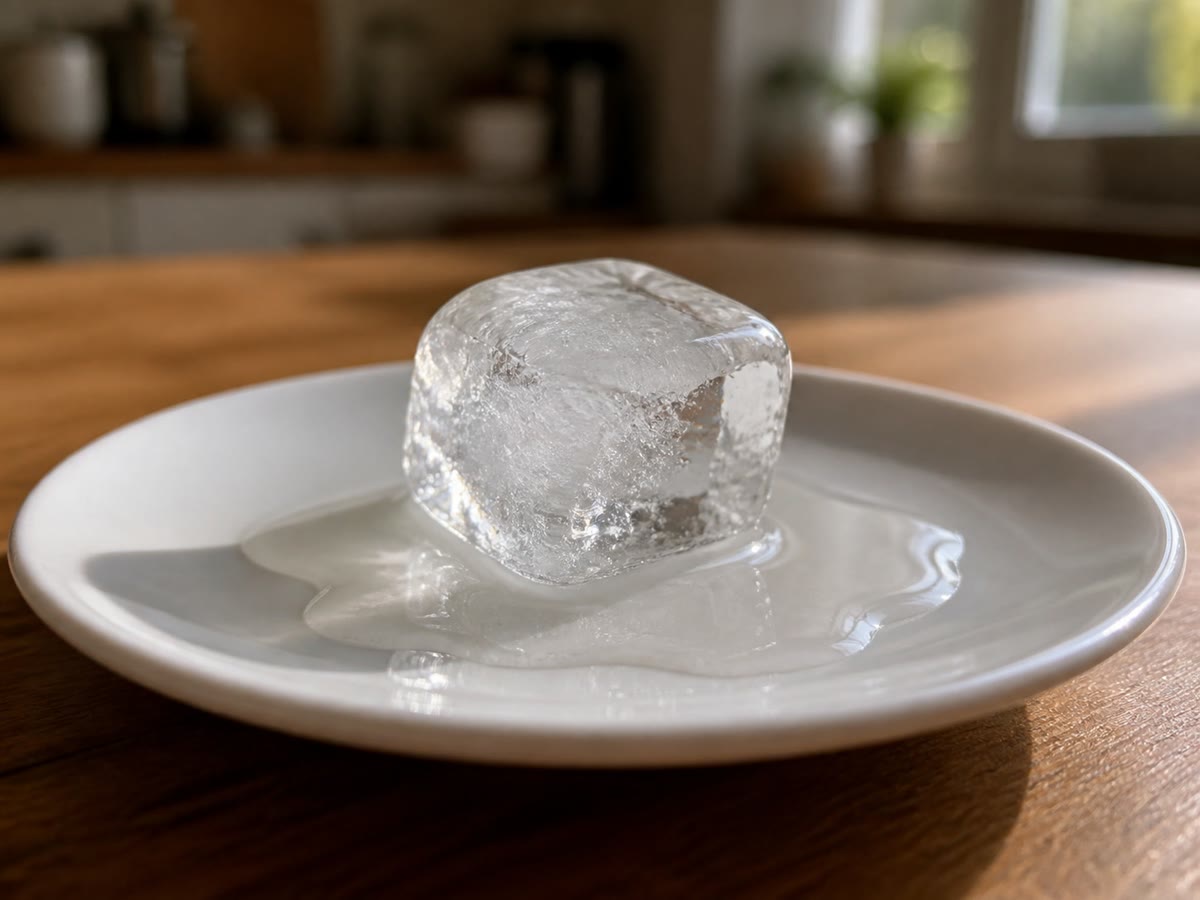
Put an ice cube on a plate in the kitchen. It is hard and cold. The warm air of the room warms it, little by little: the cube gets smaller and smaller, a puddle grows around it, and after a while only water is left. The warmth of the room turned hard ice into liquid water — we say the ice melted.

Example 2.9 (Cold can win too)
The freezer does the opposite job: put a small cup of water inside in the evening, and in the morning you will find it hard as stone — ice. Warmth melts ice into water; strong cold turns water back into ice. Water will keep changing back and forth like this all through the book.
2.4 Exercises
Exercise 2.1 ★
Order from coldest to hottest: bath water; an ice cube; soup fresh from the pot; the air of your bedroom.
Solution
Solution of Exercise 2.1.
The ice cube, then the air of the bedroom, then the bath water, then the soup fresh from the pot.
Exercise 2.2 ★
Find the comparing word: the tap water is … compared to the hot chocolate, but … compared to the orange juice from the refrigerator.
Solution
Solution of Exercise 2.2.
The tap water is cold (or cooler) compared to the hot chocolate, but warm (or warmer) compared to the juice.
Exercise 2.3 ★
Name four things that warm what is near them. Which one warms the whole park?
Solution
Solution of Exercise 2.3.
For example: the Sun, a flame, a radiator, your own body (or rubbing hands). The Sun warms the whole park.
Exercise 2.4 ★
Rub your palms together fast while counting to , then touch your cheek. What do you feel? What did the rubbing do?
Solution
Solution of Exercise 2.4.
The palms feel warm against the cheek: rubbing warmed them up.
Exercise 2.5 ★
Two ice cubes come out of the freezer together. One goes on a plate in the sun, the other on a plate in the shade. Which one melts first, and why?
Solution
Solution of Exercise 2.5.
The cube in the sun melts first: the Sun warms it, and warmth is what melts ice. The one in the shade gets less warmth and lasts longer.
Exercise 2.6 ★
What is in the puddle left on the plate after an ice cube melts? Where did the hard ice go?
Solution
Solution of Exercise 2.6.
The puddle is water — the same water that was the ice cube. The hard ice did not disappear; the warmth of the room melted it into liquid water.
Exercise 2.7 ★
A metal slide and a wooden bench stood in the shade all morning. Tom touches both and says the slide is colder. Use Remark 2.3 to explain what is really going on.
Solution
Solution of Exercise 2.7.
After a whole morning in the same shade, the slide and the bench are equally cold. The metal only feels colder to the hand — touch is not a fair judge, as the metal and wooden spoons showed.
Exercise 2.8 ★
Using Method 2.4, explain how to find out which of two bowls of water is warmer. Why should you use the same hand for both?
Solution
Solution of Exercise 2.8.
Touch one bowl, then the other, right away, with the same hand, and ask a friend to check without hearing your answer. The same hand is needed because the three-bowls trick showed that two hands can disagree about the very same water.
Exercise 2.9 ★★
Lea builds a snowman and, feeling sorry for him, wraps him in her warm coat. Her brother says the coat will melt him faster. Lea says the coat will keep him cold longer. Who is right, and why? (Think of Remark 2.7: what does a coat really do?)
Solution
Solution of Exercise 2.9.
Lea is right. A coat makes no heat: it only stops warmth from passing through. The snowman has no warmth to keep in — instead the coat keeps the warm air of the day out, so the wrapped snowman melts more slowly and lasts longer.