Primary & Middle School Physics · Grades 1–9
56Voltage and the Voltmeter
Since the first battery lit the first bulb, one word has done heavy, vague duty in this book: the “push”. Batteries push weakly, the mains pushes murderously, two batteries nose-to-tail push together. The push now becomes a measured quantity with a famous unit — and its instrument, unlike last chapter’s, refuses to stand in the road.
56.1 Voltage
Definition 56.1 (Voltage)
The voltage between two points of a circuit measures the electrical push available between them — how hard the current is driven from one point to the other, as a waterfall’s height measures how hard it drives the millwheel. Voltage is always a between: between the two terminals of a battery, between the two sides of a lamp — never at a single point alone. Its unit is the volt (), honoring the inventor of the first battery.
Example 56.2 (The volt family album)
A single round cell: . The flat pocket battery: — three cells nose-to-tail inside one wrapper. The rectangular nine-volt with both terminals on top: , six hidden cells. A car battery: . The wall socket: — more than a hundred and fifty little cells’ worth of push, which is the whole quantitative content of “the socket, never”. Lightning between cloud and ground: hundreds of millions of volts, briefly.
Proposition 56.3 (Voltage without current)
Voltage and current are different quantities, and voltage comes first. A battery alone in a drawer, wired to nothing, drives no current at all — yet between its terminals the full stands ready, measurable, like a waterfall’s height on a day the mill is closed. Push can exist without a march; the march never exists without a push.
Definition 56.4 (Voltmeter)
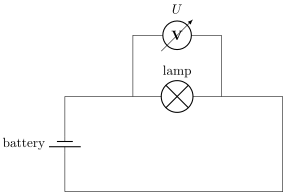
A voltmeter measures the voltage between two points — so it is connected across them: in parallel with the component of interest, one lead on each side, like a surveyor holding a level between two heights. Built opposite to the ammeter in every way, it opposes current almost completely: connected across anything, it draws next to none — so clipping it on disturbs nothing, and no loop need ever be broken.
Method 56.5 (Measuring a voltage)
- leave the circuit intact — nothing is broken for a voltmeter;
- clip one lead to each side of the component: the lead where the conventional current enters, the common lead where it leaves;
- largest range first, step down to comfort;
- read, and write the unit.
The two meters’ manners, side by side: ammeter — break the road, stand in it, oppose nothing; voltmeter — break nothing, stand aside, oppose everything. Confusing the two manners is the workshop’s most expensive habit.
56.2 Rated voltages
Definition 56.6 (Nominal voltage)
Every lamp, motor and appliance carries a nominal voltage — the push it is built for, stamped on its base or plate: a flashlight bulb “3.5 V”, a car headlamp “12 V”, a kettle “230 V”. Fed its nominal voltage, the device performs as designed; fed much less, it sulks — dim lamp, lazy motor; fed much more, it burns out — brilliantly, once.
Example 56.7 (Matching lamp to battery)
A “3.5 V” bulb on the flat battery: slightly overdriven — bright, and short-lived. On a single cell: a sleepy orange glow. On the battery: one dazzling instant, then the thin thread parts — the filament’s obituary. The label is a contract: honor it, and the lamp lives its advertised life.
Remark 56.8 (Why 230 V kills)
Now the old absolute rule gets its number. The body’s damp conducting road, offered , passes a current too small to feel. The same road at — fifty times the push — passes fifty times the current, well past the few hundredths of an ampere that stop a heart. The socket is not “somewhat” stronger than your battery bench: it is two orders of magnitude beyond it, and the rulebook’s severity is plain arithmetic.
56.3 First voltage readings
Example 56.9 (Around a simple loop)
One battery, one lamp, meters in hand. Across the battery: . Across the lamp: — the lamp receives what the battery offers. Across a stretch of connecting wire: , or as near as the meter can say — a good wire is a level road, spending none of the push. The push lives across the workers, not along the roads: a reading worth remembering when next chapter’s laws make it official.
Example 56.10 (The open switch’s confession)
Lamp dark, switch open — where did the push go? Measure: across the dark lamp, ; across the open switch, the full . The battery’s push stands entire across the gap, waiting — the one place in the loop where two points are truly “far apart” electrically. Close the switch and the readings trade places. An open switch is where the voltage waits.
56.4 Exercises
Exercise 56.1 ★
What does voltage measure, and why is it always “between”? Give its unit and the waterfall image.
Exercise 56.2 ★
From memory: the voltages of a round cell, the flat battery, the rectangular battery, a car battery, the mains.
Solution
Solution of Exercise 56.2.
; ; ; ; .
Exercise 56.3 ★
A battery lies wired to nothing. What current flows? What does a voltmeter across it read? Which proposition speaks?
Exercise 56.4 ★
Contrast the two meters’ manners: connection, road-breaking, opposition to current. Which mistake builds a short circuit with a dial?
Solution
Solution of Exercise 56.4.
Ammeter: in series, the road broken for it, opposing almost nothing. Voltmeter: in parallel, nothing broken, opposing almost everything. The expensive mistake: an ammeter wired across — in parallel — becomes a short circuit with a dial.
Exercise 56.5 ★
What is a nominal voltage? Predict a “6 V” lamp’s behavior on ; on ; on .
Solution
Solution of Exercise 56.5.
The push a device is built for. On : a sleepy glimmer. On : designed brightness and lifespan. On : one brilliant instant, then the filament parts.
Exercise 56.6 ★
In the simple loop, what does the voltmeter read across the battery, the lamp, and a stretch of wire? Where does the push live?
Solution
Solution of Exercise 56.6.
Battery: ; lamp: ; wire: about . The push lives across the workers — the wire is a level road.
Exercise 56.7 ★
Switch open: what stands across the dark lamp, and across the open switch? What happens to both readings at the click?
Exercise 56.8 ★
Why does clipping a voltmeter across a working lamp disturb the circuit almost not at all? What does the meter decline to do?
Solution
Solution of Exercise 56.8.
It declines to carry current: opposing almost completely, it sips next to none through itself, so the lamp’s march and glow continue as if unobserved.
Exercise 56.9 ★★
The flat battery hides three cells. Draw (or describe) their arrangement, and compute the voltage if one cell were accidentally reversed — the flashlight chapter of years ago now with numbers. (Opposed pushes subtract.)
Solution
Solution of Exercise 56.9.
Three cells nose-to-tail: . One reversed opposes the other two: — the flashlight mystery of years ago, now in volts.
Exercise 56.10 ★★
A camper’s lamp is rated ; the van’s battery reads fresh and after a long evening. Describe the lamp’s evening, and why nothing burned out.
Exercise 56.11 ★★
A voltmeter mistakenly wired in series with the lamp (loop broken, meter in the gap): predict the lamp’s behavior and the meter’s reading — remember what a voltmeter opposes. (The lamp’s silence and the meter’s number are both instructive.)
Solution
Solution of Exercise 56.11.
The voltmeter in the road opposes almost everything: the march all but stops, and the lamp stands dark. The meter, carrying the loop’s only push across itself, reads nearly the battery’s full voltage — a correct number for a wrongly built circuit: instructive, and no fire.
Exercise 56.12 ★★★
Two identical lamps in series on : a voltmeter finds about across each. The same lamps in parallel on the same battery: predict each lamp’s voltage, and reconcile both findings with the brightness rules you have known for years (series pairs dim, parallel pairs shine full). Which chapter-to-come will make your predictions law?
Solution
Solution of Exercise 56.12.
In parallel each lamp spans the battery directly: each — full nominal push, full brightness, as the old parallel rule promised. In series the two lamps share the — about each, an underfed pair glowing dim, as the old series rule observed. The chapter after next makes the sharing a law of voltages.
56.5 Problem: The Battery Drawer Audit
Problem 56.1
Weekend problem — the great battery drawer audit; a voltmeter, a shoebox of cells, and the family’s gadget shelf
Every house has the drawer: loose cells, mystery batteries, gadgets that “need new ones”. Audit day — voltmeter in hand.
Part I — Sorting the cells.
- Describe the correct voltmeter connection to check a loose cell — and why no circuit needs building first.
- The audit’s readings, fresh from the drawer: , , , . Sort them: fresh, usable, tired, dead.
- A nine-volt battery reads . Roughly what does each of its six inner cells contribute?
- Why does a nearly dead cell still show some voltage although it can no longer light anything? (Its push survives feebly; what has it lost the strength to drive?)
Part II — The gadget shelf.
- The camera wants two cells nose-to-tail. What voltage does it expect, and what will the pair of survivors from question 2 deliver?
- The old radio takes four cells nose-to-tail and sulks below . Which drawer cells, if any, can crew it?
- Little brother crams three cells into the two-cell torch “for extra brightness”, wedging the third across the spring. The bulb is rated . Predict the show, in nominal-voltage language.
- The doorbell transformer plate reads “”. Someone proposes wiring the doorbell straight to a nine-volt battery “since eight is almost nine”. Assess: fair match or slow murder?
Part III — The audit’s laws.
- In the torch (bulb and cells in series, switch open), the auditor measures: across the open switch, ; across the bulb, . Explain both, and predict both after the click.
- Across every stretch of the torch’s wiring the meter says , lit or dark. What does this declare about good wire, in push-language?
- The mains socket is not audited, by standing family law. Restate the law with this chapter’s number, and the arithmetic sentence behind it.
- File the audit report: three sentences — what a voltmeter is and is never; what a label’s nominal voltage promises and threatens; and where, in any idle circuit, the voltage waits.
Solution
Solution of Problem 56.1.
1. Clip the voltmeter’s two leads to the cell’s two terminals — across, in parallel; a voltmeter breaks nothing and needs no circuit: it measures the waiting push. 2. : fresh. : usable. : tired. : dead — drawer to bin. 3. About each — six healthy cells. 4. Its chemistry still raises a feeble push, but can no longer drive a useful march: the voltage survives as a promise the cell lacks the strength to keep under load. 5. Two nose-to-tail: it expects ; the survivors deliver — the camera may work, grumbling. 6. Four cells must total or better: four fresh s give — fine; mixing in the s, any crew totaling at least serves (e.g. two fresh and two usable: ). The tired and dead need not apply. 7. Three cells: onto a bulb — half again over nominal: one glorious over-bright evening at best, most likely a prompt burnout. The contract punishes excess. 8. Slow murder, gentle but real: on an device is a steady over-push — it will run, warm, and age fast. Nominal means nominal; “almost” is how filaments die young. 9. The battery’s push waits, entire, across the only true gap — the open switch; the idle bulb, carrying no current, shows none. After the click: switch near , bulb near — the push moves from the gap to the worker. 10. That good wire is a level road: it delivers the march without spending push — all the voltage is saved for the workers. 11. “The socket is — fifty times the strongest battery in this drawer; fifty times the push drives fifty times the current through the same damp hands, and the heart stops at hundredths of an ampere. Audits end at the drawer.” 12. For example: “A voltmeter stands across, never in the road. A label’s nominal voltage promises designed performance and threatens burnout beyond it. And in any idle circuit, the voltage waits at the gap — across the open switch, ready.”