Primary & Middle School Physics · Grades 1–9
66Kinetic Energy and Road Safety
Since the wind-up toys of your childhood, energy has been a story of stores and forms — vivid, useful, and unnumbered. The wait ends now. Motion’s energy gets its formula, energy gets its unit, and the arithmetic turns out to govern a matter of life and death: why a car at double speed is four times harder to stop, and what a single second of inattention costs in metres.
66.1 The energy of motion
Definition 66.1 (The joule)
Energy — every form of it — is measured in joules (), honoring the experimenter who proved heat itself a form of energy. Anchors: lifting this book from floor to shelf spends a few joules; a beating heart, about one joule per beat; a chocolate bar stores a million joules of food energy.
Proposition 66.2 (Kinetic energy)
A body of mass (in ) moving at speed (in ) carries, by virtue of its motion, the kinetic energy
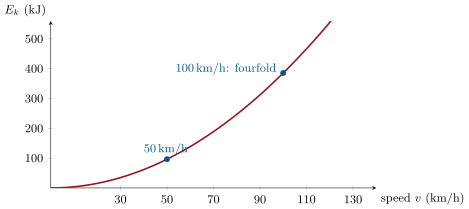
in joules. Two dials, unequal powers: doubling the mass doubles — but doubling the speed quadruples it, for the speed enters squared. Speed is the dangerous dial.
Example 66.3 (First computations)
A football at : . A sprinter at : . A car at — convert first: — : nearly a hundred thousand joules. The same car at : four times as much — . The formula’s warning, in numbers.
Example 66.4 (Where braking sends it)
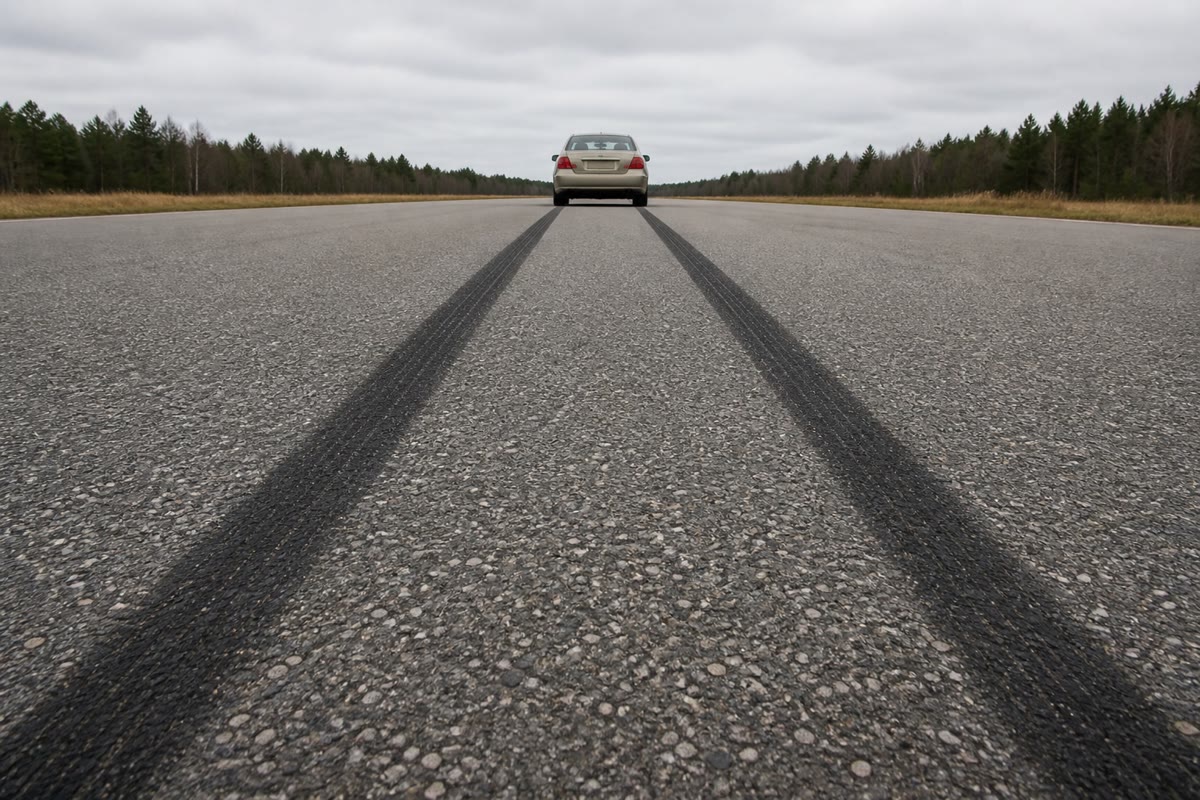
To stop, a car must hand its entire to something — energy is passed on, never erased, as the chains of your childhood insisted. The brakes’ grip converts it to heat: discs glow amber after mountain descents, and the smell of hot brakes is kinetic energy retiring. In a crash the handover is violent and instantaneous — into crumpled steel. Every road-safety number below is this bookkeeping: the bigger the , the longer, or uglier, its retirement.
66.2 The stopping distance
Proposition 66.5 (Stopping = thinking + braking)
A driver who spots danger stops only after two stretches of road:
- the reaction distance: the road covered while the brain notices and the foot moves — about one full second at unchanged speed, so this stretch grows in proportion to ;
- the braking distance: the road the brakes need to retire the kinetic energy — and since carries , this stretch grows with the square of the speed: double speed, fourfold braking road.
Their sum, the stopping distance, is the number that meets the child chasing the ball.
Example 66.6 (The table every driver should own)
Dry road, alert driver (one-second reaction; good brakes):
| speed | reaction | braking | stopping |
|---|---|---|---|
Read it twice. At city speed, a bus-length and a half; at highway speed, a full running track and a fifth. And the proportions confirm the two laws: reaction grows like , braking like — at high speed, braking devours the total.
Method 66.7 (Estimating a stopping distance)
- convert the speed to (divide by );
- reaction distance: one second’s travel — the number itself, in metres;
- braking distance: scale a known anchor by the square — from at , multiply by ;
- add, and compare with what the road ahead actually offers.
Wet roads double the braking share; tired or distracted drivers stretch the reaction second toward two — rerun the sum with the honest inputs.
Example 66.8 (The price of a glance)
A two-second glance at a phone at : the car covers — half a football pitch — driven blind, before any reaction second even begins. At city speed the same glance blindly spends : past the crossing, past the school gate. The most dangerous component of the car is unmeasured by any formula here: the driver’s attention.
Remark 66.9 (Belts, bags and helmets)
In a collision the car stops in a metre of crumpling — but an unbelted passenger continues at full speed (the quiet sentence of last chapter, grimly applied) until stopped by whatever comes: dashboard, windscreen, road. Seat belts and airbags stop the body over a longer distance and time, retiring its kinetic energy gently instead of all at once; the cyclist’s helmet does the same for the skull’s irreplaceable contents, its crushable foam buying centimetres of gentle stopping. None of them reduce your by a joule — they civilize its retirement.
66.3 Exercises
Exercise 66.1 ★
Give the energy unit and two of its anchors, and write the kinetic energy formula with its units.
Exercise 66.2 ★
Compute : a hare at ; an rugby player at .
Solution
Solution of Exercise 66.2.
Hare: . Player: .
Exercise 66.3 ★
Which raises a car’s more: adding half its mass in cargo, or raising its speed by half? Show both factors.
Exercise 66.4 ★
Name the two stretches of the stopping distance and their growth laws — one proportional, one squared.
Solution
Solution of Exercise 66.4.
Reaction distance — one second’s travel, growing in proportion to ; braking distance — the retirement of , growing with .
Exercise 66.5 ★
From the driver’s table: what fraction of the stopping distance is braking at — and at ? What changed?
Solution
Solution of Exercise 66.5.
At : of — about half. At : of — some seventy percent. The squared component outgrows the proportional one: at speed, braking devours the total.
Exercise 66.6 ★
Where does a braking car’s kinetic energy go? Cite the smell and the glow — and the childhood law that forbids it simply vanishing.
Exercise 66.7 ★
Compute the reaction distance at , and (one alert second). What simple pattern do the answers march to?
Solution
Solution of Exercise 66.7.
; then ; then — marching in proportion to the speed, as a one-second stretch must.
Exercise 66.8 ★
Why does a seat belt not reduce your kinetic energy — and what does it civilize instead?
Exercise 66.9 ★★
A scooter’s braking distance is at . Estimate it at and at — and state the law you scaled by.
Solution
Solution of Exercise 66.9.
Braking scales with the square of speed: at (double), ; at (triple), .
Exercise 66.10 ★★
Town councils lower school-zone limits from to . Compare the two stopping distances (anchor: of braking at ; one-second reaction) — and the two kinetic energies. Which comparison do you find more persuasive on a poster?
Solution
Solution of Exercise 66.10.
At : reaction , braking — stopping in about , against at fifty: less than half the road. Energies: — barely a third of the crash energy. Both persuade; the poster-ready line is usually the road one — “at 30 you stop before the child; at 50 you reach them still moving”.
Exercise 66.11 ★★
Rain doubles braking distances. Rebuild the driver’s table’s stopping column for wet roads at and — which component did you double, and which not, and why?
Solution
Solution of Exercise 66.11.
Double only the braking share — rain lengthens the retirement, not the brain: at , ; at , . The reaction second is dry and wet alike.
Exercise 66.12 ★★★
A truck of rolls at . Compute its in scientific notation; find the speed at which a car would match that energy (set the two formulas equal — the algebra is yours this year); and conclude why runaway-truck escape ramps exist on mountain roads while no such ramps serve cars.
Solution
Solution of Exercise 66.12.
Truck: ; . Matching car: gives , — no road car approaches it. A truck at highway speed carries racing-car energies with lorry brakes: when they overheat and fail on a long descent, only a gravel ramp can retire megajoules safely. Cars never need one; their energies die in ordinary brakes.
66.4 Problem: The Safety Campaign
Problem 66.1
Weekend problem — the class designs the town’s road-safety campaign; posters checked by formula; the mayor’s difficult questions
The town commissions a campaign, on one condition: every number on every poster must survive a physics audit. The class calculates. (Anchors: reaction one second; braking at , scaling by the square; car mass .)
Part I — Poster one: “50 not 60”.
- Compute both speeds in (one decimal).
- Reaction distances at both speeds?
- Braking distances at both (scale the anchor)?
- The poster’s headline: “Ten more units of speed, — how many more metres of stopping?” Fill in the number.
Part II — Poster two: “The wall of speed”. The design shows crash energies as fall heights: a crash at speed “equals” falling from the height where the same energy would be gained.
- Compute the car’s at (from Part I) and at .
- The artists need heights: falling from gains about for this car ( — next chapter’s other formula, borrowed early). To what fall heights do the two crash energies correspond? (Divide; round to the metre.)
- Which everyday buildings match those heights? Draft the poster’s line.
- The mayor objects: “Nobody drives into walls; cars crumple, belts catch.” Defend the poster’s physics while conceding his point — what do crumple zones and belts change, and what number do they not change?
Part III — Poster three: “One second”.
- At , how many metres does one distracted second cost before any braking? And a two-second phone glance?
- The tired-driver variant: reaction stretched to two seconds. Recompute the full stopping distance at and compare with the alert driver’s .
- A skeptical councillor: “Surely a second matters little beside those big braking numbers.” At which speeds is he most wrong — low or high? (Compare the two components’ growth laws.)
- Sign off the campaign: three poster-bottom lines, one per poster, each carrying its formula in plain words.
Solution
Solution of Problem 66.1.
1. ; . 2. and . 3. ; at sixty, . 4. Stopping: against — the poster’s blank: about eight and a half metres more, two car-lengths past where the fifty-driver has stopped. 5. At fifty: about . At ninety (): . 6. ; . 7. Ten metres: a three-storey house; thirty-two: a ten-storey block. Draft: “A crash at 50 is a fall from the third floor. At 90, from the tenth. Choose your window.” 8. The heights honestly measure the energy that must be retired — that number no engineering changes. Crumple zones and belts change the retirement’s manner: metres of gentle stopping instead of centimetres of cruel one — which is why the fall analogy overstates injury in a modern car, and why the energy it depicts is real all the same. 9. blind per second; a two-second glance, — half a pitch before the reaction second even starts. 10. — the tired driver adds a bus-length and a half to the alert driver’s total. 11. Most wrong at low speeds: there the squared braking share is small and the reaction stretch is most of the stopping distance — in town, the second is the danger. (At high speed braking dominates — but per second is no trifle there either.) 12. For example: “Ten more of speed, ten more metres of stopping — speed enters twice, once squared. A crash is a fall: energy grows with the square of speed. One second of glance is twenty-five metres of blindness — attention is the shortest braking distance of all.”