Primary & Middle School Physics · Grades 1–9
44Density: Why Things Float
In your very first year, a tiny coin sank while a great log floated, and we promised that the “why” was a treasure of this course. You have earned it. The key was forged over two chapters — mass for the stuff, volume for the room — and today the two turn together in the lock.
44.1 The mass of one cubic centimetre
Example 44.1 (Fair comparison at last)
Comparing a whole log with a whole coin was never fair: different sizes, different shapes. The fair contest takes equal volumes: one cubic centimetre of each contestant. One of water has a mass of . One of oak: about . Of stone: about . Of iron: . Equal rooms, wildly unequal stuff — this is the number the floating game was waiting for.
Definition 44.2 (Density)
The density of a substance is the mass of one cubic centimetre of it, in grams. Water’s density is per ; oak’s about ; iron’s . To find a density, no new instrument is needed: measure a sample’s mass and its volume, then divide — share the grams equally among the cubic centimetres, and the answer is each centimetre’s share.
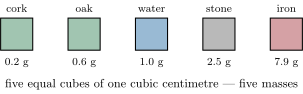
Proposition 44.3 (Density is a signature)
The density of a pure substance is the same for every piece of it, large or small: a splinter of oak and a whole beam both carry about in each cubic centimetre. Density therefore identifies substances, as melting points do: measure a mystery object’s mass and volume, divide, and compare with the table — the substance often confesses on the spot.
Method 44.4 (Measuring a density)
For a pebble — or a crown:
- measure its mass with the balance: say ;
- measure its volume by the rise of water: say ;
- divide the grams by the cubic centimetres: — each cubic centimetre carries ;
- consult the table: density — our pebble is ordinary stone.
44.2 The floating rule
Proposition 44.5 (Why things float)
An object floats in water if its density is less than water’s — less than per cubic centimetre — and sinks if its density is greater. The water, so to speak, compares the intruder with itself, room for room: lighter-than-me-per-room rides on top; heavier-per-room goes down. The same rule governs any liquid, each with its own density as the referee.
Example 44.6 (Six years of puzzles, settled)
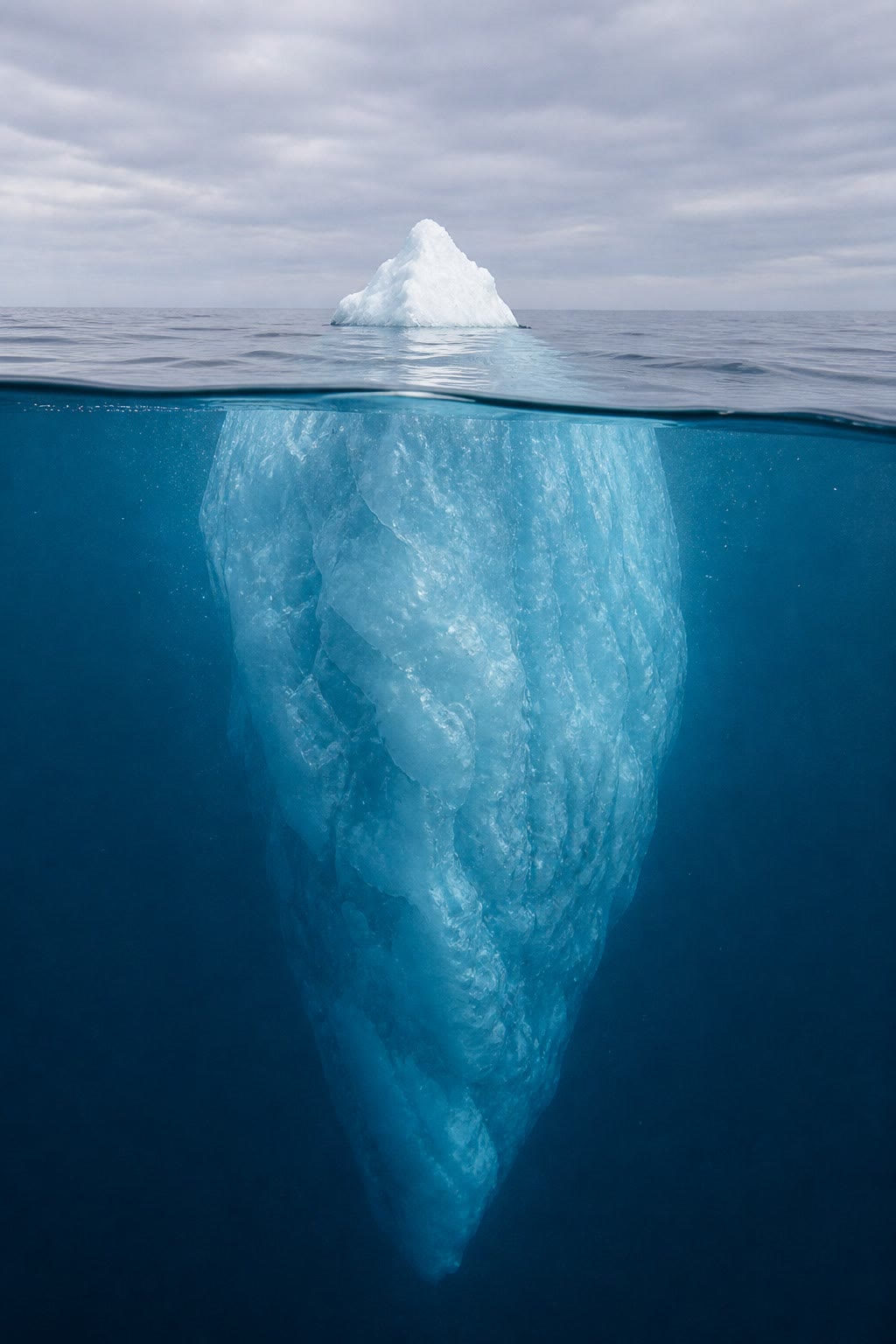
The log (): floats, however huge — every cubic centimetre of it underbids water. The coin (bronze, near ): sinks, however small. The plastic duck, the cork, the pencil: under , floaters all. Ice, at — water’s own swollen solid — floats on its own liquid by a whisker, which is why ponds wear lids and icebergs sail. And the plasticine boat? Shaped as a bowl, the boat-plus-air parcel holds much air per room: the parcel’s density drops below , and down at the docks the same trick launches ten-thousand-tonne ships of steel.
Example 44.7 (The liquid tower)
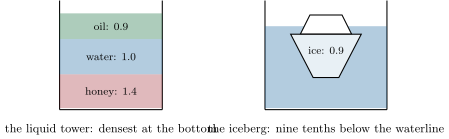
Pour honey, then water tinted with ink, then oil gently down a tall glass’s side: three layers, honey () at the bottom, oil () on top, refusing to mix their ranks. Drop in guests: a grape () sinks through the oil, sinks through the water, and rests on the honey — denser than two floors, lighter than the third. The tower is the floating rule performed as theater.
Remark 44.8 (Reading the iceberg)
Ice’s against water’s does more than float the berg: it sets the waterline. Nine tenths of an iceberg’s bulk rides below the surface — the famous hidden mass that sank proud ships. Exactly why the fraction below matches the density ratio is a beautiful law of the ancient bathtub scientist himself, proved honestly in the High School volume; the table of densities already whispers the answer.
44.3 The crown, at last
Example 44.9 (Archimedes closes the case)
Now finish the story begun two chapters ago. The crown’s mass: easy, the balance gives it. Its volume: impossible for a lumpy masterpiece — until the bathtub’s lesson gave the rise method. Mass divided by volume: the crown’s density — and density is a signature. Pure gold signs ; silver signs ; a secret blend signs something in between. Legend says the goldsmith’s crown confessed a density well short of gold’s, and the fraud was exposed without a scratch on the crown. The weekend problem hands you his numbers.
44.4 Exercises
Exercise 44.1 ★
What is the density of a substance? Give water’s, and state the floating rule.
Solution
Solution of Exercise 44.1.
The mass of one cubic centimetre of the substance, in grams; water’s is per . The rule: less dense than water floats, denser sinks.
Exercise 44.2 ★
Predict float or sink in water: oak (); stone (); cork (); iron (); ice ().
Exercise 44.3 ★
A block has mass and volume . Find its density. Float or sink?
Exercise 44.4 ★
A mystery lump: mass , rise in the cylinder . Its density — and, from the chapter’s numbers, its likely substance?
Solution
Solution of Exercise 44.4.
: the signature of iron.
Exercise 44.5 ★
Why is the density of a splinter of oak the same as of a whole oak beam? What is this property good for?
Solution
Solution of Exercise 44.5.
Density belongs to the substance, not the piece: every cubic centimetre of oak carries the same share of grams, splinter or beam. That makes density an identity card for unknown substances.
Exercise 44.6 ★
In the liquid tower, why does honey sit at the bottom and oil on top? Where does a grape of density come to rest?
Exercise 44.7 ★
Ice floats on water — why is this odd for a solid, and which old proposition about freezing water explains the ?
Exercise 44.8 ★
The great log and the little coin of your first year: give the final, complete answer, with numbers from the chapter.
Solution
Solution of Exercise 44.8.
Wood signs about : every cubic centimetre of the log underbids water’s , so the log floats however huge. Bronze signs near : every cubic centimetre of the coin outbids water, so it sinks however small. Size never mattered; the per-room mass always did.
Exercise 44.9 ★★
One litre of a certain liquid has a mass of . What is its density in grams per cubic centimetre? Will an ice cube () float or sink in it?
Solution
Solution of Exercise 44.9.
, so grams per cubic centimetre. Ice at is denser than this liquid: the ice cube sinks in it.
Exercise 44.10 ★★
Steel signs , yet steel ships float. Resolve the paradox with the parcel idea of Example 44.6 — what belongs to the ship-parcel besides steel, and what must its overall density be? When does a holed ship stop satisfying the rule?
Solution
Solution of Exercise 44.10.
The floating parcel is the whole hull: steel shell plus the great volume of air it encloses. Averaged over all that room, the parcel’s density falls below , and the rule says float. A hole lets water replace the air: the parcel’s density climbs toward steel’s own, passes — and the rule, unmoved, says sink.
Exercise 44.11 ★★
Sea water is a little denser than fresh water — about . Explain why swimmers float noticeably better in the sea, and predict what happens to a ship’s waterline as it sails from the salty sea into a fresh river.
Solution
Solution of Exercise 44.11.
The referee changed: against sea water’s , a swimmer’s near- body is comfortably on the floating side, so the sea carries you higher. Entering fresh water (), the ship loses that margin and settles deeper: its waterline rises up the hull.
Exercise 44.12 ★★★
A hollow metal sphere floats exactly half-submerged in water. Reason out the density of the whole sphere-parcel (metal shell plus the air inside). Then argue which way it moves if water slowly leaks inside, and at what moment it begins to sink — rule and parcel, working together.
Solution
Solution of Exercise 44.12.
Half-submerged, the sphere sits exactly as deep in the water as a parcel half water’s density should: shell plus air average out to about grams per cubic centimetre — the hidden air doing most of the lightening. As water leaks in it replaces air, the parcel’s average density climbs, and the sphere settles deeper and deeper; the moment the average passes water’s , the floating rule switches sides and the sphere goes down.
44.5 Problem: The King’s Crown
Problem 44.1
Weekend problem — the case of the king’s crown, reopened with your instruments; the goldsmith’s trial, solved by division
Reopen antiquity’s most famous fraud case with modern numbers. Signatures: gold , silver (grams per cubic centimetre).
Part I — The evidence. The king gave the goldsmith of pure gold. The finished crown, on the balance: exactly.
- The mass matches perfectly. Why does this alone prove nothing about the fraud? (What could the goldsmith have done and still matched it?)
- What volume should of pure gold occupy? (Share the grams: how many cubic centimetres at each?)
- Archimedes lowers the crown into a brim-full vessel and collects the overflow: . What is the crown’s true volume?
- Compare the two volumes. What does the comparison already shout?
Part II — The signature.
- Compute the crown’s density from its mass and its measured volume (one decimal is enough).
- Set the three signatures side by side: gold, the crown, silver. Where does the crown fall?
- Explain, in one sentence to the king, why the crown cannot be pure gold.
- The goldsmith protests: “Perhaps the balance erred!” Grant him a generous error of either way. Does any mass between and rescue a pure-gold crown of volume ? (Check the density range.)
Part III — How much was stolen? Suppose the goldsmith kept some gold and replaced it, gram for gram, with silver.
- Why does replacing gold by silver, gram for gram, keep the mass right but swell the volume?
- Test a guess: a crown of gold silver. Volume of the gold share? Of the silver share? (One decimal.)
- Total the guessed crown’s volume, and judge the guess against the measured : too much silver, or too little?
- The court needs a verdict sentence: state what was proved beyond doubt (pure gold or not), what the method was, and why the crown never needed to be harmed — Archimedes’ true triumph.
Solution
Solution of Problem 44.1.
1. Nothing: swapping gold for an equal mass of silver keeps the balance happy — mass alone cannot see the substitution. 2. . 3. — the overflow is the crown’s volume, by displacement. 4. The crown takes more room than pure gold of its mass should: something bulkier than gold hides inside. 5. . 6. Gold — crown — silver : the crown falls between the two signatures. 7. “Sire, every cubic centimetre of pure gold carries ; your crown carries only about — pure gold it is not.” 8. The range gives densities up to — nowhere near : no plausible balance error rescues the goldsmith. 9. Silver is less dense: each stolen gram of gold gave back a gram of silver that needs more room — gram-for-gram substitution preserves mass and inflates volume. 10. Gold share: ; silver share: . 11. Total — more than the measured : the half-and-half guess used too much silver; the true theft was smaller (the measured volume sits between and ). 12. “Proved: the crown is not pure gold. Method: its mass shared over its water-measured volume gives a density far below gold’s unchangeable signature. And the crown never needed so much as a scratch: the water read its secret from the outside — that is the triumph.”