Primary & Middle School Physics · Grades 1–9
3Light and Shadows
Switch off the lamp in a room with no window: everything disappears. Switch it on: the room comes back. Seeing needs light. And wherever there is light, there are also shadows — your faithful dark twin follows you on every sunny pavement. Let us find out where light comes from, and how shadows are made.
3.1 Where light comes from
Definition 3.1 (Light sources)
A light source is a thing that makes its own light: the Sun, a lamp, a candle flame, a firefly. Everything else — a book, a ball, the walls, you — makes no light of its own: we only see these things when light from a source falls on them.
Example 3.2 (Sources or not?)
The Sun, a torch, a burning match and a television screen all make light: sources. The Moon, a mirror and a white wall can look very bright, but they make no light of their own — they only send back light that reaches them. Switch the lamp off, and the brightest mirror goes dark.
Example 3.3 (Try it: the dark room)
In the evening, close the shutters or curtains of a room, switch off every lamp, and wait while you count slowly to . What do you see? At first, almost nothing — with no source, there is no light to see by. Then open the door a crack: one thin slice of light is enough to bring back tables, chairs and toys.
Remark 3.4 (Never look at the Sun)
The Sun is by far the strongest light source we ever meet. Never look straight at it, not even for a moment, and never through binoculars or a magnifying glass: its light is so strong that it can hurt your eyes for good. The Sun is to be enjoyed sideways — by the light it throws on everything else.
3.2 How shadows are made
Definition 3.5 (Shadow)
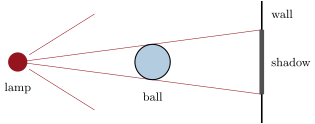
A shadow is the dark patch that appears behind a thing that blocks the light. Light cannot go through your body, so behind you the ground gets no light from the Sun: that dark you-shaped patch is your shadow.
Method 3.6 (Making a sharp shadow)
- Make the room dark — shadows hide when light comes from everywhere;
- switch on one lamp or torch;
- hold a toy between the lamp and the wall;
- look at the wall: there is the shadow, on the far side of the toy from the lamp.
Move the toy closer to the lamp: the shadow grows huge. Move it close to the wall: the shadow shrinks to the toy’s true size.
Example 3.7 (Try it: shadow animals)
With the lamp of Method 3.6, put your hands in the light instead of a toy: two fingers up make rabbit ears, both thumbs crossed make a flying bird. The wall shows the shape your hands cut out of the light — a shadow always keeps the shape of its blocker, seen from the lamp.
Remark 3.8 (A shadow is not a thing)
You cannot pick up a shadow, fold it, or keep it in a box. A shadow is not made of anything: it is a place where light is missing. That is why it vanishes the moment the lamp goes out — there is nothing there to stay behind.
3.3 Shadows follow the light
Example 3.9 (Which side is the shadow on?)
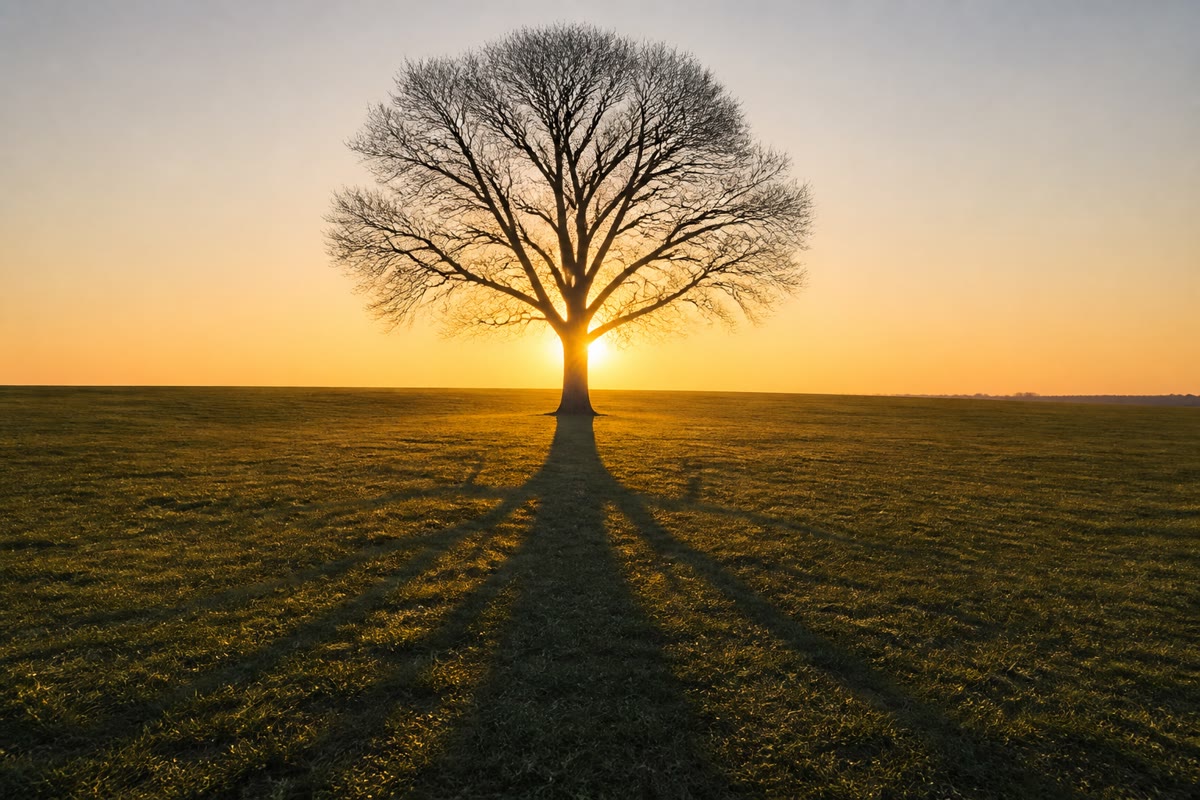
In the morning, the Sun is on one side of you and your shadow lies on the other side. Face the Sun: your shadow hides behind you. Turn your back to the Sun: your shadow stretches out in front. The shadow always sits exactly opposite the source.
Example 3.10 (Try it: chalk around a shadow)
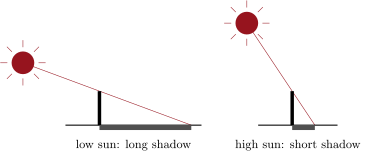
On a sunny morning, stand still in the playground while a friend draws a chalk line around your shadow. Come back after lunch and stand on the same spot: your shadow has moved out of its chalk line and changed its length! The Sun changed its place in the sky — and the shadow followed. The next chapter follows the Sun through its whole day.
3.4 Exercises
Exercise 3.1 ★
Sort into light sources and non-sources: a candle flame; the Moon; a firefly; a mirror; a torch; a white wall.
Solution
Solution of Exercise 3.1.
Sources: the candle flame, the firefly, the torch. Non-sources: the Moon, the mirror, the white wall — they only send back light that falls on them.
Exercise 3.2 ★
Why can you see nothing at all in a closed room with no window and no lamp? What is missing?
Exercise 3.3 ★
Name the three things needed to make a shadow on the wall, and put them in the right order along a line.
Solution
Solution of Exercise 3.3.
A light source, a blocker, and a wall (or screen, or ground) — in that order along a straight line: the source shines, the blocker blocks, the wall shows the dark patch.
Exercise 3.4 ★
The Sun is on your left. On which side is your shadow? You turn right around — where is it now?
Exercise 3.5 ★
Using Method 3.6, make the shadow of the same toy first huge, then small. What did you move, and which way?
Exercise 3.6 ★
Can a shadow be picked up and put in a pocket? Explain what a shadow really is, using Remark 3.8.
Exercise 3.7 ★
Why must you never look straight at the Sun, even though looking at a lamp only dazzles you a little?
Solution
Solution of Exercise 3.7.
The Sun is a far stronger source than any lamp: its light is so strong it can hurt the eyes for good, not just dazzle them for a moment.
Exercise 3.8 ★
At midday the Sun hangs high; in the late afternoon it hangs low. When is your shadow longer? Draw the two shadows of a tree, one for each moment.
Exercise 3.9 ★★
Mia says: “My shadow was in front of me, and after I turned around it was behind me — so the shadow turned with me.” Sam says the shadow never moved at all. Think of Example 3.9: who is right, and why did it look like the shadow turned?